HOME/BLOG/THE BEST THING I EVER BUILT STILL WASN'T THE RIGHT MESSAGE
AI Building
The Best Thing I Ever Built Still Wasn't the Right Message
Five versions in, and the thing finally got smaller
August 24, 2026|5 min read
Before we get into what I built, let's talk about lead magnets for a minute, because I've watched people declare them dead for years, and if I'm honest, I've felt it myself.
Do lead magnets still work?
Yes. When they're done correctly, they absolutely work, and the jaded feeling is simply looking at them through years of experience (and let's be honest, years of collecting things that gathered dust on your hard drive).
I've been making lead magnets since my WordPress Chick days, and I've built just about every format there is: PDFs, e-books, videos, infographics, workflows, and more than one quiz. The formats have been through every evolution you can name, and every few years somebody announces the whole category is dead.
One of the best-converting lead magnets I ever made was an infographic, PLUS an audio. It was a good-looking piece on making money with your WordPress site, but the design isn't what made it work. What made it work is that I recorded an audio to go with it, where I talked people through the ideas in more depth than the graphic could hold. It also wasn't in any way, shape, or form how to 'get rich quick'... it was solid marketing strategies and best practices that only work if you do the work. Anyone willing to sit and listen to me talk was telling me something, because that willingness marks an ideal customer. The infographic got the opt-in, the audio built the relationship, and speaking let me go deeper than I could have in writing without handing over an entire book.
So when the jaded feeling shows up, I remind myself what it actually is: knowledge bias. I've built too many of these and know enough about marketing to experience a lead magnet the way my reader does. She isn't tired of them... She's tired of bad ones (aren't we all?).
There's also a reason I never stopped making them, beyond list growth. A lead magnet is a trust exchange. When you give somebody something free with real value in it, actual value rather than a teaser, you're giving her an honest indicator of who you are and what working with you provides. That doesn't expire with a format trend.
Which brings me to the one I just rebuilt.
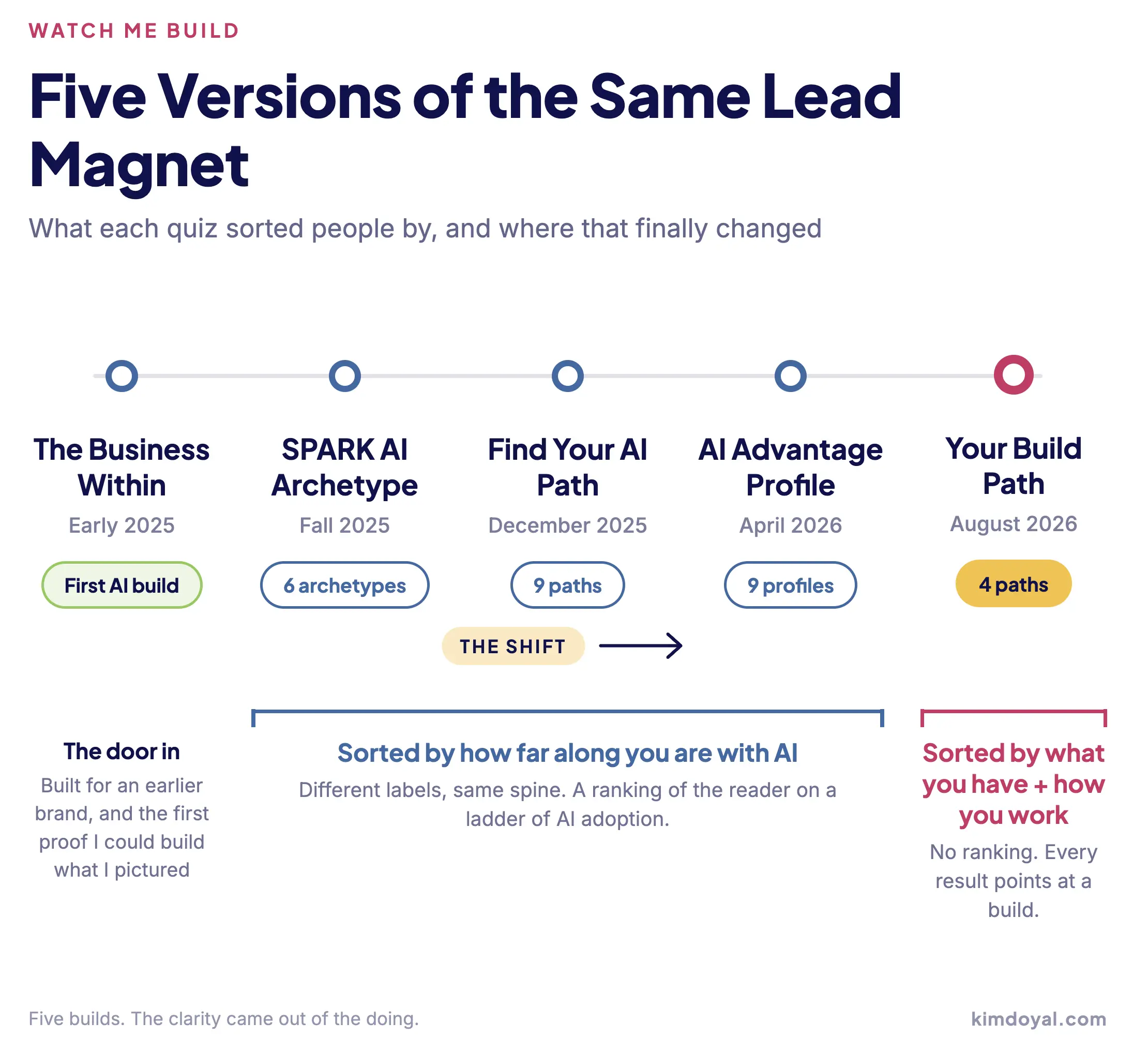
I just finished building my quiz for the fifth time.
Not five tweaks to the same thing, but five separate builds of the quiz lead magnet that sits at the front of my business. Different names, different logic, different outcomes, and a different email sequence behind each one. The version I finished last week is the first one that belongs to the business I actually have.
I want to walk through all five, because the sequence is the point, and because the first one deserves more credit than I've given it.
Where did this actually start?
The Business Within quiz was the first real thing I ever built with AI. That was about a year and a half ago, and it's the reason I'm doing any of this.
I'd been in this space long enough to have paid other people to build things for me, or to have wrestled a plugin into doing something approximately like what I pictured. Then I sat down and built a quiz myself. It looked the way I wanted it to look, it worked the way I wanted it to work, and within about an hour I knew I was never going back. That quiz is what got me giddy about vibe coding, and it was the door I walked through. Everything since then, including the Lab, the tools, the directories, and the apps, came through it.
(And the improvement in what these tools can do in a single year blows my mind. What took me a weekend of head-down work eighteen months ago is now a typical afternoon conversation.)
So version one gets its kudos. It was aimed at a brand I've since moved past, and the segmentation wouldn't survive ten seconds of scrutiny today, but none of the other four exist without it.
The SPARK AI Archetype Quiz came in the fall of 2025, with six archetypes, weighted scoring, and eight questions. Builder, Educator, Optimizer, Creator, Connector, and Strategist. It got a landing page, and then I retired it because by the time it was finished I'd already moved off the positioning it was written for.
Find Your AI Path landed in December. Nine paths on a matrix, with Content, Operations, and Builder crossed against three levels of experience.
Your AI Advantage Profile shipped in April 2026, and this is the one to pay attention to. Nine profiles on a 3x3, trimmed down from eighteen questions to eight, with a full results page scoring across all three focus areas, a designed PDF behind the opt-in, and a five-email Bento sequence that branched on three separate custom fields. In May, I rebuilt the landing page in Claude Design as a magazine spread, laying out the whole nine-profile matrix so you could see where you might land before you started.
It was, by a wide margin, the best-built thing on this list. It still wasn't the right message.
Plus... nine profiles? You'd think I was studying DNA sequences, lol. It was too much.
Five builds in a year and a half. The first four sorted people by how far along they were with AI. The fifth finally asked a better question.
Why change a quiz that was working?
Because the build was right and the message wasn't, and those two things look identical from the outside.
Once you scrape the labels off, versions two, three, and four all sorted people the same way: by how far along they were with AI. Sparked, Scaling, Leading. Explorer, Integrator, Architect. The vocabulary changed, but the core didn't, and that core ranks the reader on a ladder of AI adoption.
Think about what that actually hands somebody. She answers eight questions about her business, and the payoff is a label telling her she's at the early stage of a technology she never asked to be graded on. The copy can be warm, and the next steps can be good (and I worked hard on those next steps), but the frame is still a verdict. Not to mention, she probably knows what stage she's at (minus the fancy-pants name I created).
It also wasn't measuring anything her business cares about. Whether she's "Scaling" with AI has almost nothing to do with whether she's sitting on a decade of expertise that she's still selling by the hour. The first is a fact about her tool use, the second is a fact about her business model, and only one of those tells either of us what to build next.
Version five sorts on two things instead. The first is what she already has, meaning expertise still trading by the hour versus something already packaged. The second is how she prefers to work, meaning expressing and reaching people versus building systems and structure. Those two questions cross into four paths: Amplify, Reclaim, Scale It, and Productize. Nobody gets ranked, and everybody gets pointed at a specific build.
The other thing that happened is that nine outcomes became four. Five rounds of iteration made the thing smaller, which is the opposite of what iteration usually does to a product, and it's probably the clearest signal that something finally landed (adding features is my kryptonite 😂).
So why did it take five versions?
Because the clarity came from doing it, and each version was right for where I was when I built it.
I've repositioned this business twice before. I was The WordPress Chick for ten years, and around 2017 going into 2018, I moved to my own name and my own brand. That was a huge transition (anyone who's done this knows it feels like leaving a friend behind). From there it was content marketing and email marketing, and that was my lane for a long stretch. I was good at it (this was also the window where we created and sold the physical content planner, so e-commerce was part of that era).
This move into AI, into saying plainly that building is what I want to do and what I intend to be known for, is the biggest of the three. I've known the whole time that it would be iterative, and not because I was winging it. A repositioning of that size doesn't resolve inside a planning document. You find out what you're actually building by building things and watching which ones make you want to keep going.
Every one of those quizzes was a sincere answer to "who is this for, and what am I solving for her?" None of them was a placeholder or a stall. Each one was the truest answer I had access to on the day I built it, and each one made the next answer better. That happened in the build itself, where the scoring, the field structure, and the sequence logic all got tighter every round, and it happened in the thinking.
I could not have written version five's segmentation a year ago. The way it sorts people came from the positioning work I did this spring, from watching how people moved through the earlier versions, and from eighteen months of getting more precise about who I'm talking to. That precision wasn't available in advance. It came from building, shipping, and paying attention to what happened next.
And here's the part I most want you to hear if you're the person I write for. AI can build nearly anything you describe, and it keeps getting better. What it can't do is decide who you serve, what problem she's carrying, or what you want to be known for.
Those core marketing and positioning principles, and understanding how they fit into what you're building, are the behind-the-scenes, unsexy work a lot of people don't want to do. That's exactly why it's a differentiator. And if you've been running a business for years, you already have more of that raw material than you think. The build is the easy part now. The thinking is where you're ahead.
*Bonus tip: If you're not promoting the thing you've built (I wasn't), that's a clear indicator something is off. That being said, rushing to change it before you're clear usually isn't the answer.
Why does owning it matter?
Because this is where things are heading, and because ownership is empowerment, not a line item or just a protest against the subscription model (although two things can be true at the same time 😉).
Here's what I mean. My quiz lives in my own repo, sitting next to my positioning documents, my voice guide, the previous versions, and every email sequence I've written. When it was time for version five, the rebuild was mostly a conversation, because everything doing the work already knew my business. The scoring logic sits in one tunable config file, there are four results pages, and the whole quiz funnel, from the questions through the email sequence, lives where the rest of my assets live.
Now compare that to a subscription tool. Quiz platforms aren't bad, and plenty of businesses run fine on them. But that software doesn't read your context files, your design system, your voice, or your customer avatar, and it won't at a price that makes sense. It hands you fields to fill in, and every new version starts from zero inside somebody else's structure. Plus, you will never get as close to your own brand on someone else's platform as you can with something you've built.
A custom solution built on your actual business context used to require a dev team and a matching budget. Now it's available to a business of one, and I truly believe that's the direction all of this is going. My quiz evolves at the speed of my clarity, not the speed of somebody's product roadmap. When the thinking sharpened, nothing stood between the new thinking and the build. That's the whole point of owning it.
Ask it three questions, and get specific enough that the answers are useful.
For a long stretch, my quiz was interesting to me. The nine-profile matrix was a genuinely satisfying piece of thinking, and I enjoyed building it. But interesting-to-me and useful-to-her are two different things, and a lead magnet only works when it's built on the second one.
Here's the prompt I'd run if I were auditing mine from scratch today. Paste it into Claude or ChatGPT, and give it real detail about your business rather than a summary, because the output is only as good as what you feed it.
Copy & paste this into Claude/ChatGPT or Gemini:
I want you to interview me about a lead magnet I have live, then pressure-test it. Ask me one question at a time, and wait for my answer before you move on.
Start by asking who, specifically, I serve. Push back if my answer is a demographic or a job title instead of a person in a situation. Keep going until I've described someone you could picture.
Then ask me what problem that person is actively trying to solve right now, in her words rather than mine. Ask me how I know that's the problem, and what evidence I have beyond my own assumption.
Then ask me what my lead magnet currently gives her. Ask me directly whether it clarifies her problem or just tells her something about herself. Ask what she can do differently the moment she finishes it.
Then ask me what paid thing it leads to, and whether the lead magnet actually sets that up or whether there's a gap she has to jump on her own.
When you have all four answers, tell me honestly where the weakest link is. Don't be encouraging. If the lead magnet is sorting people on something I find interesting rather than something they care about, say so plainly, and tell me what it should be sorting on instead.
The question that mattered most for my last version was the third one. Does it make her problem clearer, or does it just tell her something about herself? Nine profiles told her something about herself. Four paths tell her what to build.
Keep the outcome count low enough that you'll maintain it, too. Nine outcomes meant nine sets of copy, nine PDFs, and nine branches to update every time an offer changed. Four is a number I can keep honest.
Frequently Asked Questions
Do I need to be technical to build my own quiz?
No. You need to be able to describe what you want and react to what you see. My quiz came out of conversations with AI, not code I wrote by hand, and the thinking work, meaning who it's for and what it sorts on, matters far more than anything technical.
What should a quiz sort people by?
Something the person taking it actually cares about, which usually means her situation rather than her skill level. Sort on what she already has and how she prefers to work, then point every result at a specific next step. If your results page tells her what she is instead of what to do, start there.
Should I use a quiz platform instead of building my own?
A platform is a fine starting point, and plenty of businesses run on them. The tradeoff is that your logic lives inside their structure, so every revision starts over from zero and nothing accumulates. If you expect your thinking to keep evolving, and mine has five times now, owning the build pays for itself quickly.
How many results should a quiz have?
As few as you can defend. I went from nine outcomes down to four, and four is the number I can keep current every time my offers change. Every result you add is another set of copy, another email branch, and another thing to maintain.
Go take it, then go build yours
The fifth version is live at kimdoyal.com/quiz. Eight questions, four paths, and a 30-day build plan for wherever you land. No level, no ranking, and no badge telling you where you sit on somebody else's ladder.
Take it and tell me what you think, and especially tell me if you've built one of these yourself and you'd have sorted it differently.
Then, if you want your own, that's the workshop I'm putting together next. Build Your Own Quiz, $35, run live. You come out the other side with a quiz that's yours, meaning your questions, your paths, and your logic, in something you own instead of something you rent. We'll do the thinking work and the build together, in that order, because that's the order it works in.
The waitlist is here: [WAITLIST URL]
I'm running it live before I record anything, because I want to hear the questions people ask while they're in the middle of building rather than guess at them afterward. (Which is, if you're keeping score, the same lesson as the rest of this post.)
And if your current lead magnet has been sitting untouched for a year, I'd start with the prompt above. Not with a rebuild...With the three questions.
Find the first thing worth building.
A few questions. Your Build Path, plus a 30-day plan. No fluff.
Kim Doyal is a digital marketing strategist and AI builder with 18 years of online business experience. She is the founder of AI Spark Studios and SPARK Lab, and the creator of The Hub — a custom 33-agent AI operating system that runs her entire business. She has also built kimdoyal.com, StackRewards, and multiple AI tools and agents using vibe coding, a natural language approach to building software without a traditional development background.