HOME/BLOG/HOW TO GROW YOUR SUBSTACK WITHOUT LIVING ON IT... BUILT FOR FREEDOM — PART 01
AI Building
How to Grow Your Substack Without Living on It... Built for Freedom — Part 01
What I started building, why it matters more than the tactics, and what I think a lot of us are actually trying to figure out right now
April 26, 2026|5 min read
QUICK ANSWER
My Substack growth system, which doesn't require constant presence, has three layers: a notes engine that batches and schedules some of your notes automatically, a curated recommendations approach that runs on a quarterly cycle, and a welcome sequence that personalizes follow-up based on who each subscriber actually is. The distribution side runs automatically the moment you publish. You build the structure once; it does the work while you're doing yours.
I try not to get on my phone in bed when I wake up, but on this particular day, I picked it up and checked my inbox.
That's when I saw an article from Jenny Ouyang about growing on Substack with Claude, and I was too excited to wait until I got to my desk.
That kind of excitement, the kind that pulls you toward something before coffee, is worth paying attention to right now, and building a Substack growth system that runs without constant upkeep is exactly what it pulled me toward.
Not because I think you should be productive before 8 am (or whatever time you start your day), but because a lot of us aren't feeling that pull very often these days, and when we do, it means something.
I've been having conversations with friends lately, entrepreneurs I've known for years, and there's something underneath a lot of those conversations that we don't usually say out loud: a tiredness with the performance of it all. Not with the work itself, but with the constant maintenance of visibility, the feeling that you're always one algorithm update away from starting over, the sense that the business exists to feed the content machine instead of the other way around.
I think there's a real social media exhaustion happening, and I don't think exhaustion or even backlash quite names it. It's more like clarity. At this stage of my life and my business, I know what I'm building for, and it isn't a 'creator economy' content machine that cranks out digital products for the sake of scale.
It's freedom, the ability to do genuinely interesting work, to master skills that matter to me, to serve clients at a higher level, and to close the laptop at a reasonable hour without feeling like I failed some invisible metric.
Here's the thing about AI that I keep coming back to, and it's not about the hype or the productivity theater that saturates every conversation about these tools right now: AI can give us the infrastructure to stop performing for platforms and start building for people.
But, and I want to say this clearly because I think it gets missed, AI also makes it incredibly easy to just keep working, to do more, to fill every available hour with output. That's not the point, and it's not what I'm after. The point is infrastructure that runs without you, so the hours you do work are actually worth something.
That's what I've been trying to build, and last week I stopped to get clear on all of it.
What Does a Substack Growth System Look Like When You Don't Want to Live on the Platform?
A Substack growth system that works without constant presence has three layers:
✔️ Intentional notes that go out even when you're not thinking about it
✔️ Recommendations approach that runs on a quarterly cycle rather than constant maintenance
✔️ Content designed to compound over time through a consistent voice and internal linking. The distribution side, which I'll get to, runs automatically the moment you publish.
Last week, I took time to step back and focus on the architecture of everything I'm building, because I'd hit a point where I had momentum in a lot of directions and needed to actually look at what I was creating and why. I wrote about the bottleneck [link] — the realization that the constraint wasn't ideas or effort but the friction between the work I was doing and the results that should follow from it.
The architecture week was the same impulse, just bigger: getting genuinely clear on where everything is headed before adding more to the pile.
What came out of that week is the context for this post.
I'm not building toward a massive audience or a high-volume digital product business. I'm building toward a smaller, more intentional practice: AI-powered tools and systems, a membership for people who want to move from using AI to building with it, and consulting work for clients who need someone who actually knows how to wire this stuff together (side note: smaller & intentional does not mean smaller profits and income. Contrary to what gurus might tell you, you don't need a massive audience to build an income and lifestyle that works for you).
Substack is part of that, but it's not the whole engine. It's a channel, and it deserves the same kind of intentional infrastructure I'm building everywhere else.
So when I read Jenny's article and felt that pull, I didn't bookmark it.
I started doing it (well, once I got to my desk 😉).
The distribution piece, the automation I built that takes every Substack post I publish and distributes it to five platforms without me touching another tab, that was already done. I wrote about that automation [link to distribution post], and I'm not going to retread it here. What I was missing was the intentional structure underneath my Substack presence itself: the notes, the recommendations, the thread from my builds to subscriber growth.
That's what I started building.
What Does the System Actually Include?
Three areas, each with a clear enough structure that I can execute without rethinking it every time I sit down.
The notes engine
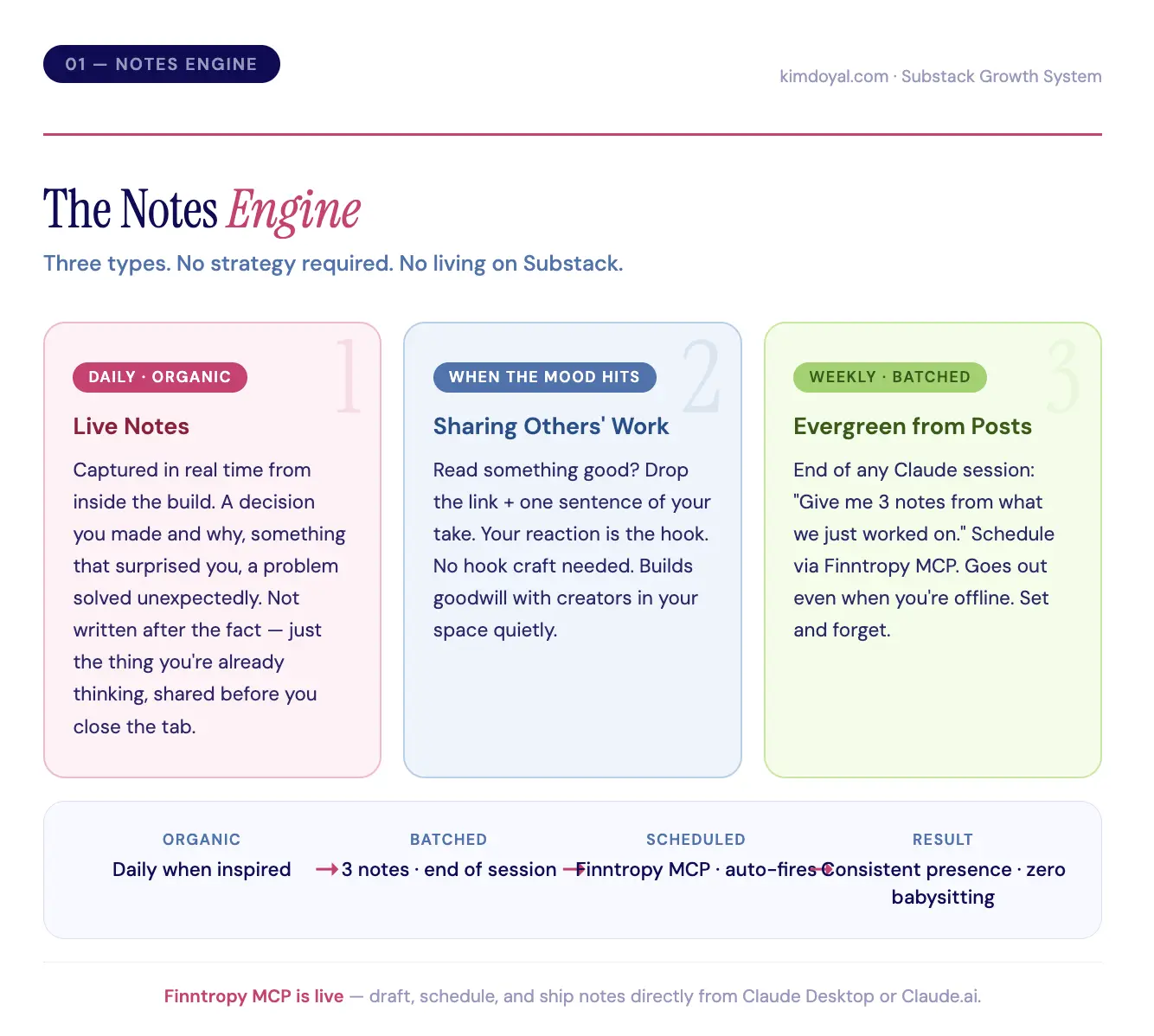
Most of what I was already doing organically just needed a framework. There are three types of notes in this system, each serving a different function.
The first type is what I'd call live notes, captured in real time from inside whatever I'm building. When I'm deep in a project, there's always something worth saying: a decision I made and why, something that surprised me, a problem I solved in a way I didn't expect. These aren't written after the fact or dressed up for an audience; they're the things I'm already thinking, just captured and shared before I close the tab.
The second type is sharing other people's work, which is something I genuinely enjoy and want to do more consistently. When I read something worth sharing, I drop the link with a sentence of my actual reaction. No hook formula, no manufactured engagement strategy, just a real response.
The third type is something I added to my own Hub after Dheeraj showed me a feature he has for Subflow (and something he uses in his own custom content management tool). Batching evergreen notes pulled from content I've already published. Once a post is live, I can generate a JSON file from it, drop it into SubflowAI, and it breaks the content into individual notes I can edit and schedule.
Finn Tropy's MCP, which came out a few days ago (at the time of this writing), adds another layer: I can now draft and schedule notes directly in a Claude session without switching tabs. (More on that below.)
Three types of notes. No strategy required. The batched layer is the one that runs without you.
The recommendations situation (it really does feel like a 'situation')
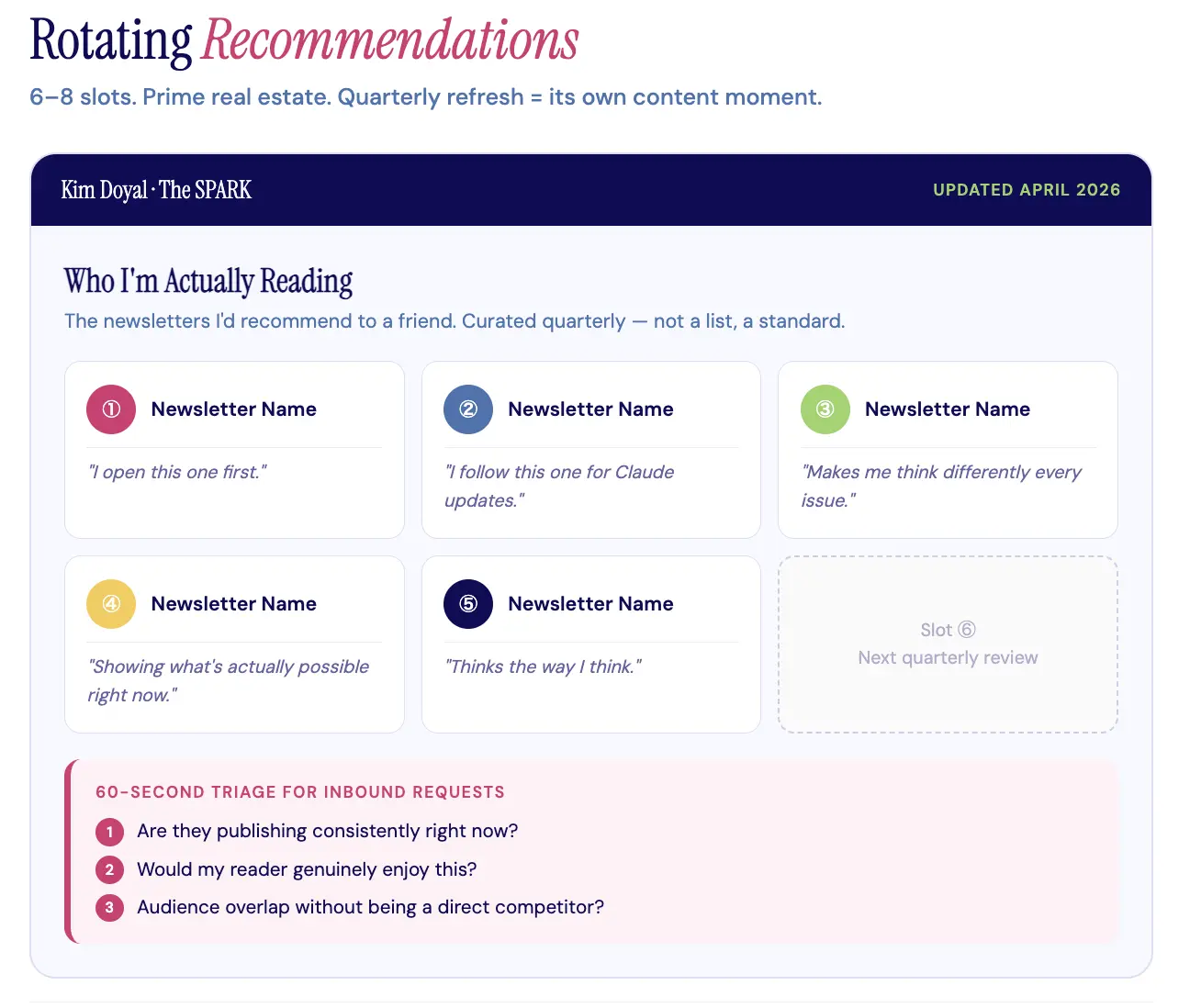
I already have a lot of recommendations set up on my Substack, and I've been genuinely uncertain whether the native recommendation engine is even the right approach. I wrote about deleting 428 subscribers, and the thinking behind that piece applies here too: more is not always better, and recommending newsletters just to appease an algorithm is exactly the kind of thing I don't want to do. What I'm building instead is a curated "Who I'm Actually Reading" page (page name TBD), with six to eight slots, updated quarterly. The quarterly refresh becomes its own content moment, a short post on who I'm recommending and why, and it gives me a thoughtful way to respond to recommendation requests without feeling like I'm either playing the game or being rude.
Treating recommendation slots like prime real estate, not a favor exchange. Six slots, quarterly refresh, its own content moment.
Watch Me Build
My positioning is "I build AI-powered tools, apps, and systems. Watch me." The Watch Me era is real. The Watch Me Build series, the actual documented body of work that makes that literal, is something I'm defining right now (It's not live yet). This post is, in a way, part of how I'm figuring out what it looks like: one build at a time, the problem, how I directed AI to solve it, what broke, what worked, website first for SEO and then Substack, auto-distributed the moment it publishes.
The connection between what I'm building and this newsletter needs to be clear, not something subscribers have to piece together themselves.
The welcome email gap
Every new Substack subscriber automatically flows into Bento via an n8n automation I just created.
What isn't set up yet is what should happen next: The welcome sequence. The plan is straightforward: a welcome email that tells them what to expect, a suggestion to take the Build Path quiz, and a follow-up sequence that responds to their actual results rather than treating every new subscriber the same way. The reason I'm using Bento alongside Substack is exactly this: so the emails people get from me reflect who they are and what they actually need, not just the fact that they subscribed.
What Made It Click: Finn's MCP Moment
By the end of the session, without opening a new tab, I'd drafted a Substack note, formatted it, tagged Jenny, Finn, and Dheeraj, and scheduled it to go out at 2 pm... all from inside Claude.
Finn Tropy's Substack Notes MCP came out just a few days ago, and I installed it this morning. That's it. That's the whole point.
Not the particular tool, not this specific workflow, but the experience of friction disappearing between what you want to do and actually doing it. The note was going to exist anyway because I was excited about what I'd built. The system just got it out of my head and into a schedule without requiring anything else from me.
I want to say something about the people whose work made this morning possible, because it's relevant to how I think about building in general. Jenny's article was the catalyst for this morning. Finn built the tool that connects two things that should already be connected. Dheeraj built SubflowAI, which I'd already wired into my workflow before this morning even started. I pulled a piece from Jenny's framework, pulled in Finn's MCP, combined it with the SubflowAI workflow Dheeraj built, and made something that works for how I actually operate. That's how this is supposed to work: take what's useful, adjust it to your situation, and build on it.
Why Infrastructure Beats Strategy Every Time
The thing I keep coming back to is the difference between having a strategy and having infrastructure. A strategy lives in a document. Infrastructure runs whether you're thinking about it or not.
I didn't finish the entire system the morning I started it, but it's almost done. The recommendations page isn't live yet. The Watch Me Build series hasn't been formally launched. The welcome email hasn't been updated. What I did this morning was lay the structure down clearly enough that I can execute on each piece without having to rethink it from scratch every time I sit down.
Last week's architecture thinking made this morning possible. This morning makes next week easier. The note that went out at 2 pm today will go out whether I'm thinking about Substack or not (I know there are multiple options for scheduling posts on Substack, including natively on the app. Use whatever system works for you).
Freedom isn't something you earn after you've built everything.
It's the frame you build inside of, the gentle structure underneath that keeps things moving so you can focus on the work that actually requires your presence. Growing your Substack consistently isn't about doing more; it's about making sure what you're already doing has somewhere to go.
I'm not building this to produce more content. I'm building it so that the content I produce reaches the right people and keeps doing its job while I do mine.
What's Coming
The three remaining SPARK Insiders tools are nearly done, and when they are, Substack subscribers will hear about SPARK Lab before anyone else does. Watch Me Build is now getting its formal structure. Paid ads start in May, pointing to the quiz rather than a generic opt-in, because a personalized result is a more honest hook than a PDF nobody asked for.
If you haven't taken the Build Path quiz yet, that's where I'd start. Eight questions, a personalized result based on where you actually are, and a clear next step that isn't "just do more."
Frequently Asked Questions
Can you grow a Substack newsletter without spending hours engaging on the platform every day?
Yes, and that distinction matters. Consistent presence and constant presence aren't the same thing. A structured notes engine with batched scheduling, a clear recommendations strategy that runs on a quarterly cycle, and content designed to compound over time can keep your Substack growing without requiring you to be logged in every day managing it.
What is the best way to use AI to grow a Substack newsletter?
The highest-leverage use isn't generating more content. It's reducing the friction between the work you're already doing and the notes, scheduling, and distribution that should follow from it naturally. Tools like the Finntropy Substack Notes MCP let you draft and schedule notes directly from inside Claude, so growth becomes a byproduct of your existing work sessions rather than a separate task.
How do you batch Substack notes using Claude?
There are a few approaches that work well together. SubflowAI can pull published content and break it into individual notes you can edit and schedule. With the Finntropy MCP connected to Claude, you can also draft and schedule notes directly from a Claude session by prompting: "Give me three notes from what we just worked on." Either way, the notes come out of the work rather than from a separate content creation session.
What are "live notes" and how do they fit into a Substack content strategy?
Live notes are captured in real time from inside the work — not written after the fact or packaged up as a content piece. When you're deep in a build or a project, there's always something worth saying: a decision you made and why, something that surprised you, a problem you solved in a way you didn't expect. Capturing those in the moment and turning them into notes means your most authentic content costs almost nothing extra to create, because it's already happening.
Why build a curated recommendations page instead of relying on Substack's native recommendation feature?
The native feature is built around algorithmic discovery. A curated page signals taste and editorial judgment, which builds a different kind of trust with your existing readers. It also lets you be thoughtful about who you recommend rather than treating recommendation slots as a growth tactic, which matters when your brand is built on actually meaning what you say.
What if I'm earlier in my business and don't have automated distribution set up yet?
Start with the notes engine. It costs nothing to set up and doesn't require any existing automation. The three note types — build exhaust, sharing others' work, and batched evergreen notes from published content — work at any stage. The distribution automation and MCP tools are the next layer once you have content worth distributing consistently.
Built for Freedom is an ongoing series documenting what a business designed for time, mastery, and genuine work actually looks like in practice.
Your obvious offer is hiding in plain sight.
Free. Tell it what you know and who you help, and it'll show you the offer everyone can see but you.
Kim Doyal is a digital marketing strategist and AI builder with 18 years of online business experience. She is the founder of AI Spark Studios and SPARK Lab, and the creator of The Hub — a custom 33-agent AI operating system that runs her entire business. She has also built kimdoyal.com, StackRewards, and multiple AI tools and agents using vibe coding, a natural language approach to building software without a traditional development background.