HOME/BLOG/INSIDE MY 33-AGENT AI OPERATING SYSTEM (AND WHY I NAMED THEM AFTER GREEK GODDESSES)
Vibe Coding
Inside My 33-Agent AI Operating System (And Why I Named Them After Greek Goddesses)
Part 1 of the Watch Me Build series... grab a coffee, this one's a ride
March 25, 2026|5 min read
I didn't plan to build a 33-agent AI operating system.
I wanted a way to research, outline, and write a blog post faster.
That was a few weeks ago. I'd been using AI the way most people do... asking questions, generating drafts, bouncing ideas around. I had my voice skills, my story bank, my audience persona... all the things that take a lot of time upfront to get the right output later,
It was fine. Helpful, even.
But I was still the connector at every step. Copy from here, paste over there, go run the research manually, come back, open a new chat, lose all the context, start over.
Then, thanks to both Karen Spinner & Dheeraj Sharma, I got started with agents (subagents) when I bought some of their agents. Research agents, competitive analysis, content gap detection, that kind of thing. Installed them, started using them, and something clicked.
Not in a "the heavens opened" way (yet). More like... "oh. OH. Now these are my kind of agents!" Confession: I saw people creating agents and understood their power, but until I started running them, I can honestly say I didn't fully grasp it.
They weren't chatbots, and they weren't prompts with fancy names. They were specialized tools that knew how to do one specific thing really well, and they had access to my actual business context. My voice guide, my audience profiles, my content strategy, my content... Everything loaded automatically, every single time.
And I thought... what if I built more of these? What if I built them around my actual workflow instead of adapting my workflow to whatever SaaS tool happened to exist?
That question changed everything.
What Is a Business AI Agent System?
A business AI agent system is a collection of specialized AI tools, each handling a specific task, working together under your direction. Not a chatbot. Not a prompt. Persistent infrastructure that loads your business context automatically.
Think of it like having a team of virtual specialists who never forget your brand voice, never lose your audience profiles, and never start from scratch. You build it once, it runs continuously, and it compounds value every single day you use it.
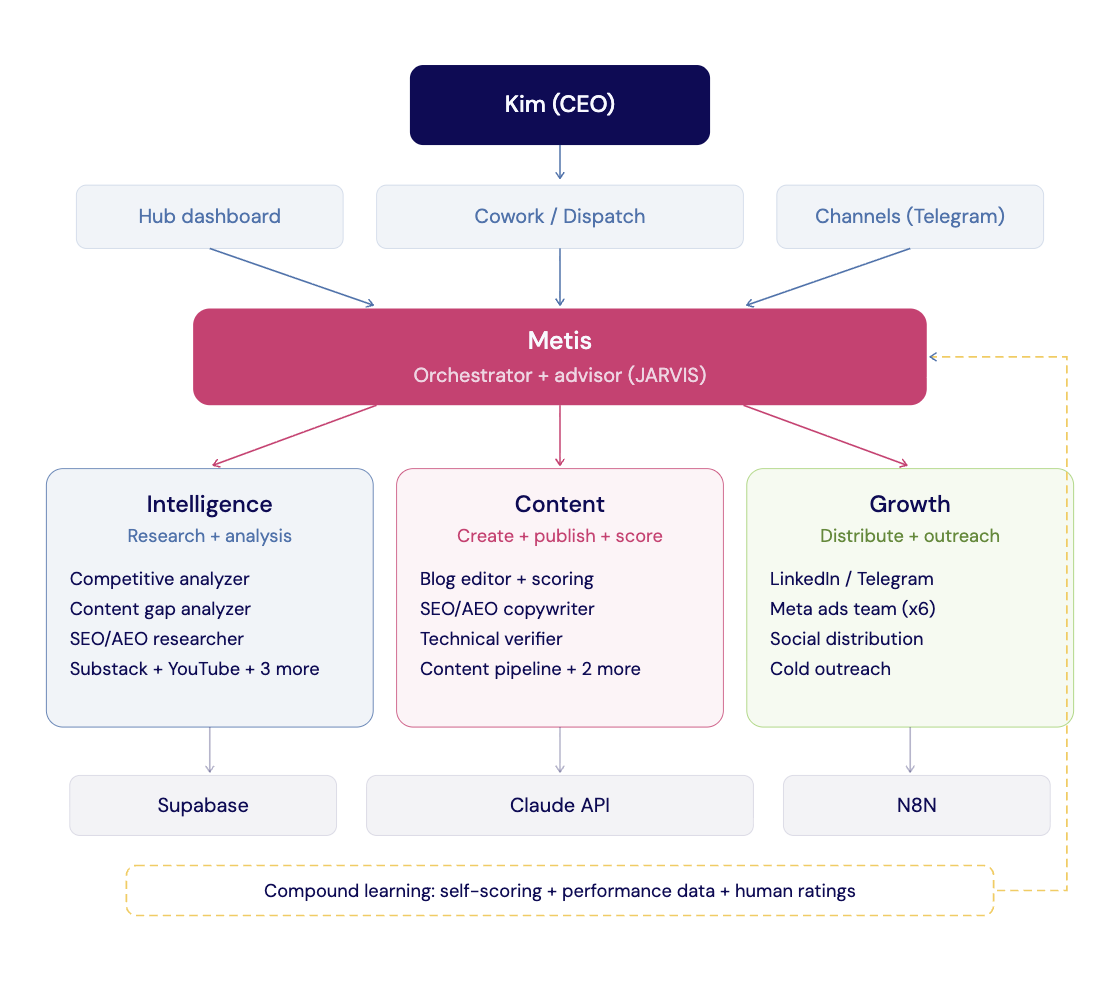
Here's where I started: (This was created with Claude's Visioning tool)
The complete cycle: Intelligence finds opportunities, Content creates posts, Growth distributes them. Kim's only two actions are Approve and Publish. Everything else is automated.
I have 33 agents organized into five divisions, each led by a director. Yes, I named them all after Greek goddesses (we'll get to that).
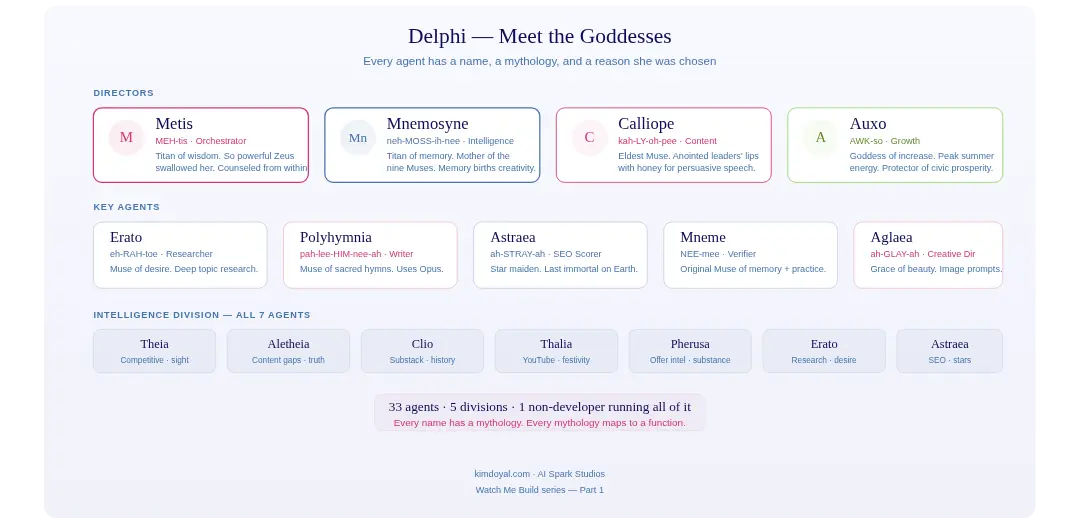
Intelligence 7 agents, led by Mnemosyne... that's neh-MOSS-ih-nee, goddess of memory. These are the researchers. They find keywords, analyze competitors, audit my SEO, research what's happening on Substack and YouTube, and identify content opportunities.
Content 9 agents, led by Calliope... kah-LY-oh-pee, the eldest Muse. These are the creators. A copywriter who knows my voice, a creative director for image prompts, a brand editor who checks consistency, and a technical verifier who catches errors before I publish.
Growth 5 agents, led by Auxo... AWK-so, goddess of increase. Distribution, outreach, advertising, and analytics. When content is published, they make sure it reaches people.
Technical Ops 9 agents, led by Arete... ah-reh-TAY, spirit of excellence. The behind-the-scenes crew. Performance audits, security scans, accessibility checks, and code quality.
And then there's Metis (MEH-tis, goddess of wisdom and strategy). She's the orchestrator. The one who sits above everything and coordinates between divisions. I call her my JARVIS (like Iron Man)... if JARVIS were a Titan goddess who was so powerful that Zeus swallowed her because her intelligence threatened him.
Why Did I Name AI Agents After Greek Goddesses?
It first started when I added Claude to my hub (Kim's Hub). I wanted to use a female name for my AI assistant in my hub, because why not?
I named them after Greek goddesses because mythology maps to function better than you'd expect, and giving agents identity changes how you use them. When something has a name and a story, you remember what it does.
For a long time, though, I had boring functional names for everything else. "SEO researcher." "Content writer." They were fine, but forgettable. I had 25+ agents doing real work; I just hadn't thought about organizing them as a unified system.
That part was inspired by my friend Lesley, who introduced me to the concept of pulling agents together as a "Board of Directors" with Greek goddess names. The idea of giving them divisions, mythology, and an architecture they work within... that conversation was the spark. Credit where it's due, even when the implementation looks nothing like the original idea.
What I kept coming back to was this: I didn't need a collection of goddesses. I needed a place to go for answers. In Greek mythology, Delphi was the center of the world (the Greeks called it the Omphalos... literally, the navel of the earth). Apollo's sacred sanctuary on Mount Parnassus, where people traveled from across the ancient world not to visit the gods, but to consult the Oracle. To get clarity. To get direction. These 33 agents each have a specific role and domain, and Delphi is where you bring the question.
Mnemosyne is the Titan goddess of memory and remembrance. She's also the mother of the nine Muses. Memory gives birth to creativity. Intelligence gives birth to content. The mythology maps perfectly.
Astraea (ah-STRAY-ah) is my SEO scorer. She was the last immortal to walk among humans during the Golden Age, and when she left Earth, she became the constellation Virgo. Her scales became Libra. Goddess of precise measurement and fair scoring.
Tell me that's not perfect for an agent that scores blog posts across 12 weighted SEO dimensions — from keyword density to AEO readiness — and rolls it into a single letter grade. 😉
33 agents, 5 divisions, and yes, a pronunciation cheat sheet. Every goddess was chosen because her mythology maps to her function.
I have a pronunciation cheat sheet now. That's how committed I am (I feel like a ding-dong every time I mispronounce them... even though AI can't hear me when I'm dictating, lol).
How Does the AI Agent Content Pipeline Actually Work?
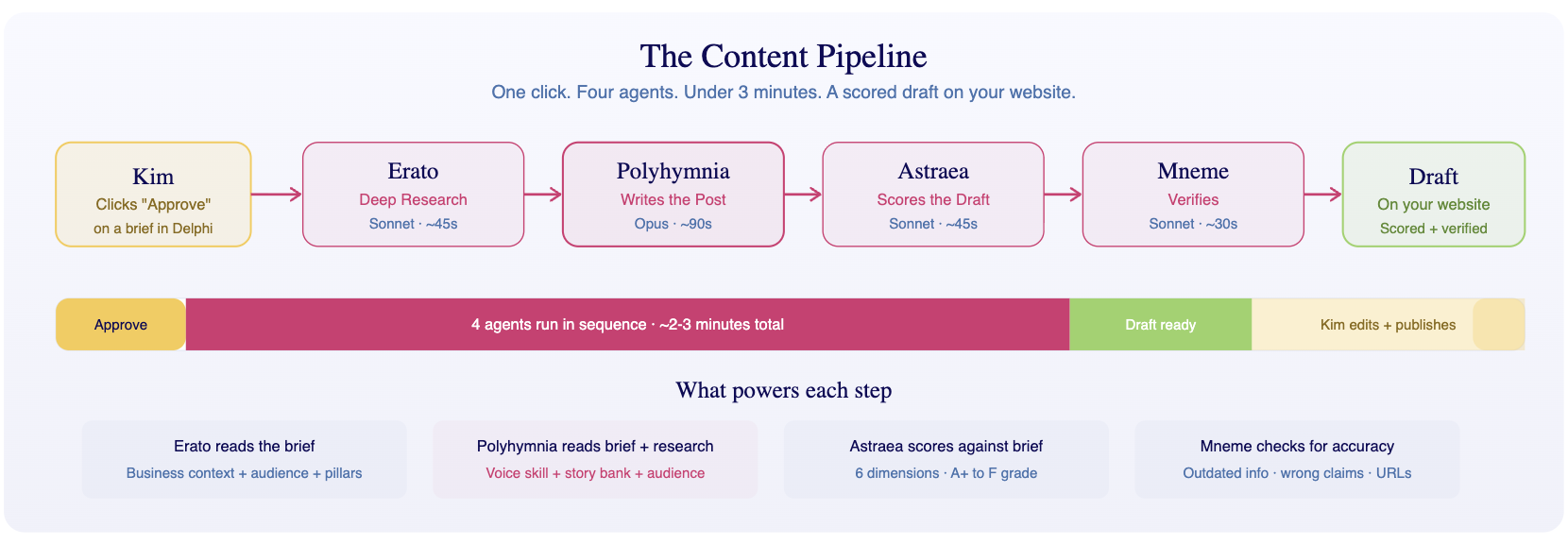
The content pipeline takes a single approved brief and produces a scored, verified blog post draft in under three minutes, with no manual handoffs between steps.
Here's the real sequence, step by step.
Mnemosyne's Intelligence team runs research across six different tools:
Perplexity
Firecrawl
YouTube Data API
Substack's network
My own content history
The competitive landscape.
They produce structured reports that land in a command center I built called Delphi. (Named after the sacred site where mortals went to consult the Oracle. The Delphi is where I go to speak with them.)
When an Intelligence agent identifies a content opportunity, it generates a writing brief. Keywords, headings, FAQ questions, differentiation angles, and opening hook. That brief appears in Delphi's approval queue.
I click one button. "Approve."
And then four agents run in sequence, automatically:
✔️ Erato (eh-RAH-toe, Muse of desire) conducts in-depth research on topics.
✔️ Polyhymnia (pah-lee-HIM-nee-ah, Muse of sacred hymns) writes the full blog post using my voice guide, story bank, and audience profiles.
✔️ Astraea scores it across six SEO/AEO dimensions.
✔️ Mneme (NEE-mee, one of the original Muses of memory and practice) runs pre-publication quality assurance, catching outdated information, incorrect claims, and potential issues.
The whole thing takes about three minutes.
One click starts the chain. Four goddesses, four Claude API calls, one scored draft on my website. Total time: 2 minutes and 51 seconds.
When the pipeline finishes, a scored and verified draft appears on my website. Not published. Just sitting there as a draft, waiting for me to add my stories, adjust the voice, format the images, and make it mine.
The first time the pipeline ran successfully, I nearly fell off my chair. 🤯
Not because the writing was perfect (it wasn't... Polyhymnia made up projects I hadn't built, which is a whole other conversation about teaching AI what's true versus what sounds good).
But because the structure, the SEO formatting, the headings, the FAQ section, the voice... it was 85-90% there.
I went from spending 3-4 hours per blog post to spending 30-45 minutes on the parts that actually need me. The thinking, the stories, and my personality.
How Much Time Does an AI Agent System Actually Save?
My content production time dropped from 3-4 hours per post to 30-45 minutes of hands-on editing, a reduction of roughly 75-80%. The research quality is also better than what I was doing manually.
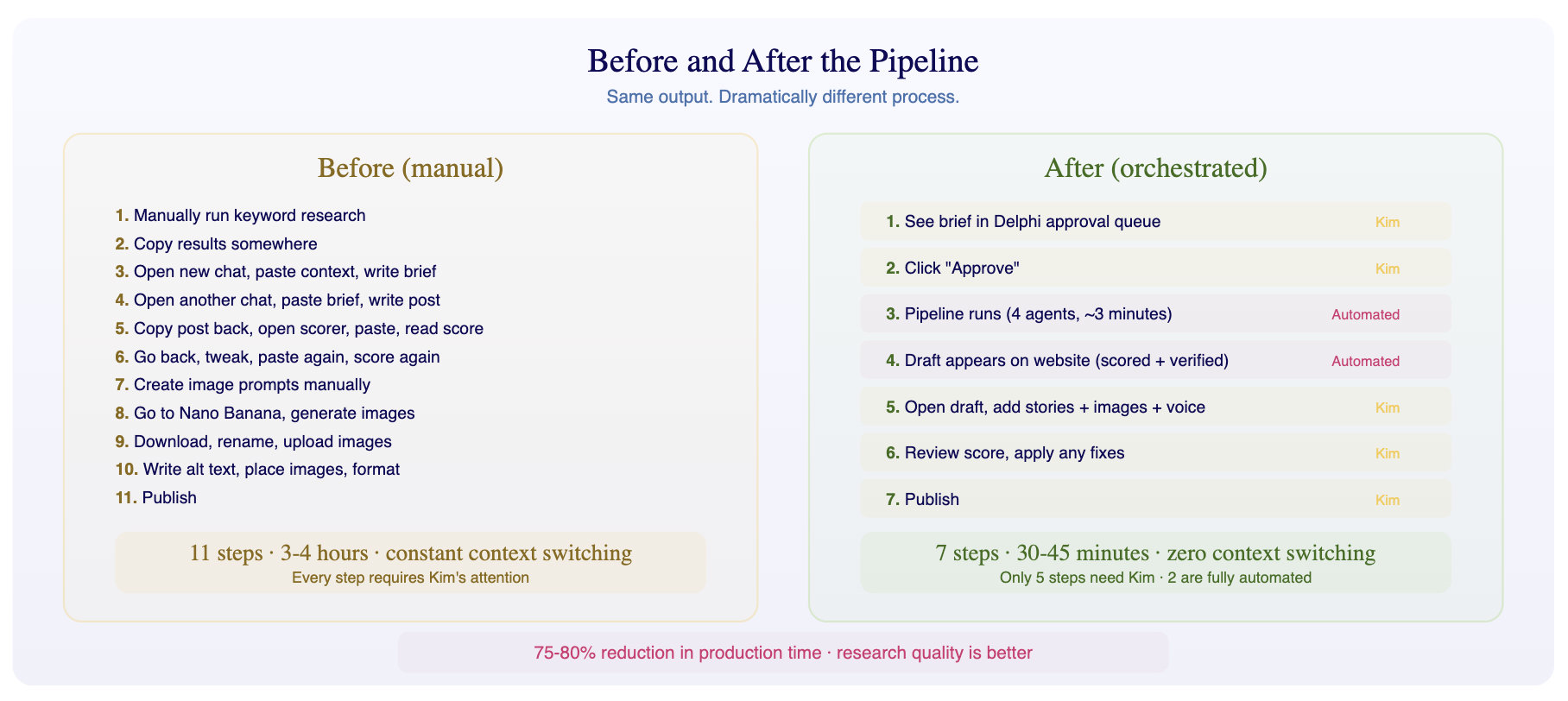
Let me show you the before-and-after, because this is where it gets real.
Before the system: Manually run keyword research. Copy the results somewhere. Open a new chat. Paste context. Write a brief by hand. Open another chat. Paste the brief. Write the post. Copy it back. Open the post scorer. Paste the content. Read the score. Go back. Tweak. Paste again. Score again. Then manually create image prompts, go to Nano Banana, generate images, download, rename, upload, write alt text, place them, format, and publish.
Eleven steps. Constant context switching. 3-4 hours (assuming I was focused).
After the system: See a brief in Delphi. Click Approve. Go make coffee. Come back. The draft is on my website with a score and verification results. Spend 30 minutes making it mine.
Publish.
Seven steps, but only two of them need my brain... reviewing the brief and editing the draft.
Same output. 75% less time. And the two automated steps (research and scoring) are actually better than when I did them manually.
The rest? The research, the first draft, the scoring, the verification? The goddesses handle it.
What Tools Do You Need to Build an AI Agent System?
You need less than you think. My entire system runs on tools that are either free or that I was already paying for, with the only additional cost being Claude API usage at roughly $20-50 per month.
Here's the actual stack:
Claude (API plus the Max plan for direct conversations). VS Code with Claude Code for building. Supabase for the database. Next.js and Vercel for the website and the Hub. n8n on Railway is next (for automation of some of the agents).
Every agent is a markdown file with instructions. Not code, not a programming language. A text file that describes what the agent should do, what tools it can use, and what rules it should follow.
If you can write a Google Doc, you can write an agent.
That's not me simplifying it for a blog post. That's the actual truth.
What Went Wrong While Building This?
Plenty went wrong. The content pipeline died silently on its first run. The AI fabricated projects I never built. And the command center was showing raw code instead of readable content.
Here are actual things that happened during the build:
The first time I tried to run the content pipeline, it got stuck. Just... hung. No error message, no completion, nothing. I clicked "Approve," the system said it was running, and then... silence.
It took multiple rounds of testing, checking logs, trying fixes, and going back and forth before we figured out the problem. The system was trying to do the work in the background, but the server shut down before the agents could finish. Think of it like starting a dishwasher and then flipping the breaker... the machine can't finish if you cut the power. The fix was to keep the system running until all four agents completed their work.
Polyhymnia (my writer) fabricated three projects I'd never built and recommended tools I don't use. She made them up because she didn't have access to what I've actually built, so she filled in the gaps with plausible-sounding fiction.
We had to add a "truth layer" to her instructions... a hard rule that says "NEVER fabricate specific examples. If you don't have a real one, use a placeholder like [INSERT: your real project here]."
The approval queue was showing raw code when you clicked "View." Just walls of technical data that meant nothing to me as a business owner. We had to rebuild the routing so that clicking "View" actually takes me to the page where the research lives in a format I can read and use.
I'm telling you this because the "build in public" content out there tends to skip the debugging.
The messy middle is where the real learning happens. And honestly? Not knowing what's "hard" was my biggest advantage. I didn't know why the pipeline was dying. I just clicked the button, saw that nothing happened, and went looking for the answer.
Ignorance is bliss when you're building with AI. You don't know you're not supposed to be able to do this, so you just... do it.
What's Coming Next in This Series?
This is the first post in a series documenting the entire build. Not the polished, retrospective version. The real-time version with screenshots, architecture diagrams, and decisions that worked alongside those that didn't.
A quick note on where things stand right now: I have one fully automated pipeline (the content pipeline you just read about). Everything else, the research agents, the competitive analysis, the Substack and YouTube intelligence, I trigger manually. The system works, but it's not running on its own yet. I'll be sharing how things go as I wire up the rest of the agents and get them talking to each other.
Here's what's coming:
The content pipeline deep-dive ... how four AI agents produce a scored blog post in under three minutes, step by step, with real logs showing the pipeline completing.
My custom Hub ... the business operating system that replaced a handful of SaaS subscriptions, and what it actually costs versus what I was paying.
What broke and what I learned ... the full messy middle. In plain language and easy-to-understand processes, and every "oh, THAT's why it's not working" moment.
Wiring it all up ... taking 33 agents from "I click a button, and one thing happens" to "they hand work off to each other automatically." This is the part I'm most excited (and nervous) about.
And eventually, how you can build this too. Not my system. Yours. Starting with one voice review agent and building from there, one real problem at a time.
If you've ever wondered whether you could build something like this without being a developer... you're exactly who I'm writing for.
I'm 55. I live in the California Sierra foothills. I have zero developer background. And I have 33 Greek goddesses running my business.
Let's see where this goes.
Kim Doyal
Kim Doyal is a digital marketing strategist and AI builder with 18 years of online business experience. She is the founder of AI Spark Studios and SPARK Lab, and the creator of The Hub — a custom 33-agent AI operating system that runs her entire business. She has also built kimdoyal.com, StackRewards, and multiple AI tools and agents using vibe coding, a natural language approach to building software without a traditional development background.