HOME/BLOG/AI ARCHITECTURE WEEK: THE FOUR ROOMS EVERY AI BUSINESS NEEDS
Business Growth
AI Architecture Week: The Four Rooms Every AI Business Needs
How I spent a week mapping my business instead of building... and the audit prompts you can use to check yours.
April 24, 2026|5 min read
QUICK ANSWER
An architecture week is a deliberate pause from creating to audit what you've already built. For AI-powered solopreneurs, it means mapping every tool, agent, and system you own into four pillars (Intelligence, Content, Growth, Business), finding the gaps you assumed weren't there, and wiring the connections that were missing. This post walks through the week I just did, what I found, and gives you the audit prompts to run on your own business.
I came into this week already tired.
The kind of tired that isn't really about any one thing... it's about the quantity of moving pieces.
At this stage of life, I know not to push through. So I stopped.
But here's where it got interesting. Instead of taking a rest week, I took an architecture week. Five days of mapping my business instead of producing in it. No new content, no new tools, no new launches. Just: what have I actually built, and does any of it connect?
(If you saw Friday's Note on the boring layer, this is the longer version of what I meant.)
The paint-color trap
Here's the analogy that kept coming back to me.
Imagine you're building a house. The foundation is poured, the framing is up, the roof is on. You've been making real progress. But you've also been spending afternoons picking paint colors and debating curtain fabric while the plumbing sits in coils on the kitchen floor and the electrical is half-wired behind the drywall.
The decor looks good. The Instagram photo of the living room is aspirational. But the house doesn't actually work. You can't live in it yet. Nobody's said it out loud because the visible layer (the paint, the decor, the beautiful kitchen backsplash) looks exactly like a finished house.
That's most AI-powered businesses right now. Mine included, until this week.
We ship tools. We launch newsletters. We build MVPs. We post about it. We pick paint colors while the foundation has gaps.
Architecture week is the week you put the paint brush down and check whether the electrical is actually wired.
What I actually did
An architecture week is five days of auditing what you've already built rather than producing new things. Here's what that looked like for me.
I opened up every agent I'd built over the last six months. Some had been running so quietly in the background I'd stopped checking on them. Some had names I'd reserved but hadn't yet wired up. Some were in three places at once, slightly different versions in each (the natural hazard of working across two machines without a sync layer).
I mapped what each one produced, where it lived, whether it was wired correctly, whether it was actually talking to the other agents.
What I found was drift. Not because I'd been sloppy, but because I'd been fast. Tools I'd set up for one purpose and outgrown. Connections I'd assumed existed but hadn't formally made. Two machines running two slightly different versions of the same skill library, silently diverging while I switched between them.
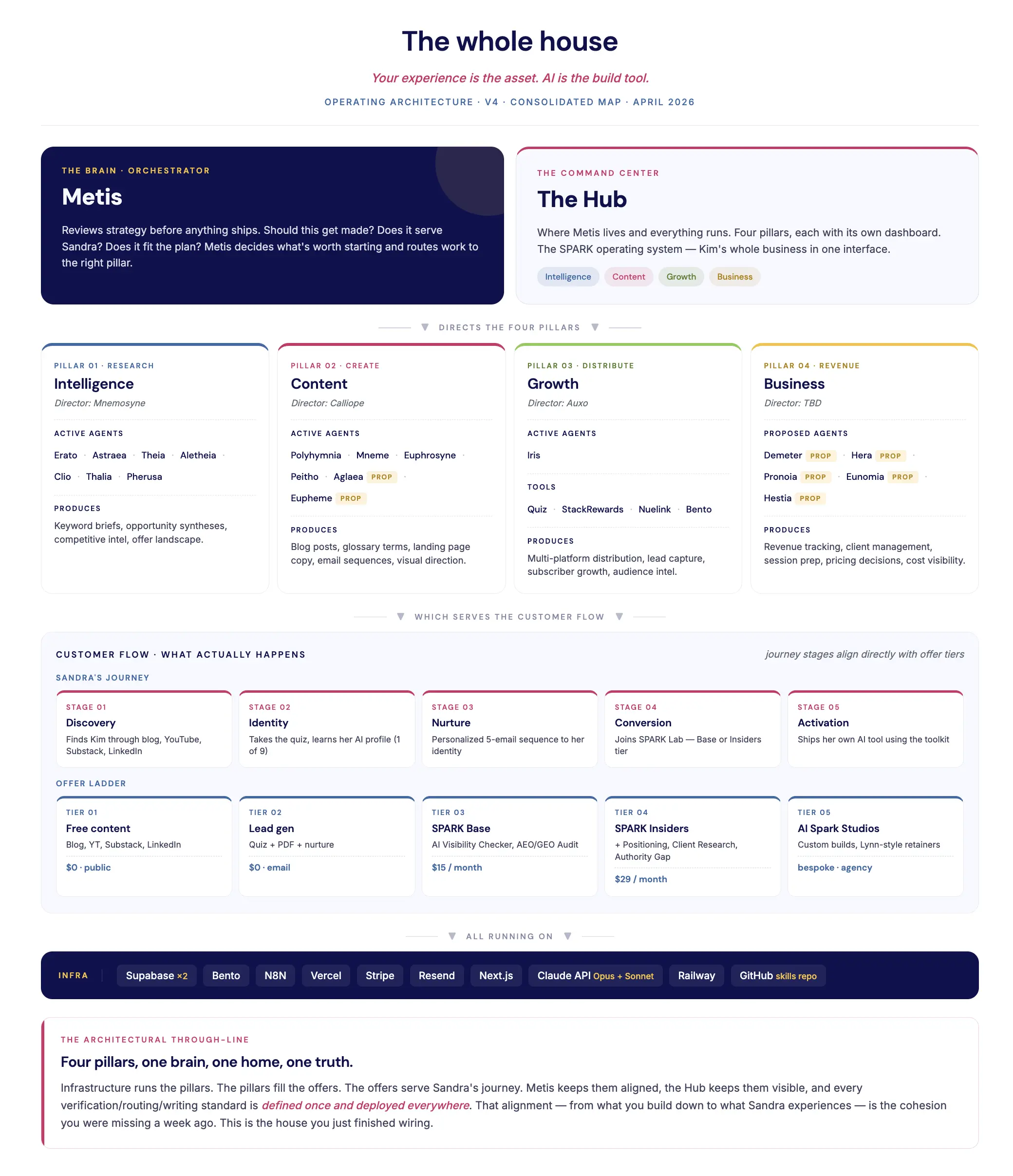
By the end of the week, I'd mapped the whole business into four pillars: Intelligence, Content, Growth, and Business. Each pillar has its own purpose, its own agents, its own output. They don't compete... they compound.
The operating architecture, v4. Metis decides what gets built, the four pillars build it, the offer ladder serves Sandra's journey... all running on the same infrastructure. Defined once, deployed everywhere.
Here's what I'm getting from this:
Focus. When I know what pillar something belongs to, I stop making random decisions about where to put it. When an idea comes up, I know which room it belongs in. When something breaks, I know which pillar to look in first.
Cohesive systems. Things that used to feel like separate projects now feel like one business. The blog, the agents, the Substack, the clients, the quiz... they're all rooms in the same house. For the first time, I can walk between them without hitting walls.
Deliberate progress. When I've been intentional about how something was built (the voice, the offers, the audience), that deliberateness showed up in moments like this week. The pieces didn't resist being mapped. They slotted into the framework because they were designed to.
The four rooms every AI business needs
Every AI-powered business breaks into four pillars: Intelligence (research), Content (creation), Growth (distribution), and Business (revenue). If anyone is underbuilt, the whole house wobbles.
Here's where you get to apply this.
These four pillars aren't specific to my business. They're the load-bearing structure of any AI-powered solopreneur business. If any one of them is underbuilt, the whole house wobbles.
For each, I'll walk you through what it is, how to tell if it's underbuilt, and give you a prompt you can paste into Claude or ChatGPT to run the audit on your own business.
Pillar 01 — Intelligence (the research room)
What it is: where signals from the outside world come in. Competitive intel, audience research, keyword data, what's trending in your niche. The room where you understand the market you're operating in. (The Build Path quiz is one example of this — it exists because I wanted specific data on who my readers are, not guesses.)
Signs it's underbuilt:
You make content decisions based on gut feel or what you saw on LinkedIn that morning
You can't name your top three competitors or what they launched last month
You don't know what your audience actually searched for last quarter
"I should probably write about X" is how your content planning starts and ends
The human side: this pillar isn't here to make every piece of content strategic. You'll publish things because you feel inspired, because something lit you up on a walk, because you want to. The research doesn't compete with that. What it gives you is the clarity to know whether what you're inspired to write belongs in your house. I'm not going to publish a post about gardening... that's not my house. But if I can connect gardening to how we tend an AI business? It belongs.
Intelligence is the pillar that tells you which is which.
Audit prompt:
I want to audit my business's Intelligence pillar (research, competitive intel, audience understanding). Here's my context:
[your niche, your audience, what you sell]
Please help me answer: 1. What's the last piece of research-backed content I published? 2. Where do I currently get signals about what my audience wants? 3. Who are my top 3 competitors, and when did I last look at what they're doing? 4. What's the one research question I've been meaning to answer but haven't?
Based on my answers, tell me: - The single biggest Intelligence gap in my business - The smallest possible system I could build this week to close it - Whether I actually need this, or if I'm fine without it
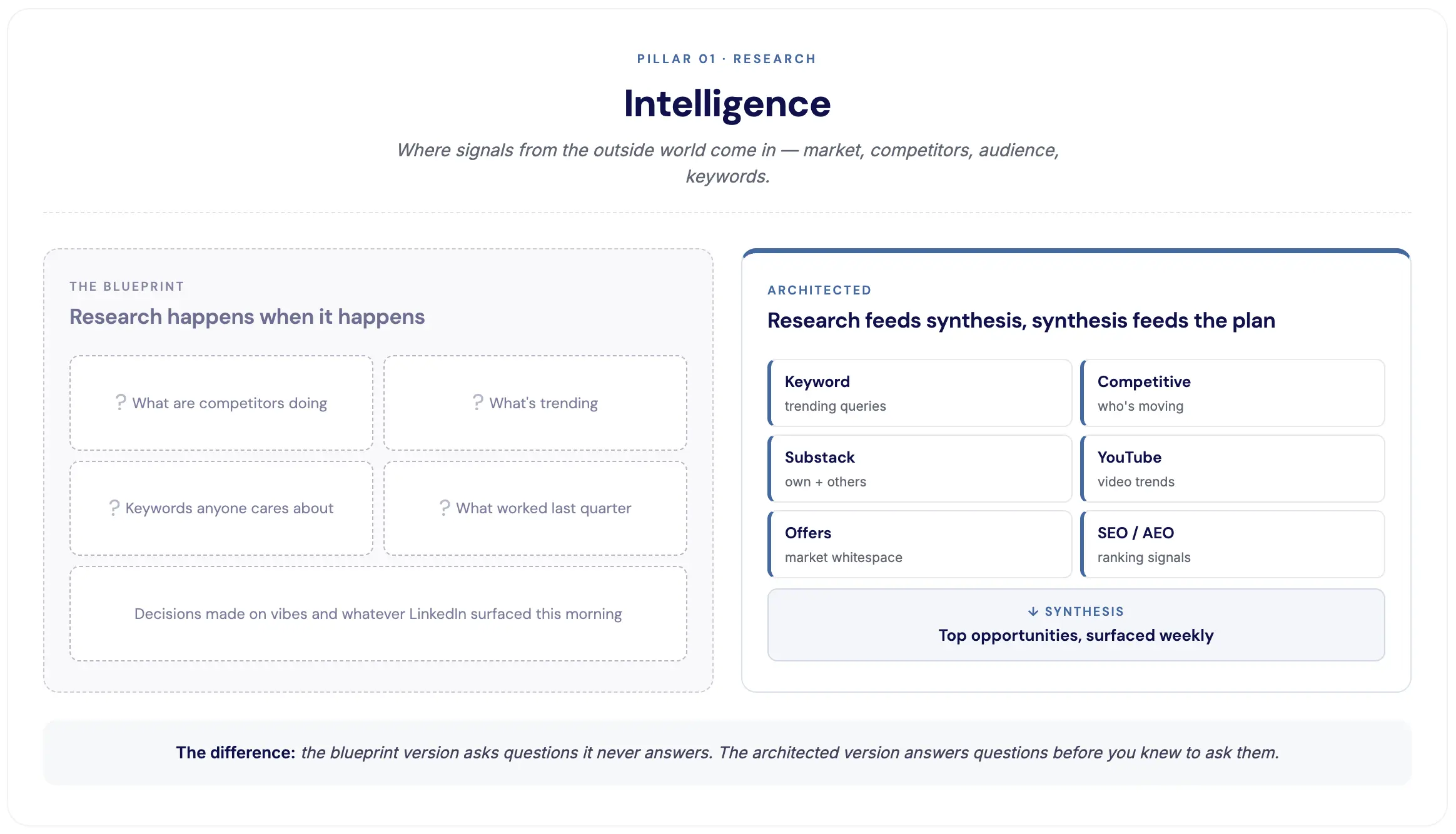
A comparison between reactive and proactive research strategies, highlighting how "Architected" intelligence transforms raw market signals into actionable weekly opportunities rather than relying on inconsistent "vibes."
Pillar 02 — Content (the creation room)
What it is: where research becomes output. Blog posts, newsletters, videos, podcasts, whatever you ship. The room where intelligence turns into something your audience can actually hold.
Signs it's underbuilt:
You create what you feel like creating on the day
Your voice drifts across pieces
You reinvent the structure every time
You can't find the post you published six months ago
You've repeated topics because you couldn't remember if you'd already covered them
The human side: this doesn't mean every piece passes through a checklist before it ships. Write from inspiration, write from impulse, write from the middle of a thought you haven't finished yet. The gates aren't there to sanitize your voice. They're there to catch the small things (an em dash that snuck in, a phrase that isn't yours, a link that rotted) so the thing that IS yours stays intact.
Audit prompt:
I want to audit my business's Content pillar (creation, voice consistency, publishing workflow).
[your main content channels and what you publish]
Please help me map: 1. What's my actual publishing cadence, not my aspirational one? 2. Who or what checks my content for voice consistency before it ships? 3. How many hours does a typical piece of content take me from idea to publish? 4. What's currently in my "started but not finished" pile?
Based on my answers, tell me: - Where voice drift is most likely happening - Which step in my current content flow has no quality gate - The one change that would buy me back the most time per piece
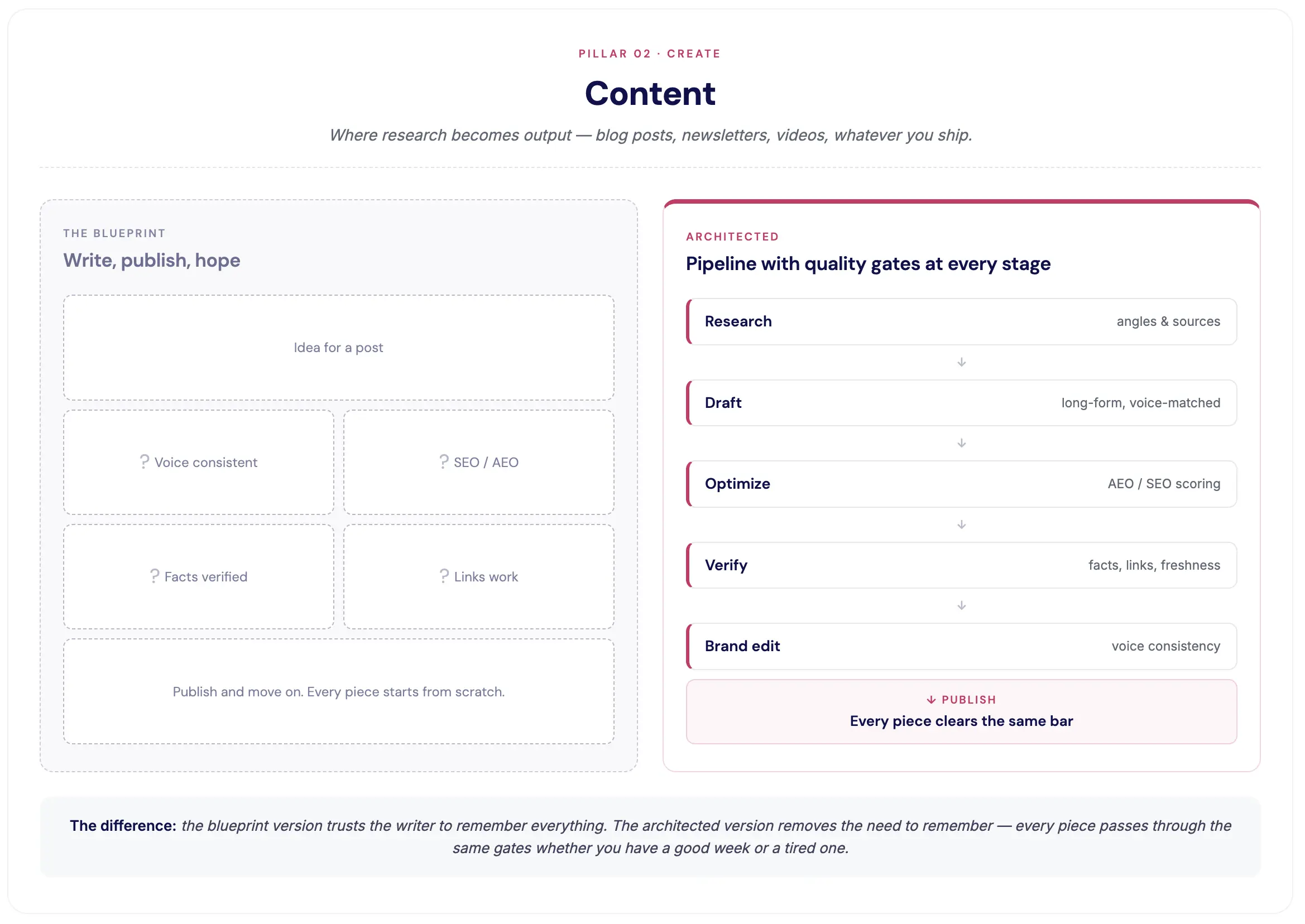
Moving from a "Write, publish, hope" mentality to an architected pipeline ensures every piece of content clears the same high bar for SEO, facts, and voice consistency—removing the need for the writer to remember every detail manually.
Pillar 03 — Growth (the distribution room)
What it is: how what you make actually reaches more people. Your email list, your channels, your referral loops, your lead magnets. The room where content becomes audience.
Signs it's underbuilt:
You publish and hope
You can't name your top three traffic sources with confidence
Your email list grows or shrinks month to month, and you don't know why
You cross-post manually, sometimes, when you remember
The human side: not everything you publish is meant to grow the list. You'll write things that serve the readers you already have, period. You'll make things just because they matter to you. What Growth gives you is the understanding that when you DO want something to reach more people, there's a system that'll carry it. The rest of the time, you can just talk to the room you've already built.
Audit prompt:
I want to audit my business's Growth pillar (distribution, acquisition, list health).
[your channels, list sizes, how you currently distribute]
Please help me answer:
1. Where did my last 10 subscribers actually come from (be specific, not "social media")? 2. What's my primary lead magnet, and when did I last update it? 3. When I publish a piece of content, what happens automatically versus manually? 4. Do I know my cost per subscriber?
Based on my answers, tell me: - The channel I'm underusing - The channel I'm overusing relative to its return - The automation I'm missing that would make the biggest difference
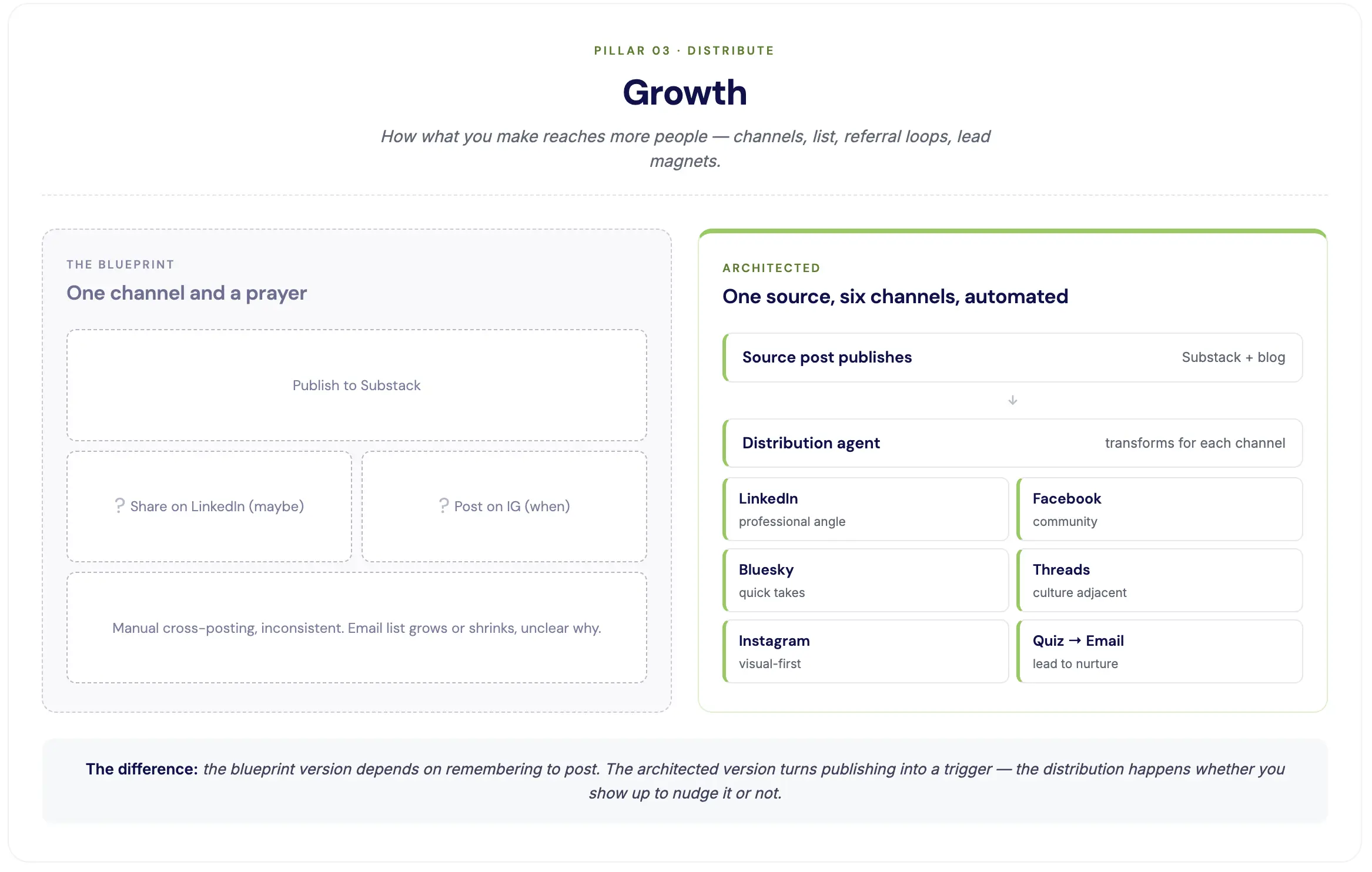
The key to sustainable growth is moving away from manual "one channel and a prayer" distribution. By architecting an automated system, a single content source (like a Substack post) can be intelligently reformatted and deployed across six distinct channels—including LinkedIn, Bluesky, and direct email nurture—ensuring your work reaches more people without constant manual effort.
Pillar 04 — Business (the revenue room)
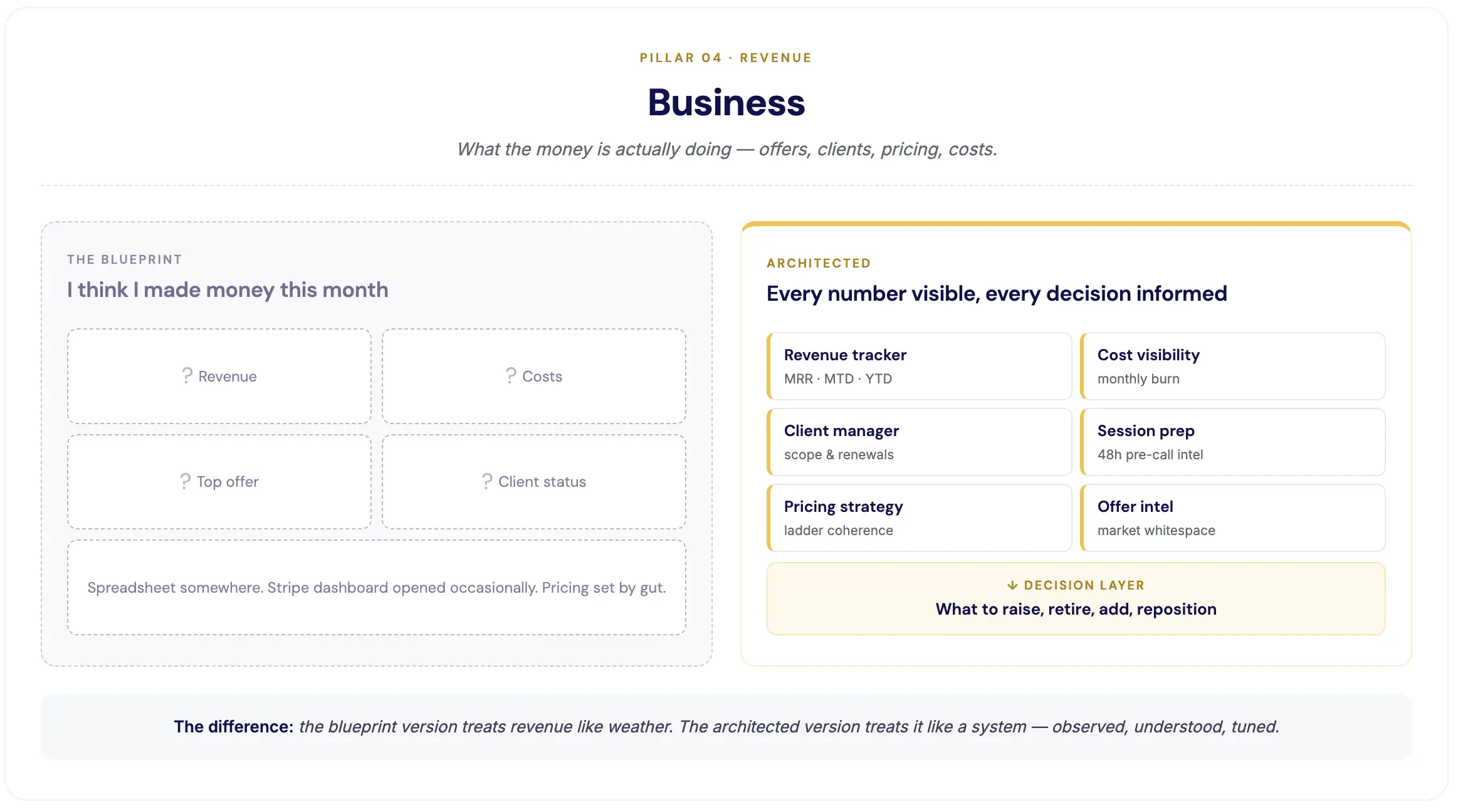
What it is: what money is actually doing. Offers, clients, pricing, costs. The room where the audience becomes revenue.
Signs it's underbuilt:
You couldn't say your monthly burn off the top of your head
Your offers don't connect to each other (each one reinvents the sale)
You're not sure which offer is carrying the most weight
You've been meaning to raise prices but haven't
The human side: not every decision has to be optimized for financial gains. You'll keep offers alive because you love them. You'll say no to clients who could pay but aren't the right fit. What Business gives you is the ability to make those decisions on purpose, not by accident. Turning down a bad fit is easier when you can see you don't actually need the revenue. Keeping an offer alive is easier when you know what it's actually costing you.
Audit prompt:
I want to audit my business's Business pillar (revenue, offers, costs, clients).
[your current offers and prices, approximate monthly revenue, approximate monthly costs]
Please help me map: 1. Which offer pulled the most revenue last month? Last quarter? 2. What's my actual monthly burn (tools, contractors, subscriptions)? 3. Do my offers lead into each other, or do they compete? 4. What's the smallest thing blocking me from raising prices or launching the next offer?
Based on my answers, tell me: - Where the revenue is hiding (the offer I'm underselling) - Where the costs are hiding (the subscription I've forgotten) - The one decision I should make this month about pricing or packaging
Relying on "I think I made money this month" spreadsheets is a recipe for instability. Architecting your revenue stream means making every number—MRR, client retention, and market opportunities—completely visible. This systematic approach transforms unpredictable cash flow into a data-driven "decision layer," allowing you to strategically raise, retire, or reposition offers based on clear metrics rather than gut instinct.
Why this is the work that compounds
Most people overestimate what they can do in a year and underestimate what they can do in a decade.
Architecture is decade-long work. Decoration is week work.
Both matter. You need both. The house has to get painted eventually, and you do need people to want to come inside. But the cultural bias right now, especially in AI, is overwhelmingly toward decoration. Toward shipping. Toward "look what I built this week."
What nobody clocks is that the people who will still be here in five years aren't the ones shipping the most this quarter. They're the ones who stopped long enough to make sure what they were shipping was actually worth shipping, on a foundation that will hold.
That's the intentionality I've been trying to hold in my business. It's not always the popular move. The LinkedIn post that says "I spent this week mapping and not shipping" gets fewer likes than the one that says "I built five tools this week."
I'd rather have the foundation right.
How to know if you need an architecture week
Five questions. If you answer yes to three or more, you need one.
Do you have more active projects than you could list from memory?
If your AI assistant started fresh today with no context, could you get back to productivity in under an hour?
Do you know what each of your active agents, automations, or tools actually produces?
Can you describe your offer ladder in one breath?
Do you know where your subscribers actually come from?
If you said yes to three or more, congratulations: you've been decorating a house that still has half-wired electrical. No shame in that. Everyone's been there.
Architecture week isn't permission to stop building. It's what makes the building last.
How long should an architecture week actually take?
It doesn't have to be a literal week. Some people can do this in a focused weekend. Others need two weeks because their business is more complex. The important part is that it's uninterrupted. You don't get the clarity if you're context-switching back to building every day.
What if I find out my foundation is mostly gaps?
That's the point. You can't fix what you don't see. Finding gaps is the value of the week, not a failure state.
I'm still in the "building the house" phase. Is this too early for me?
Possibly. Architecture week works best when you've been building for six months or more and the complexity has started to bite. If you're just starting, focus on building. Come back in six months.
How do I know when I'm "done" with architecture week?
You're not. You'll want to revisit the map every quarter. What shifted, what needs rewiring, what's stopped serving. The first pass is the hardest because you're building the framework itself. After that, it's maintenance.
Do I need AI agents to do this?
No. The four pillars apply whether you're running agents or just running a solopreneur business with spreadsheets and a newsletter. The audit prompts work the same. AI agents just make the consequences of missing architecture more visible, because when everything is connected, bad connections get loud.
Your obvious offer is hiding in plain sight.
Free. Tell it what you know and who you help, and it'll show you the offer everyone can see but you.
Kim Doyal is a digital marketing strategist and AI builder with 18 years of online business experience. She is the founder of AI Spark Studios and SPARK Lab, and the creator of The Hub — a custom 33-agent AI operating system that runs her entire business. She has also built kimdoyal.com, StackRewards, and multiple AI tools and agents using vibe coding, a natural language approach to building software without a traditional development background.