HOME/BLOG/I CAN WRITE FOUR POSTS BEFORE LUNCH... THAT'S THE PROBLEM
Content Creation
I Can Write Four Posts Before Lunch... That's the Problem
Producing content got cheap, and deciding what deserves to exist didn't
July 31, 2026|5 min read
QUICK ANSWER
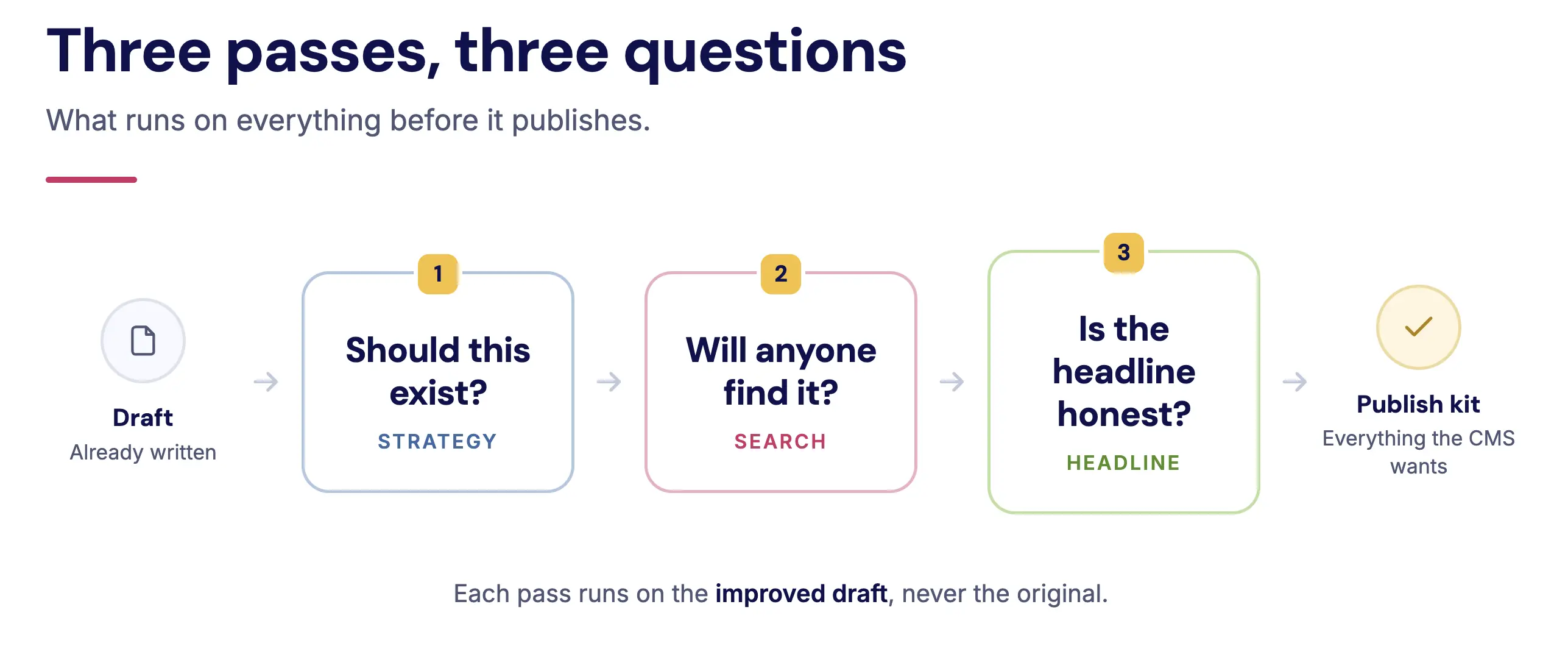
AI made producing content nearly free, and it did nothing to make judgment cheaper. So my approach to AI content creation for blogs is three passes that run before anything publishes, each one answering a single question: should this exist, will anyone find it, and is the headline honest to the piece that actually shipped?
In 2018, I had an idea for a physical content planner, and the hardest part by far was making it.
I reached out to a friend, a trained graphic designer, and asked whether I could hire her or if she would like to partner with me. She said yes... to which I had to ask her, " Yes, to which option?" lol. We started with me physically drawing the pages on paper with a pencil, sending them to her. She turned my drawings into InDesign files, which took weeks (many, many, long Zoom calls. I think our longest was 6 hours!), and then we had to figure out printing, fulfillment, and inventory. We ended up with a company in Atlanta that handled the printing (a better price than anything overseas... they do books too, if anyone is looking for that, just message me).
We went from an idea in August to a fully designed planner by December. Printing and shipping started in March, but we presold it and covered the first print run.
One thing I was adamant about from the very beginning was that we were going to run ads (Meta). We started at $10 a day.
By the end of 2019, we started increasing ad spend. In January of 2020, we started scaling. That month, we spent $29,000 on ads and generated $67,000 in revenue from a planner that cost us under $10 to produce. I wrote the first ad that actually converted, and we scaled it to $1,000 per day. All in, that planner did close to half a million dollars before we closed it down (COVID showed up right as we were scaling; we hired a different ad agency and basically spent most of our profits on them. Never again... any solopreneur can run their own ads thanks to AI). We eventually closed it down (we should have tried to sell it, oh well). We both had our own businesses, and it was time. (I will never touch e-commerce again, but that's a different post.)
When I think back on that experience, I'm super grateful my friend said yes (she's incredibly talented and very smart), but I also think about what that would look like today.
If I were starting with that same idea today, I could generate fifty planner layouts before lunch. I wouldn't need a designer, a pencil, or six weeks. I could have a printable PDF by dinner.
And absolutely none of that would tell me whether the planner was worth making.
None of it would have written that ad. The ad worked because I did the work. I studied copy, I practiced it, I learned how to write an ad. That part didn't come from production, and it wouldn't have come from a tool either.
I can write four blog posts before lunch now. So can you. The constraint that shaped every content strategy of the last fifteen years- that making things is slow and expensive- quietly stopped being true, and most of the advice built on top of that constraint is still sitting there as if nothing happened. For the people who are creating at that speed without the practice and experience behind them, the constraints are few and far between.
If I were to crank out four posts before lunch, not only would they be garbage (I spend a lot of time on my posts), but the judgment of whether those posts should (or need to) exist wouldn't be there.
That gap costs more than it looks, because publishing something mediocre isn't free. If I decided to crank out 4 posts before lunch, each one would cost me the hour I spent making it, the time it takes to put it on my site and Substack (with formatting, links, SEO, etc.), a slot in an inbox I had to earn, and a small piece of the assumption that what I send is worth opening. None of that shows up anywhere I can see it at the time. It shows up later as a number that's been quietly sliding for months, and by then I've long since forgotten which posts did it.
So for the last few months I've been building the other half. Three passes that run on every single thing I publish, before it publishes. Not to write it... to decide whether it should go out, and to tell me why (the process I use to ideate, outline, draft, and edit takes its own chunk of time before I even get to these passes).
Every pass answers a question I used to answer with a gut feeling.
Three questions, in that order. The order is the part that matters.
Pass One: Should This Exist?
The first pass asks whether the piece is worth publishing at all, before anyone worries about whether it's findable. It scores the draft against what my publication actually promises and who actually reads it, and if the answer is bad enough, it stops.
Back in May, I wrote about running my whole newsletter through Karo Zieminski's Publication as Product framework, which is where I finally figured out what my publication actually promises. If you want the foundation, start there, and then go read her original(it's behind her paywall, and it's worth it).
The one-sentence version: a product is a repeatable experience of value someone chooses to return to, and your publication is a product whether you're treating it like one or not.
Karo's framework operates at the publication level.
What I built runs one level down, on the individual post. Five dimensions scored one to five... promise alignment, person fit, value type, identity beat, and shareability... with grade bands and one feature I use more than any other.
If a post scores below 2.5, the whole thing stops. It won't optimize something that shouldn't ship; it just tells me the angle is wrong.
It hasn't stopped me yet, and I trust it more because of that. It also hasn't stopped me because I've been writing online for a long time; I spend a lot of time on the 'pre-work' for an article before I even begin writing (with or without AI).
But here's where it got more interesting. A few days ago I realized my scorecard was missing something I'd written about in May and then never actually built: not every post has the same job.
Some posts bring new people in. They're builds, with a real output you can see. Others keep the people who are already here, the reflective ones that answer "am I in the right place?" rather than "what do I do Monday?" Score both against the same yardstick, and it'll tell you the second kind is failing when it's doing exactly what it's supposed to do.
So now the first thing the skill does is classify the post, then read the scores through that. A weak shareability score on a build post is the top thing to fix. The same score on a reflection piece is fine, and it says so, instead of sending me off to manufacture a quotable line that has no business existing.
(The six value types in my version are mine, not Karo's. Hers are practical, intellectual, emotional, social, community, and identity. Mine are insight, proof, utility, belonging, aspiration, and entertainment, because those are the ones I could score consistently. Use hers if they fit you better or create your own.)
Pass Two: Will Anyone Find It?
The second pass asks whether anyone will ever come across this. That's AI content creation for blogs at its least glamorous... is the structure clean, can a machine pull a straight answer out of it, and are the specifics concrete enough to be worth quoting?
This is the SEO/AEO pass.
It runs on the improved draft, never the original, and it scores six things. One hard rule I'd give anyone: it is not allowed to touch anything that scored a 5 on voice. Optimization has a talent for sanding writing down into something technically correct and completely dead, and search engines stopped rewarding that a while ago anyway.
Now, the part I actually want to tell you is a small demonstration of the whole problem.
For a while I've been adding a Quick Answer near the top of my posts and an FAQ at the bottom. Standard AEO advice, and I'd absorbed the common explanation that these work because of schema markup, the structured data that tells search engines what a page contains.
I went to verify it before I wrote it down as fact.
It isn't true.
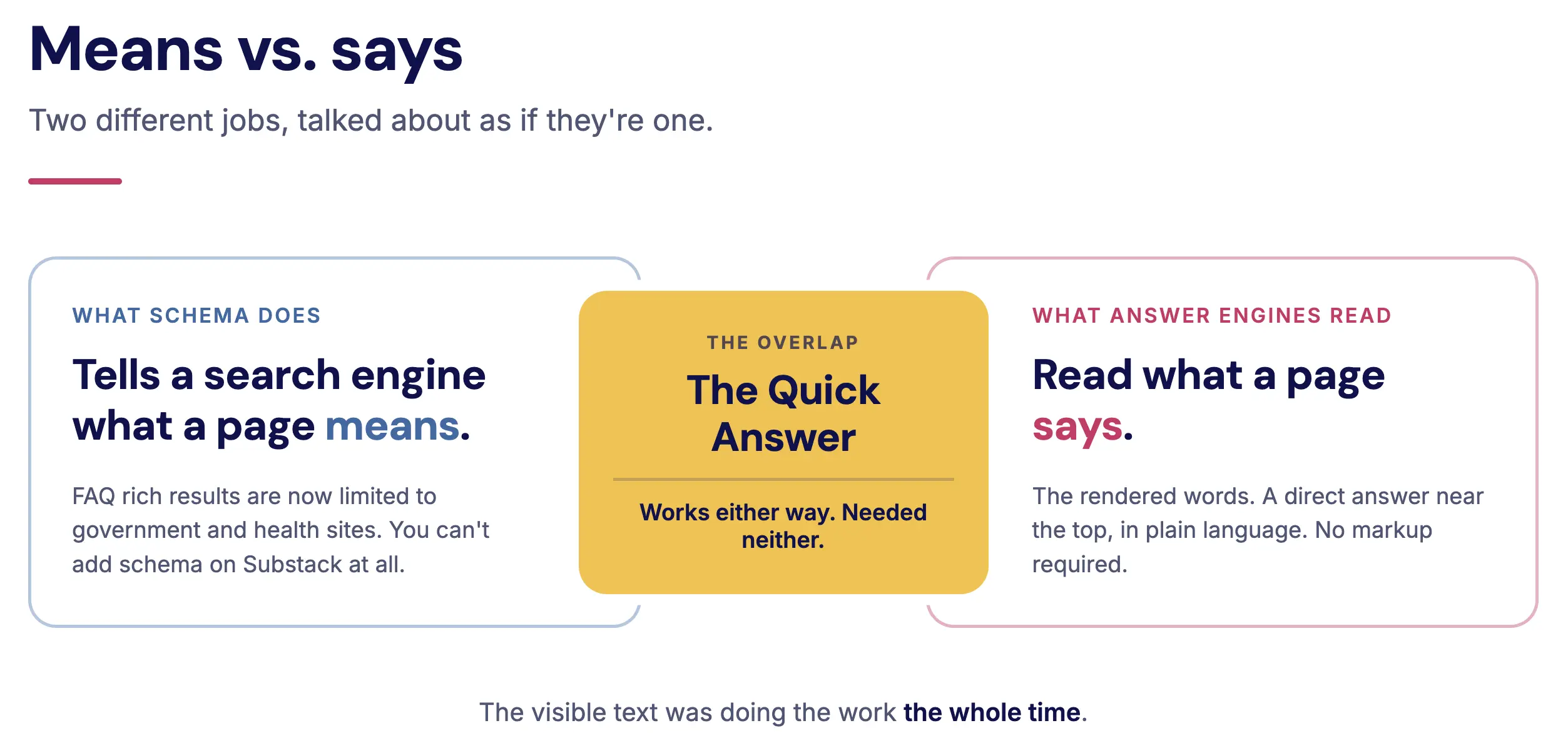
Substack doesn't let you add your own schema... on-page and indexing decisions belong to the platform, not to you. Fine, I knew that part. What I didn't know is that FAQ schema barely does anything for anyone now. Google restricted FAQ rich results to well-known government and health sites, and deprecated the How-To result on mobile. So even on my own site, where I control everything and have it implemented properly, I'm not getting that snippet, and neither is anyone else outside those categories.
The Quick Answer never worked because of schema. It works because it's a clear, direct, extractable answer sitting at the top of the page in plain words. Schema tells a search engine what a page means. Answer engines mostly read what a page says.
Which means the Quick Answer does its job everywhere, including on platforms you don't control. What you're losing on Substack is a layer that was doing considerably less than most of us assumed.
I still write FAQs for the blog and sometimes strip them for Substack. The reason is just different than I thought it was.
And that's the thing worth noticing. I'd been following that advice correctly for months. It was the right tactic for a reason (or should I say season?) that had quietly expired, and I only caught it because something in my process made me go check instead of repeat. That's a judgment failure, not a technical one, and it's the kind that's invisible until you build a habit of verifying. *It's also a judgment failure that AI won't catch if you don't tell it to look for it.
Schema tells a search engine what a page means. Answer engines mostly read what it says. The Quick Answer sits in both and never needed the markup.
Pass Three: Is the Promise Honest?
The last pass asks one question about the headline: does it promise what the piece actually delivers? Not whether it's clever, and not whether it'll get clicked. Whether it's true. This is called 'The Headline Doctor.'
It's built on Joanna Wiebe's methodology at Copyhackers, which I've been reading for years and have turned into a critique layer I can run on demand.
Three of her ideas do most of the work. Headlines are found, not invented... the good one is usually already sitting in something a reader said to you, and the job is noticing rather than being clever. Clarity beats cleverness every time, because a headline someone has to decode has already lost them (I've written plenty of headlines I thought were clever that flopped, lol. Nothing like learning the hard way). And there's a real line between a headline that pulls someone in and one that tricks them, which she articulates far better than I do.
A headline can lift your clicks and still be the wrong thing to do.
This pass runs last for a specific reason. The headline has to be honest to the piece that actually ships, and the piece changes during passes one and two. Write it against the original draft, and you're promising something the final version no longer delivers.
We've all clicked through to an article because of the headline, only to read it and wonder where the thing the headline promised is.
What Comes Out
What lands at the end is everything the CMS asks for, and I never want to write:
Titles and subject lines. Five to eight title options labeled by technique, plus three to five subject lines for the email send. This can take a few iterations, but I never mind. Each iteration means I understand that the headline isn't hitting the mark. Sometimes I know the technical reason it's off; other times, it's a gut feeling.
The metadata. Meta description, the excerpt that shows up in previews, primary and secondary keywords, category, and tags. This can also take a couple of passes because if the keyword for the post isn't in the meta description or the title, I may as well be speaking parseltongue, lol (a language from Harry Potter that lets you speak to snakes 😂). If I didn't pay attention to the keyword before my final edit, it can also mean a headline rewrite and changes to parts of the post (note to self: look at this first!).
The visual pieces. Alt text, a prompt for the hero image, and inline image callouts dropped where they actually belong in the piece.
A LinkedIn post. Built from the single strongest idea in the piece, developed properly. Not a summary. Confession: Right now I'm pretty much just pushing content to LinkedIn. I have zero clarity on what I want to do with this platform.
I used to do all of this work once the actual writing was done. It's incredibly tedious.
Then I publish to kimdoyal.com first, because I want the SEO on a property I own, and cross-post to Substack after. And because I always edit a little in the CMS, I bring the published version back through so the next pass is reading what actually shipped, rather than a draft I abandoned. It takes four minutes, and it means the system learns from my real writing. *I think I'm going to create an MCP to streamline this process.
None of this is input, output, done.
It's iterative, which I think is the most commonly misunderstood aspect of working with AI.
An Honest Aside About Time
I should say this plainly, because the productivity framing is going to be somebody's takeaway and it's wrong.
AI is not saving me a ton of time right now. I'm working more. Not because I feel pressure, but because I'm having so much fun that I keep going. I truly feel like everything I've done over the last 18 years has prepared me for this moment (to make the most of this technology).
The three passes don't give me my evening back.
They make what I publish better, and they let me kill the wrong idea on Monday instead of finding out on Friday when nothing has happened. That's a different kind of win, and right now the time invested is worth it.
One Thing You Can Do Before You Write the Next One
You don't need any of my files for this part, and it's the piece of the system I'd hand over first.
Whatever you're doing for AI content creation for blogs or newsletters, decide before you start what job the piece is actually doing. Is it meant to bring someone new in, or to keep someone who's already here? Write it down somewhere you'll see it when the numbers come in.
Then judge it by that.
A build post that brings in subscribers and gets no comments did its job. A reflective piece that gets twenty replies and no new subscribers also did its job. I spent a long time treating the second kind as underperforming, and it wasn't... I was holding it to a standard it was never trying to meet.
That one decision, made before you write instead of after you publish, is most of what the first pass does.
This also gives clarity to your readers and subscribers. I'm assuming a goal with your content is to bring in new subscribers. Subscribers
Three Layers, and Only One Is for Sale
There are three layers here, and it's worth being precise about which is which.
The methodologies are free and public. Karo's framework, Joanna's teaching, the AEO and SEO principles. You don't need me for any of the ideas, and every source is linked above. Go read them; they're better than my summary.
The assembled skill is real work. Three methodologies encoded into one file, with rubrics, grade bands, fix sequences in priority order, a full deliverables block, and a stop condition. That's the afternoon I spent building it and the several afternoons since, finding what was missing. That file lives in SPARK Lab for fifteen dollars a month.
The context isn't for sale and couldn't be. My voice skill, my story bank, my audience profiles. That's eighteen years of knowing exactly who I'm writing for, and it's the only reason the same three frameworks produce something useful for me and something generic for a stranger.
Which is why the first thing the skill does is refuse to score anything until you've defined what your publication promises and who specifically reads it. Twenty minutes, once. That's not setup, that's the actual work. Everything after it is mechanics.
I joke that if software is ugly, I bounce. Seventeen years of using other people's software is exactly what qualified me to start building my own, because I already knew what I wanted and what drove me crazy. The tool didn't give me that. It just finally let me act on it.
Same as the planner, where the pencil was never the hard part.
You already know your people, you know what they actually need, you know which advice in your industry is nonsense. That's the judgment, and you've been building it for years without calling it that.
The rest is just knowing where to point the thing. 😉
Frequently Asked Questions
Do I need to know how to code to build something like this?
No. A skill is a text file with instructions in it. If you can write a clear document explaining how you want something evaluated, you can build one. The hard part isn't the format, it's knowing what should be in it, and that comes from your own experience rather than from any technical ability.
How long did this actually take to build?
The first version took an afternoon. Then several more afternoons over the following months, every time I found something missing... which is how most of my builds go, and why I'd rather show the whole arc than pretend it arrived finished.
What if I'm just starting out and don't have a promise or an audience yet?
Then the scoring will tell you very little, and that's useful information on its own. Write first. The promise is usually already sitting in your published work before you've put words to it, which is exactly what happened to me. Come back to a system like this once you have something to score against.
Does this only work with Claude?
The three frameworks underneath aren't tied to any tool. I built mine as Claude skills because that's what I use, but the scoring rubrics are just criteria, and criteria travel.
Will this make my writing sound like AI?
It shouldn't, and I built in a specific guard against it. Any section that scores full marks on voice is off limits to the optimization pass. Optimization has a talent for sanding writing down into something technically correct and completely dead, and the whole point is protecting the part that's yours.
Your obvious offer is hiding in plain sight.
Free. Tell it what you know and who you help, and it'll show you the offer everyone can see but you.
Kim Doyal is a digital marketing strategist and AI builder with 18 years of online business experience. She is the founder of AI Spark Studios and SPARK Lab, and the creator of The Hub — a custom 33-agent AI operating system that runs her entire business. She has also built kimdoyal.com, StackRewards, and multiple AI tools and agents using vibe coding, a natural language approach to building software without a traditional development background.