TABLE OF CONTENTS
What does an AI archive intelligence pass actually produce?How do you fact-check AI when it's analyzing your own business?What else did I get done with Fable in a week?Can AI actually build a working app from a shell in one week?What prompts can you run right now to find the gaps in your business?Prompt 1: The Business Gap FinderPrompt 2: The Builder's Edge FinderWhere this is actually goingFrequently Asked QuestionsHOME/BLOG/I FOUND THE GAPS IN MY OWN BUSINESS THIS WEEK. HERE ARE TWO PROMPTS SO YOU CAN FIND YOURS.
AI BuildingI Found the Gaps in My Own Business This Week. Here Are Two Prompts So You Can Find Yours.
This isn't over your head. It's paste, fill in your business, and run. The prompts do the heavy lifting.
July 19, 2026|5 min read

If you're in the AI space or actively using Claude, you're probably aware of all of the drama that existed around the latest model, Fable.
Claude Fable is Anthropic's newest model, and access to it has been a moving target all month. It was briefly pulled entirely over a government export-control issue, came back on July 1st, and then Anthropic kept extending the deadline for free access on paid plans... first to July 7th, then July 12th, now July 19th, on the Claude Max plan I'm on. I haven't been using Fable for heavier building and analysis work simply because I haven't had reliable access to it. With the window open again and extended (for the third time), I wanted to actually make use of it instead of letting another deadline slip by.
So I did something I'd never done before.
I handed Fable my entire content archive... every blog post on kimdoyal.com and every Substack newsletter I've published over the last few years... and asked it to read all of it as a single body of work rather than hundreds of separate posts. Not "summarize this for me." Not "turn this into a social post." I wanted patterns. I wanted to know what I've actually been saying, consistently, across years of writing, versus what I think I've been saying.
Those are not always the same thing, and if you've been creating content for any real stretch of time, you probably already know that feeling. You have a sense of what your message is, what your themes are, what you keep coming back to. But you've never actually read it all at once. You can't. There's too much of it, and you're too close to it. And honestly, the problem was never coming up with the next thing to write about... It's that you've got more ideas than you'll ever execute, and the ones that slipped through the cracks are invisible to you now.
An AI can, though. And what came back was... a lot.
What does an AI archive intelligence pass actually produce?
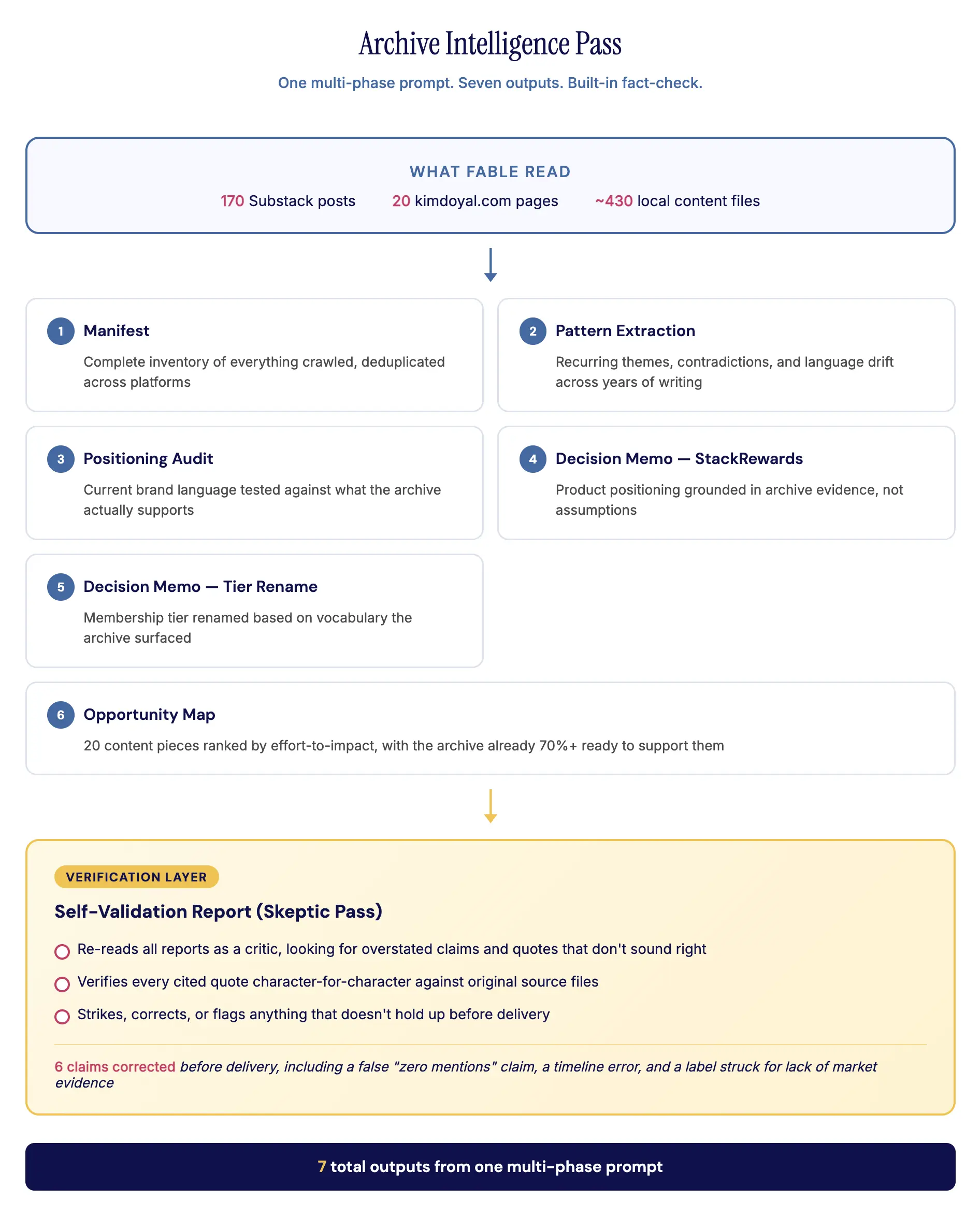
Six separate documents, from a content patterns analysis to a ranked opportunity map, all built from years of my own published writing.
Fable didn't hand me a summary. It gave me a manifest of everything it crawled, a patterns document showing what I keep circling back to (and where I've quietly contradicted myself over time), a full positioning audit testing my current brand language against what the archive actually supports, a memo specifically on one of my products, a memo on a membership tier rename I'd been sitting on for weeks, and an opportunity map ranking twenty content ideas by effort versus impact.
Six documents built from my own words. And they surfaced things I genuinely couldn't have seen myself... not because I'm not paying attention, but because nobody can hold years of their own writing in their head at once and spot the patterns objectively. That kind of distance is exactly what I don't have when I'm the one who wrote every sentence.
Here's what I mean by "things I couldn't have seen."
None of us are lacking in ideation... I know this about myself, and I don't care. It's who I am. I leap first, I fire then aim sometimes, and that's part of how I learn. But seeing it laid out in an actual audit, with evidence from my own writing? That's different (and actually helpful).
The patterns document logged 22 announcements I made in the second half of 2025 alone. Roughly ten of them were dropped cold... never mentioned again. 🤪 And yet, the things I built quietly and shipped before ever naming them publicly (the Hub, StackRewards, SPARK Lab, Her Credit Map) mostly survived. The audit gave that pattern a name: Public Game vs. Quiet Game. The things I announced loudly tended to stall. The things I built quietly tended to ship. That's not a comfortable insight, but it's a useful one (and a bit odd... you'd think it would have been the other way around. But in my defense, most of that is because of the learning process with AI and how quickly things are moving).
It also found fifteen unnamed frameworks hiding across years of posts... things I'd described and used repeatedly but never actually named or packaged. Patterns like building version one to learn and version two to ship (demonstrated across four different products), or the intake structure where AI generates a plan from your context and you approve it before anything gets built (the same mechanic in four of my products, never named). The AEO research in the archive makes the case for why this matters: AI engines love named, specific frameworks they can reference. If the framework exists in your work but has no name, it's invisible to the systems that would cite you.
And maybe the most surprising one: StackRewards has a founder story I'd already written two years before the product existed. In May 2024, I published a complete giveaway plan... sponsor-donated prizes, collaborator mechanics, a launch date, and "I'll send a status update next week." No status update ever came. I also owned three paid giveaway tools at that point and used exactly none of them. The idea lived in my archive for two years before it became a product. The AI found it. I'd forgotten about it.
How do you fact-check AI when it's analyzing your own business?
You build the fact-check into the prompt itself. A self-validation phase that re-reads every finding as a skeptic and verifies every cited quote against the original source, before anything becomes a decision.
This is the part I actually want you to pay attention to, because it's the difference between using AI and blindly trusting it.
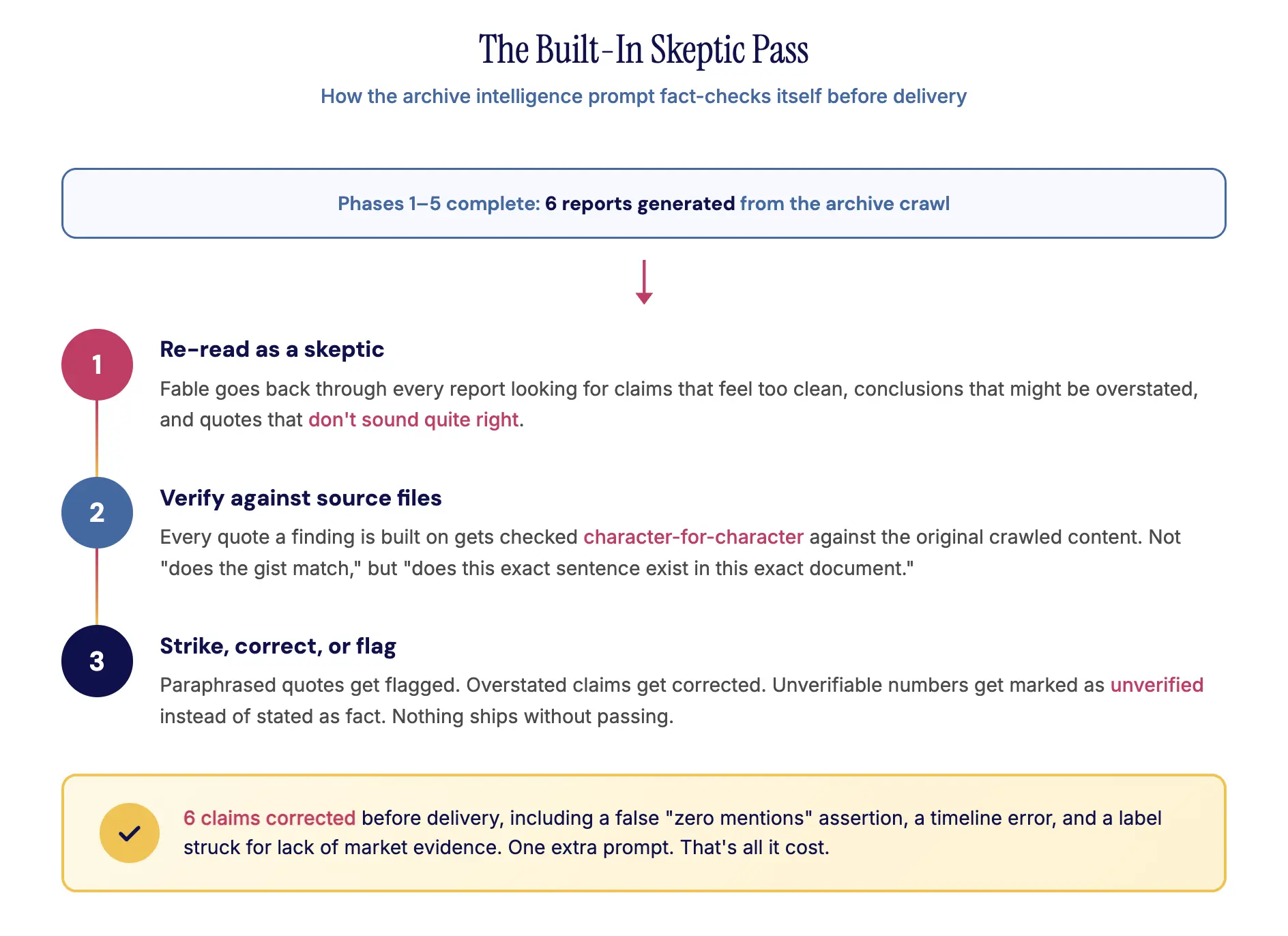
The archive pass was built as a multi-phase prompt, and the final phase was a self-validation report... a built-in skeptic pass. Here's how it worked, step by step:
Step 1: Fable re-reads its own reports as a skeptic. After producing all six documents, it goes back through the positioning audit, the product memo, and the rename memo specifically looking for claims that feel too clean, conclusions that might be overstated, or quotes that don't sound quite right.
Step 2: It goes back to the source files and checks. Every specific quote that a finding is built on gets verified character-for-character against the original crawled content. Not "does the gist match," but "does this exact sentence exist in this exact document, word for word."
Step 3: It strikes or flags anything that doesn't hold up. If a quote was paraphrased instead of verbatim, it gets flagged. If a claim was overstated, it gets corrected. If a number can't be verified in the source material, it's marked as unverified rather than stated as fact.
Think of it like checking someone's citations on a research paper. The analysis might sound convincing, but if the quotes it's built on are paraphrased, misattributed, or just made up (which AI absolutely will do if you don't ask it to check), then any decision you make from those findings is built on sand.
And it found problems.
One claim about a specific phrase never appearing anywhere in my writing turned out to be false the moment it went and checked... the phrase was right there in the archive. A couple of numbers got flagged as unverified rather than quoted as fact. That's the report doing its job. That's exactly why the skeptic pass exists.
The confidence of the output is not the same thing as accuracy, and I say that as someone who loves this technology and uses it every single day. The gap between those two things is where expensive mistakes live. Building the fact-check into the prompt itself, as an automatic phase, means I don't have to remember to do it separately every time. It just happens.
What else did I get done with Fable in a week?
A 33-agent system audit, a security sweep that caught a real vulnerability, agentic business idea research, an app duplication test, and a product that went from shell to functional... alongside the archive pass. And I was out of town for three of those days.
The 33-agent audit. My Pantheon system... the collection of AI agents that handle research, content, growth, and business functions for me... got a full audit. Phases one and two are done, which means every single agent got reviewed for what it's actually doing versus what I originally set it up to do. Some of it had drifted, which is normal. Systems you build and then mostly leave running tend to drift over time, whether they're made of code or just habits. The audit revealed where things had gotten stale and where agents needed updated instructions to match how my business actually works now, rather than how it worked six months ago. Any system you set up six months ago and haven't checked in on since has probably drifted from what you actually need now... whether that's 33 AI agents or three email automations. With my Hub and agents, it's been a constant iterative process (and one I feel like I've finally nailed, but that's another post).
The security catch I wasn't expecting. Somewhere in that process, I ran a security agent against my Operations Hub that I honestly hadn't thought to point there before because I'm the only one using it. I think I'd been in the middle of integrating it into the hub and just hadn't gotten around to doing a full sweep yet. It caught something real. Nothing dramatic, nothing that had actually been exploited, but something in my own setup that needed fixing before it became a real problem instead of a caught one.
I fixed it. And here's the learning moment for me: I have a security agent... I built it. And I still hadn't thought to run it against one of my own primary tools. With each step forward in AI, you learn more about what you didn't know you were missing. Even if your setup is a WordPress site and a handful of plugins, when's the last time you actually checked what's exposed? The agent is now part of the regular sweep rhythm, not an afterthought. Since Fable access got extended to the 19th, I'm planning to have it do complete scans of each of my projects... code, infrastructure, security, copy, onboarding flows, the works. If it's going to catch things I'm too close to notice, I want it looking at everything.
The agentic business idea research. This one I have to credit to my friend Jason, because I wouldn't have thought to do it if he hadn't mentioned he ran something similar and found a business adjacency he hadn't seen before. He shared his prompt with me, and I adapted it for my own situation... grounded in my actual assets, my skills, my existing audience, and the products I've already built, instead of generic "here are ten side hustle ideas" nonsense.
I asked Fable to brainstorm agentic business concepts... businesses that could run mostly on their own with minimal weekly maintenance... and one of the ideas that surfaced complements Vida de Playa, my Costa Rica condo project, in a way I hadn't connected before. Early days, but it's the kind of connection that only shows up when you feed a system your entire business context and ask it to look for adjacencies instead of inventing something from scratch. That's a very different use of AI than "write me a list of business ideas." It's "you know my whole situation, what am I not seeing?" Creating assets that don't require you to build and maintain another brand is absolutely possible with AI. Some of the ideas it surfaced wouldn't have been appealing pre-AI simply because of the amount of tedious work involved.
The app duplication test. I also did something purely experimental: I found an app I liked and asked Fable to build a duplicate of it, just to see if it could. It knocked it out of the park. I went a little sideways with images and graphics (because I tend to) and ended up pausing that particular project, but the core build was solid. The point wasn't to ship a clone... it was to understand what the model is actually capable of when you hand it a real reference point instead of a vague description.
Can AI actually build a working app from a shell in one week?
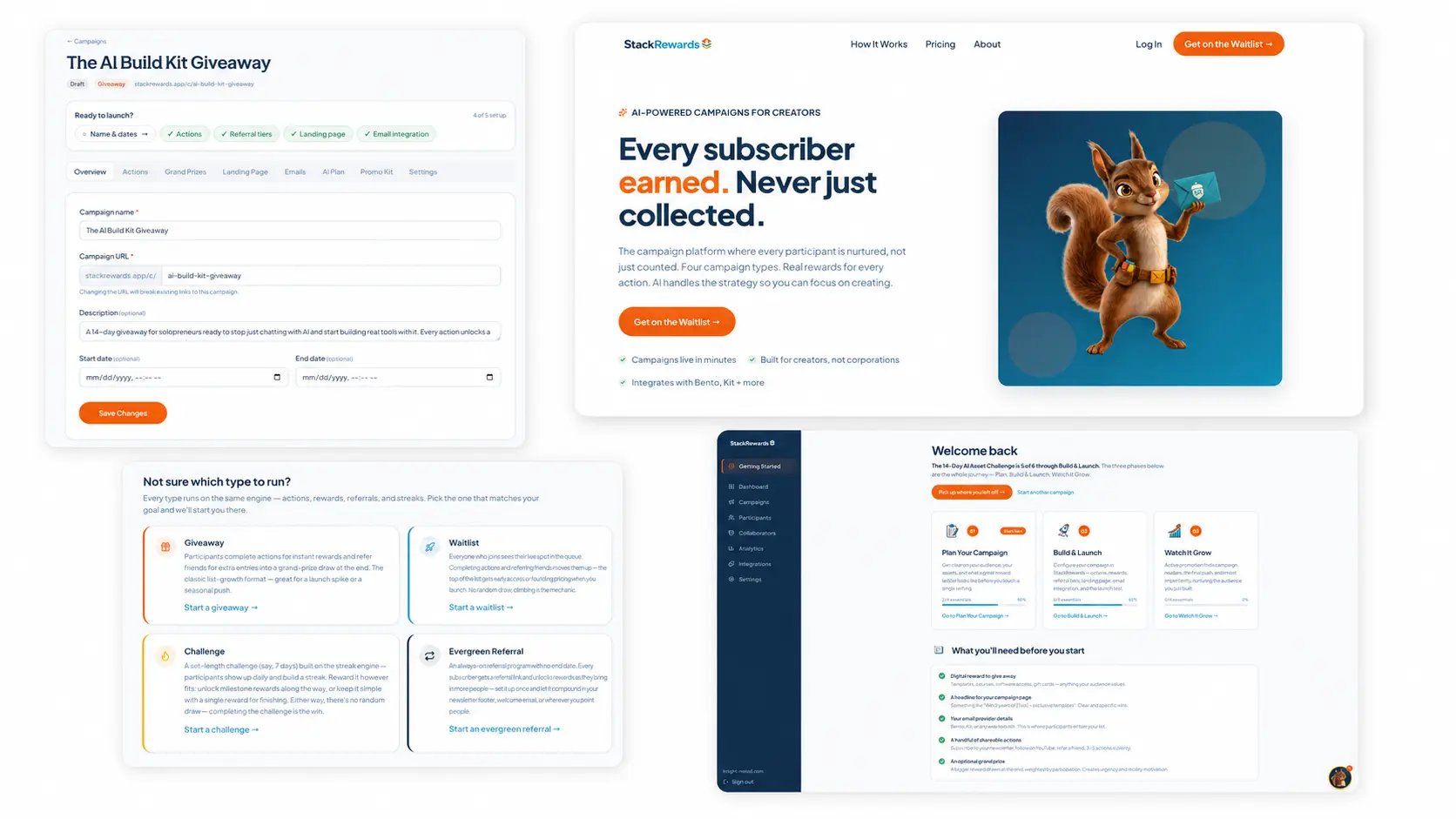
Yes. And here's something I haven't seen another product do: the waitlist for StackRewards is running as a StackRewards campaign. You experience the product by joining the waitlist. Every action you take along the way- sharing, referring friends, following along- earns real rewards. The waitlist is the demo.
But I want to be honest about what "built it out" actually means here, because I don't want to make it sound like I had an idea on Monday and a finished app by Friday.
That's not what happened.
StackRewards is on its third iteration. I had the original idea months ago, and it started as an extension of my brand. Then I decided to make it a standalone product... my name is on it, but it has its own brand identity, its own colors, its own mascot (a squirrel named Stash, who is unreasonably cute). I started from scratch.
The pre-work took real time and real effort. I mapped out a complete PRD and tech spec file. I used ChatGPT to create all the logo work and brand imagery. I used Claude Design for the design system and style direction. All of that groundwork was done before Fable ever touched the project.
What I had when I started this week was the shell... the homepage, the campaigns page, the dashboard, all the main views. What I didn't have was the wiring. The AI components that generate entire campaigns for you weren't connected. The onboarding flow wasn't built. The campaign creation process, the part that actually makes it a usable product instead of a nice-looking container, wasn't functional.
That's what Fable did, and that's the part that was genuinely impressive. All of that wiring, connected and functional, in the same week I was running archive intelligence passes, agent audits, and security sweeps. The speed of the wiring is what's new. The thinking, the planning, the design decisions... those were months of work that made the fast build possible.
Here's what makes StackRewards different from other giveaway tools, and this comes from years of being a user of this kind of software, not just a builder of it.
Four campaign types, not just giveaways. StackRewards handles giveaways, waitlists, challenges, and evergreen referral campaigns. Some of those might evolve, and honestly, a couple might get scratched entirely as I learn what people actually use... this is version one, built from what I would want as a user. But the flexibility matters, because not every audience growth play is a giveaway.
You get rewarded for every action, not just a lottery ticket. Most giveaway tools work on a points-into-a-lottery system... You do stuff, you get entries, and then someone random wins. StackRewards lets you reward participants for every action they take along the way. The experience of participating should have value on its own, not just be a gamble for a prize at the end.
AI builds the entire campaign for you. This is the part I'm most proud of because it solves a problem I've run into over and over for 18 years in online business. You know how it goes: you decide to run a giveaway, launch a lead magnet, or set up a waitlist, and you create the thing itself... and then you realize you need all this other stuff. The landing page copy, the thank you page copy, the email follow-up sequence, the social posts to promote it, and the rules. There are so many moving pieces that the actual creation of the campaign becomes a fraction of the work.
StackRewards uses AI to deliver a completed campaign to you. All of it... the copy, the sequences, the structure. Everything is editable, so you're not locked into what the AI generates. But instead of staring at a blank page for every single element, you're editing something that already exists. That's a fundamentally different starting point, and from my experience, it's the difference between a campaign that actually launches and one that sits in draft mode for three weeks because you couldn't face writing all the supporting copy.
I'm going to be my own test case in August... running a full giveaway campaign through StackRewards and documenting the whole thing. Four campaign types are already built and functional. This is version one, and it works.
I also built an MCP for it, which means StackRewards can connect directly to AI tools like Claude. 🤯 A few months ago, I wouldn't have even thought to do that. But the more you build, the more you start to see where the connection points are... and building an MCP felt like an obvious next step rather than an intimidating one. I'll be testing it myself before the app goes live for anyone else to use.
What prompts can you run right now to find the gaps in your business?
I originally planned to publish this while Fable access was still open, but it didn't happen... the post took longer than the deadline allowed. But these prompts don't need Fable. They run well in Claude Opus, ChatGPT, or whatever AI tool you're already using. The thinking behind them is what matters, not which model you paste them into.
Prompt 1: The Business Gap Finder
This one is for anyone who has a business that's been running for a while and wants to know what they're missing. Paste this into Claude (select the Fable model) and fill in the brackets:
You are a senior business strategist conducting a gap analysis. Here's my business context:
What I sell: [describe your products/services and price points] Who I serve: [describe your audience, be specific about who they are and what they struggle with] Where I show up: [list your platforms, website, newsletter, social, YouTube, etc.] What's working: [what's generating revenue or audience growth right now] What I've built so far: [tools, systems, content libraries, email lists, anything you've created]
Analyze this business for gaps across five areas: (1) revenue gaps, meaning offers I should have but don't, or pricing that doesn't match the value, (2) audience gaps, meaning people I should be reaching but am not, and where they actually hang out, (3) content gaps, meaning topics my audience needs that I'm not covering, (4) systems gaps, meaning manual work I'm still doing that could be automated or delegated to AI, (5) connection gaps, meaning relationships, collaborations, or partnerships that would accelerate growth.
For each gap, tell me what you see, why it matters, and one specific action I could take this week to start closing it. Be direct. Don't hedge. If something looks like a problem, say so.
Prompt 2: The Builder's Edge Finder
This one is specifically for people who are building things with AI (or want to start) and want to know where their specific skills and experience give them an advantage nobody else has:
You are an AI product strategist. I want to find the intersection of what I know, what I've built, and what the market needs but doesn't have yet.
My background: [your industry experience, years, specific skills] What I've built so far: [apps, tools, content, products, systems... anything] My audience: [who follows you, reads your content, buys your stuff] Tools I use: [list your AI tools, platforms, tech stack... even if it's just ChatGPT and Canva, include it] What frustrates me about existing tools in my space: [the software you use that doesn't do what you wish it did]
Based on all of this, identify three product or tool ideas I could build with AI that: (a) solve a problem I personally experience, (b) serve an audience I already have access to, (c) don't require me to learn traditional programming, and (d) could generate revenue within 90 days of building.
For each idea, tell me what it is, who would pay for it and roughly what they'd pay, what makes my specific background the unfair advantage, and what the simplest possible first version looks like. Don't give me generic "AI writing tool" ideas. Ground everything in MY specific situation.
Both of these prompts work because they force the AI to reason from your actual context instead of generating generic advice. The more specific you are in filling in those brackets, the more useful the output will be. And these work even if you've never touched Claude before, even if your business is brand new, even if you're not sure you have enough context to give. Start with what you know. The AI will ask for more if it needs it.
And if you want to go one step further, add this to the end of either prompt:
Now re-read your analysis as a skeptic. Flag any claim that feels overstated, any assumption you made without evidence, and any recommendation where you're guessing instead of reasoning from the information I gave you. Correct or strike anything that doesn't hold up.
That's the self-validation step. Use it on everything.
Where this is actually going
Her Credit Map is evolving too. I spent a couple of days working on the original build, parked it, and then had one of those clarity moments where the whole approach shifted. Instead of a member portal with logins and all the complexity that comes with it, I'm testing a leaner model... a faceless YouTube channel as the traffic engine, a standalone newsletter, an education site, and a few focused digital products. Let YouTube drive audience growth, let the content do the work, and monetize through sponsorships and products rather than a gated membership. Sometimes sitting on something long enough is what lets the right version show up.
And the traffic series I started a couple weeks ago... the pre-post and the deep dive into research and recon... is still coming. The next layer, Build & Test, needs me to actually build and test something first. I'd rather show you real output than write around a gap, so that one's landing once I've got something worth showing you.
(That's the trade I keep making, over and over, in this whole builder era I'm in. Move fast, but don't skip the part where you check your own work. Ship the thing, but tell people honestly where it still needs work.)
And if you want to see what StackRewards looks like from the inside, the waitlist is the demo. Join it, and you'll experience exactly what I've been building.
Frequently Asked Questions
What is Claude Fable?
Claude Fable is Anthropic's most advanced AI model. I used it for the heavier building and analysis work described in this post. Fable's free access window on paid plans ended July 19th, 2026, and it's now available through usage-based credit pricing. The prompts in this post work in Claude Opus, ChatGPT, or any current AI tool.
Do I need Claude Fable specifically to run these prompts?
No. The prompts work in any AI tool... Claude Opus, ChatGPT, Perplexity, whatever you're already using. Fable handles longer and more complex tasks particularly well, but you'll get useful output from any current model. Don't let the tool choice be the reason you don't try them.
How long does an archive intelligence pass take?
The crawling and analysis took a few hours of processing time, but the actual hands-on work was writing the prompt and reviewing the output. The self-validation phase ran as part of the same prompt, not as a separate step.
What if I don't have years of content to analyze?
Even six months of consistent writing gives you enough for patterns to emerge. The value isn't about volume... it's about having AI read your work as one body instead of the way you experience it, which is one post at a time over months.
Can I use these prompts for a business that's just getting started?
The Business Gap Finder works at any stage. If you're just starting, the gaps it surfaces will be different... more about "what should you build first" than "what are you missing." The Builder's Edge Finder is specifically designed for people who have existing skills and experience to build from, even if they haven't built anything with AI yet.
Is StackRewards available to use right now?
Not yet. The waitlist is open, and joining it is actually a StackRewards campaign itself, so you'll experience how the product works by being on the waitlist. The full product launches later this year.
Your obvious offer is hiding in plain sight.
Free. Tell it what you know and who you help, and it'll show you the offer everyone can see but you.
Find Your Obvious Offer →
Kim Doyal
Kim Doyal is a digital marketing strategist and AI builder with 18 years of online business experience. She is the founder of AI Spark Studios and SPARK Lab, and the creator of The Hub — a custom 33-agent AI operating system that runs her entire business. She has also built kimdoyal.com, StackRewards, and multiple AI tools and agents using vibe coding, a natural language approach to building software without a traditional development background.
Keep Reading

AI Building
How to Grow Your Substack Without Living on It... Built for Freedom — Part 01
I read the article on my phone in bed before I even got up, because I was genuinely excited about it. That kind of excitement means something right now. Here's what I started building, and why the how matters as much as the what.
April 26, 2026READ MORE

AI Building
What You Built Works... You Just Don't Want to Open It
I launched SPARK Lab minimum viable and then didn't want to log into it. It wasn't broken, it was flat, and flat is the harder problem because it doesn't tell you where to go. Here's the filter I ran on my own product, and the four prompts so you can run it on yours.
July 27, 2026READ MORE
Vibe Coding
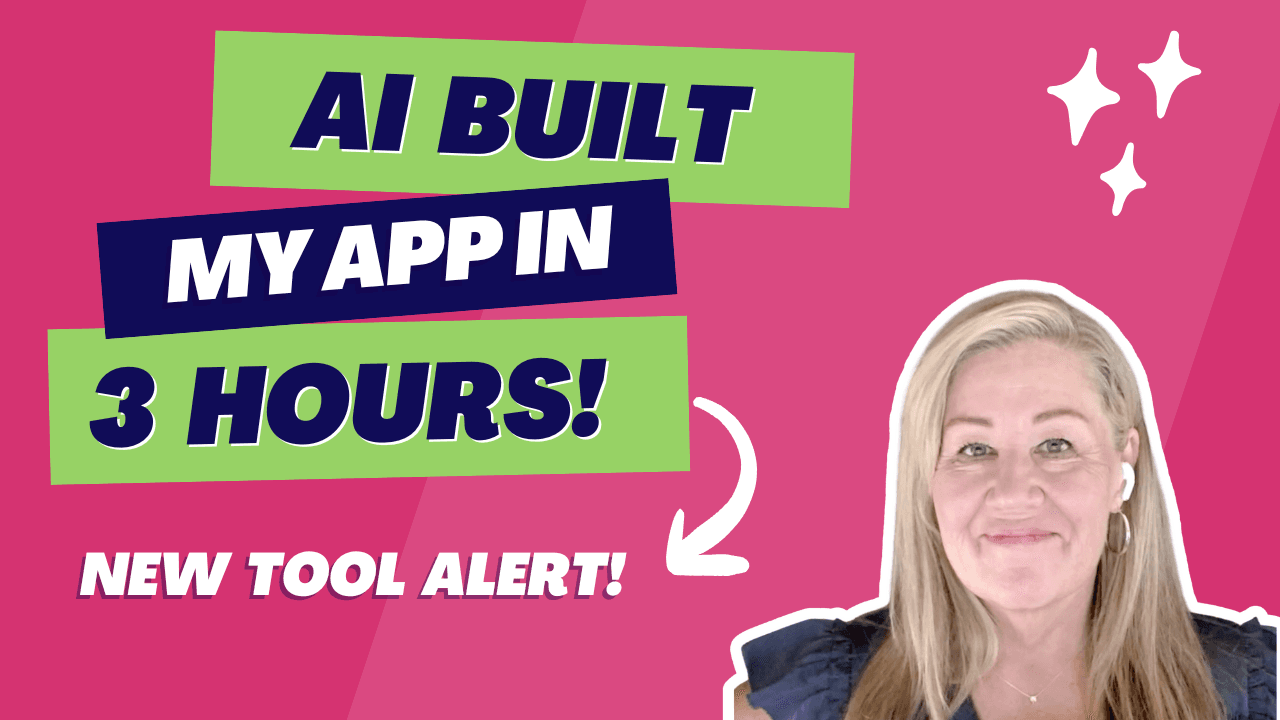
How I Built a Custom AI App in 3 Hours (A Vibe Coding Case Study)
If you've been following my journey into "vibe coding," you know I'm always on the lookout for tools that make bringing ideas to life faster and more intuitive. While I've had success with other platforms, a new tool recently caught my eye and has completely changed the game for me.
August 28, 2025READ MORE