HOME/BLOG/MCPS ARE QUIETLY BECOMING THE MOST INTERESTING DIGITAL PRODUCT I'VE SEEN IN 18 YEARS
AI Building
MCPs Are Quietly Becoming the Most Interesting Digital Product I've Seen in 18 Years
What they are, what a great one looks like, and why you don't need to code to build one
July 11, 2026|5 min read
QUICK ANSWER
An MCP (Model Context Protocol) is a bridge that lets AI tools like Claude connect to external platforms, services, and expert workflows. Daria's Amplifiers MCP is the best example I've found of what this looks like when someone builds a great one... 276 tools in one Claude integration, covering 114 expert prompts, 162 platform research tools across 25 platforms, and a growing library of image generation and utility tools. After months of barely scratching the surface, I explored the full catalog and came away convinced that MCPs are becoming a new category of digital product.
I was paying for an MCP before I knew what was in it.
Not because I didn't care, but because I wanted to support a Substack publication that I read and learn from weekly. As soon as the paid tier launched, I was all in (I knew there were paid perks for subscribers; it just wasn't my 'why' for subscribing).
I subscribe to Daria's "AI Blew My Mind" newsletter because the content is genuinely great. She's one of the few people writing about AI who doesn't make me feel like I'm being sold a lifestyle... she just shares what she's building, what she's learned, and how it works. My kind of person.
As a paying subscriber, I got access to her Amplifiers MCP. I'd used a few things from it... the carousel generator, the Voice DNA skill builder (more on both of those in a minute). But I hadn't really sat down and explored the full catalog.
Then I heard she'd added even more tools, including Pinterest research, and I thought... okay, it's time. Let me actually go see what's here.
I pulled up the catalog and took a screenshot.
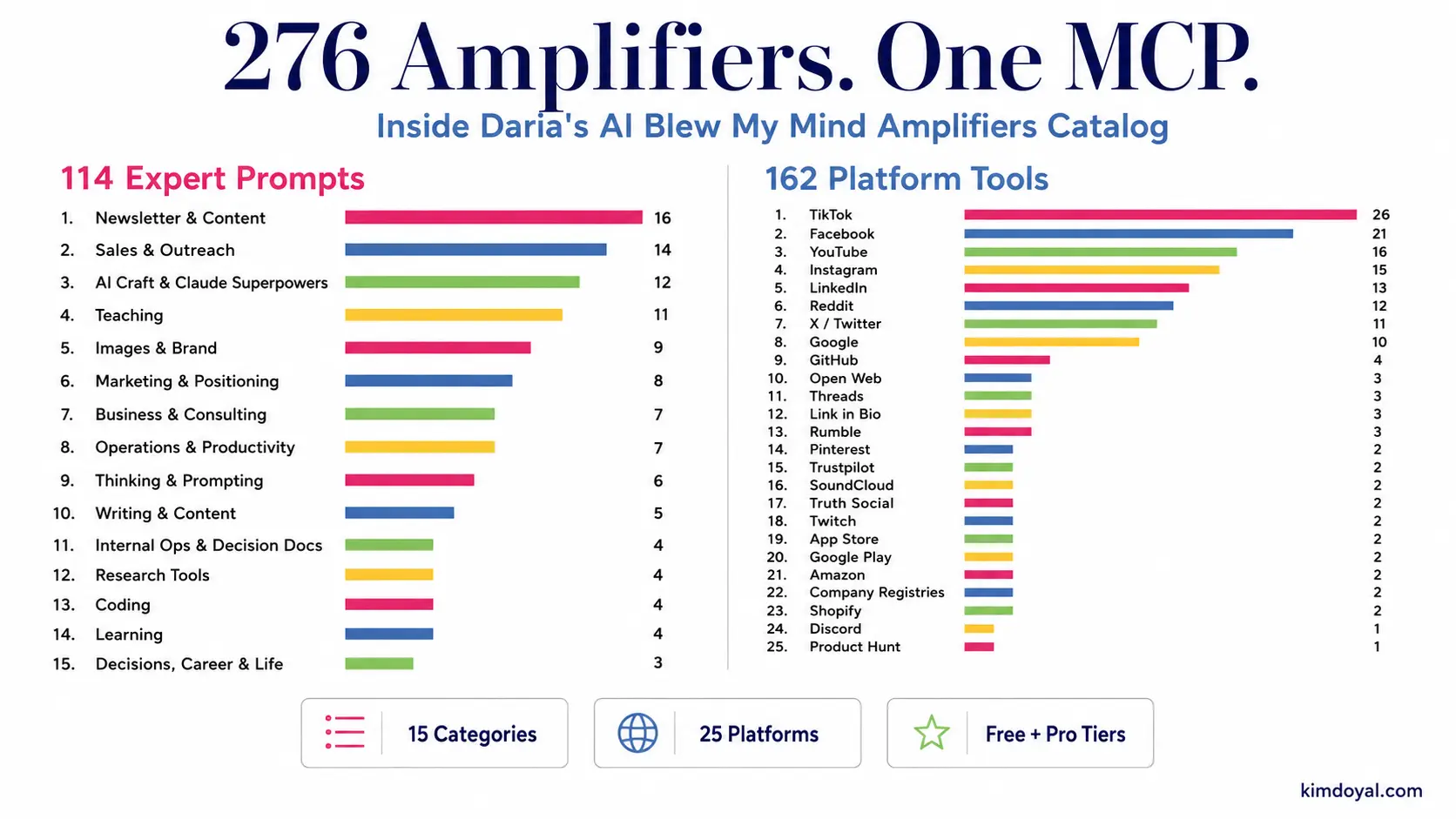
276 amplifiers. 25 platforms. 114 expert prompts. 162 research tools.
I was floored.
276 amplifiers. One MCP. Inside Daria's AI Blew My Mind Amplifiers catalog.
I'd been sitting on this for months. Paying for it. Using maybe 5% of what was available. And the thing is, I know I'm not the only one who does this. You sign up for something, use the piece that caught your eye, and never go back to see what else is in the drawer.
So this post is what happened when I finally opened the whole drawer.
What is an MCP and why should you care?
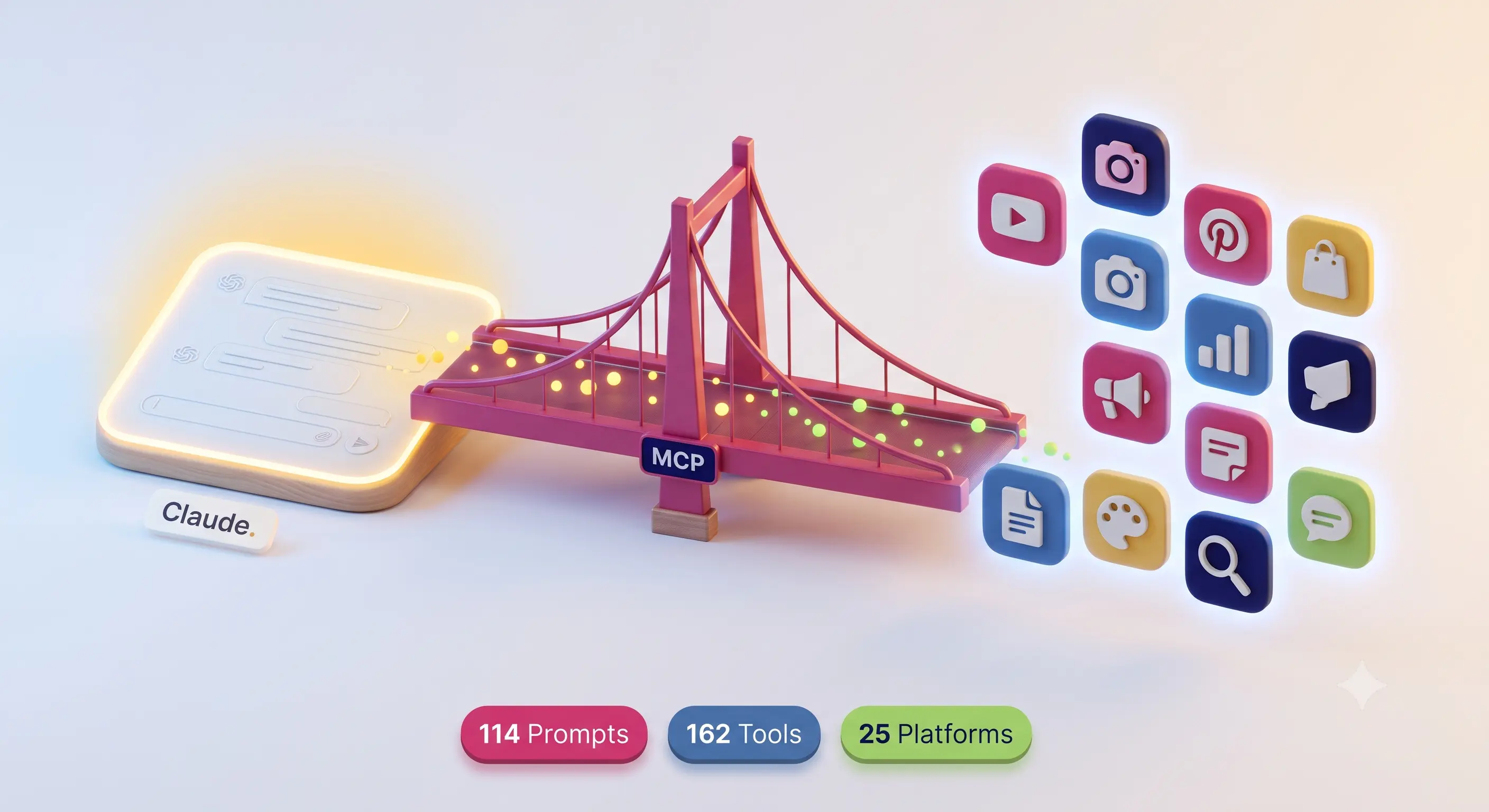
MCP stands for Model Context Protocol. In plain language, it's a bridge that lets AI tools like Claude connect to external platforms and services without you having to leave the conversation.
On one side, you've got Claude (or another AI tool). On the other side, you've got everything else... Google Drive, Pinterest, an image generator, a database of half a billion business records, you name it. The MCP is the bridge that lets Claude walk over and use those things while you stay right where you are.
Before MCPs existed, if you wanted to research what was performing on Pinterest, you'd have to go to Pinterest, search around, take screenshots of what you found, paste them into Claude, and ask for analysis. With an MCP, you just say "search Pinterest for pins about AI tools for solopreneurs" and the data comes back.
The bridge handles it.
That's the general concept. But here's where Daria did something really smart.
She didn't just build a bridge to one tool. She built bridges to 25 platforms AND loaded 114 expert prompts onto them. So when you connect her Amplifiers MCP in Claude, you're not just getting a connector... you're getting Daria's entire library of workflows, research tools, and creative generators, all accessible from inside the tool you're already using.
You don't go somewhere else. You don't copy and paste prompts from a Google Doc. You don't need to figure out the right way to ask. It's just... there.
An MCP is a bridge. Claude (or ChatGPT) on one side, everything else on the other.
What's included in the Amplifiers MCP?
276 amplifiers organized into three categories: 114 expert prompts across 15 business and creative categories, 162 platform research tools covering 25 social and search platforms, and a set of image generation and utility tools. Here's how I break it down.
Expert prompts (114 across 15 categories). These aren't "write me a blog post" prompts. They're guided workflows. A Voice DNA skill builder that extracts your writing voice into a reusable format. A StoryBrand message framework. Kahneman-style decision debiasers. A negotiation coach built on Chris Voss's methodology. Audience profile builders, case study generators, pricing strategy frameworks, carousel creators, infographic generators... the kind of thing you'd normally pay a consultant for.
The categories span Business (23 prompts, the largest), Marketing (16), Teaching (16), Operations (11), Thinking (9), Prompting (8), Image Generation (8), Content, Writing, Coding, Sales, Learning, Life Design, and Career. A mix of free and Pro access.
Platform research tools (162 across 25 platforms).This is the competitive intelligence side. TikTok (26 tools, the biggest single platform... including TikTok Shop research). Facebook/Meta (21, including the full Ad Library). YouTube (16). Instagram (15). Plus GitHub, LinkedIn, Reddit, Spotify, Pinterest, Threads, Google, and more. The full catalog covers 25 platforms... I'm detailing 23 here. You can do the math on the other two.
These tools let you pull real data: profiles, posts, comments, transcripts, ad libraries, trending content, audience demographics, follower lists, even product reviews. All from inside Claude.
Creation and utility tools. Image generation prompts (infographics, carousels, YouTube thumbnails, podcast cover art, event flyers), a QR code generator, and a background remover. The image generation tools are particularly interesting because the MCP bridges out to external generators like ChatGPT or NanoBanana and pulls the images back into your conversation. You never leave Claude.
Which Amplifiers MCP tools have I actually used?
Four so far: the Voice DNA skill builder (start here), the carousel generator, my Sketchnote skill that Daria added to the catalog, and the Pinterest research tools I ran live for this post.
I have plenty more I'm going to run, but there are only so many hours in the day, lol (gives me a good reason to do a follow-up post down the road, right?).
Voice DNA skill builder... three hours on a Friday night
If you try one thing from this catalog, make it this. I loaded Daria's Voice DNA questions into Claude and spent three hours on a Friday night rebuilding my entire voice skill from the ground up. It completely shifted how every piece of content sounds.
I wrote a whole article about the experience(yes, three hours on a Friday night... I'm a blast at parties 😂), but the short version: the Voice DNA builder walked me through a structured extraction process that pulled out things about my writing voice I'd never articulated. The emotional cadence my content follows, the specific ways I build trust, and the patterns that make my writing sound like me rather than AI-generated.
And here's why I'd recommend starting here: once your voice is dialed in, every other tool works better. The carousel generator, the blog post prompts, the LinkedIn posts... they all pull from that voice foundation. Get this right first, and the rest of the catalog opens up.
The carousel generator... knocked it out of the park
The carousel generator is what originally made me pay attention to Amplifiers. It comes with default styles, and my first attempts didn't land because I tried to wing it from my head instead of using one of the templates. When I tightened up the brief and provided visual samples of my brand style, the quality jumped dramatically.
But the thing that really blew my mind? I'd just finished working through a full article in Claude. Then, without switching tools, I told the MCP to generate a carousel from that same content. The MCP bridged out to an image generator, pulled the images back, and delivered finished carousel slides.
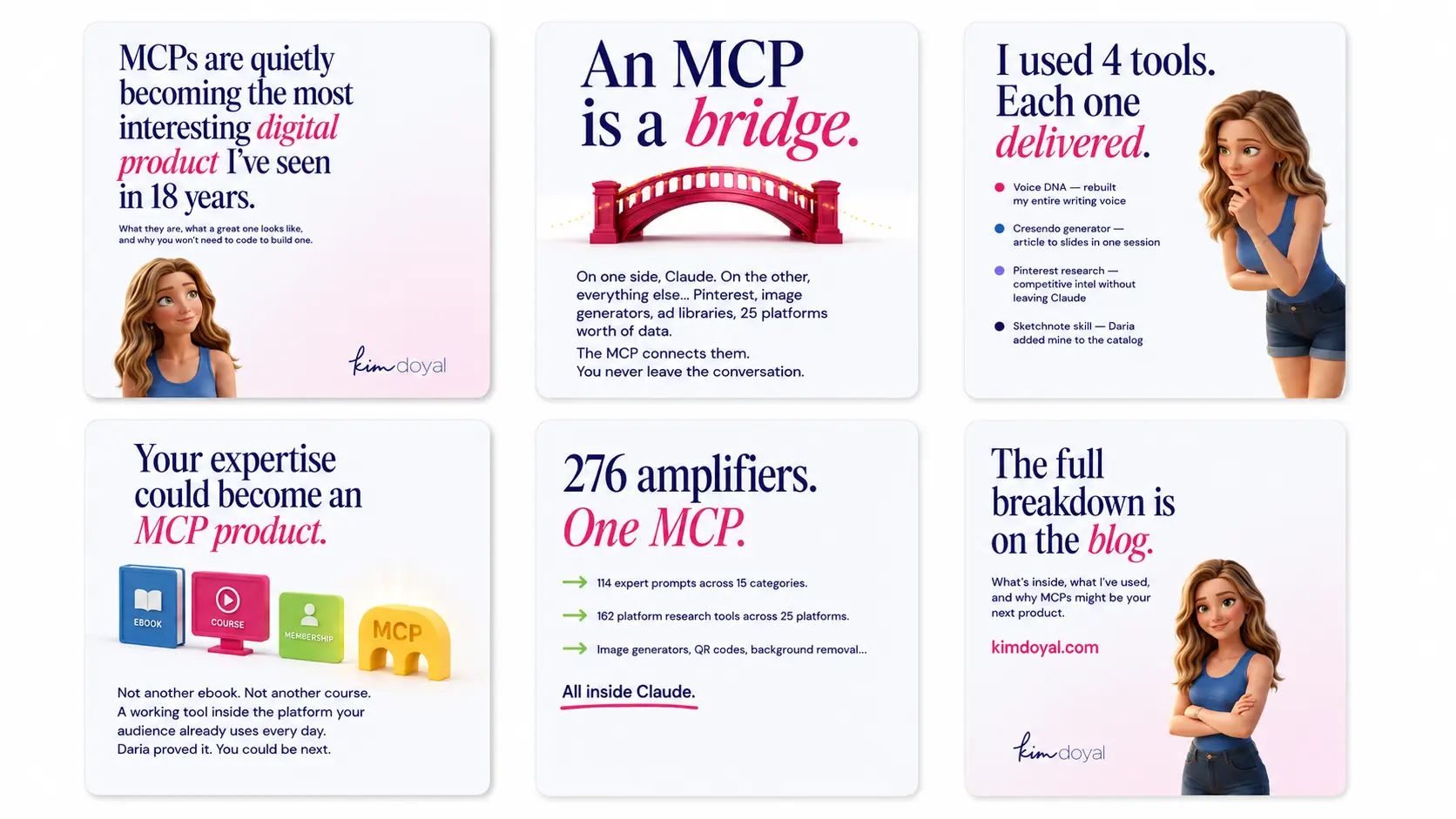
Article to carousel in one session (I had to make a few tweaks, but it was one simple prompt to generate the fixes). The image below is a carousel for this post. 😉
The full carousel... from what an MCP is to why your expertise could become one.
I don't think of Claude as an image generation tool. That's exactly the point. The MCP handles the bridge. You don't need to think about which tool generates the image. You just need to know what you want.
My Sketchnote skill... she added one of mine
I built a Sketchnote generation skill for my own use. Daria saw it, liked it, and added it to the Amplifiers catalog... with credit and a link back to me.
A subscriber's work became part of the product. That's not just a nice gesture; that's a fundamentally different product model than a course or an ebook. You can check out the Sketchnotes post here. I've included a Claude skill and custom Gem for Gemini if you want to try it out.
Pinterest research... live demo
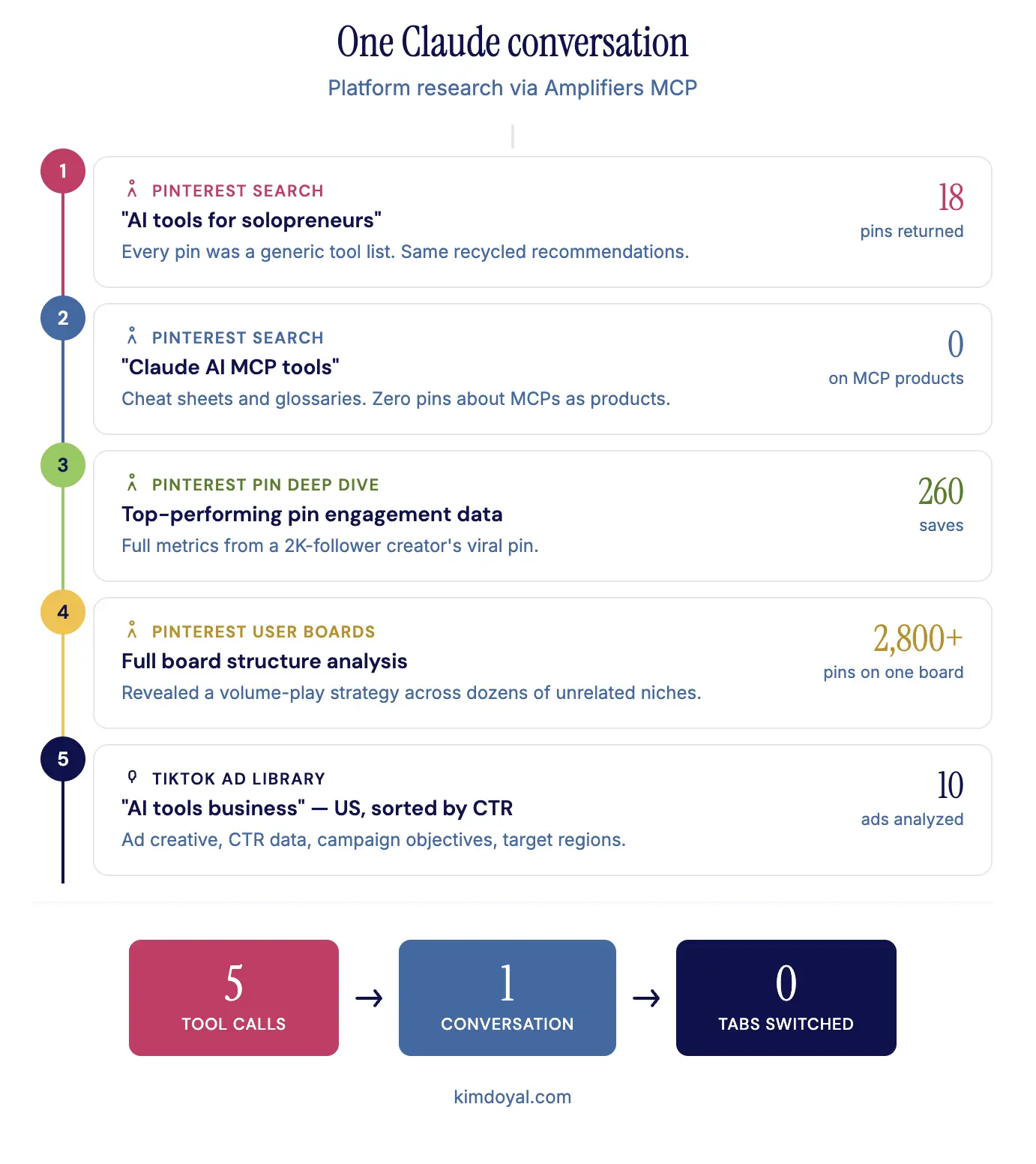
For this post, I used Pinterest's research tools to see what's performing in my space. I searched "AI tools for solopreneurs" and got back 18 pins, almost all from the last few weeks. Every single one was a generic list of tools... "12 AI tools every solopreneur needs." Surface-level content recycling the same recommendations.
Then I searched "Claude AI MCP tools" and found people pinning cheat sheets and glossaries, but not a single pin about MCPs as a product or Amplifiers specifically.
I pulled one creator's full board structure and could see his entire content strategy... 2,800+ pins on one board, covering everything from ADHD meals to AliExpress products. He's playing the Pinterest volume game across dozens of niches. That's the kind of competitive intelligence you can't get from just scrolling someone's profile.
Five tool calls. One conversation. Zero tabs switched. That's platform research from inside Claude.
Five tool calls, one conversation, no tab switching. That's what "platform research from inside Claude" actually looks like.
Could an MCP be your next digital product?
Yes, and Daria's Amplifiers is proof. She packaged 276 expert workflows and research tools into a premium Substack layer that works inside the tool her audience already uses. No separate platform, no extra login, no new tab.
Digital products don't just have to be ebooks, courses, or full-on SaaS apps. Daria spotted something: a huge chunk of her audience already lives inside Claude. So instead of building a separate platform and asking people to go there, she built her expertise into the tool they're already using.
The product becomes more valuable over time as she adds Amplifiers... without subscribers needing to do anything. They just have more.
I've been thinking about this from the other side too. I built 12 AI-powered tools inside SPARK Lab, and watching Daria's approach is making me rethink how expertise gets packaged and delivered. The model is shifting, and I think we're just at the beginning.
If you've been thinking about what your premium Substack tier could look like, or what a digital product could be beyond another PDF... this is worth sitting with for a minute.
Here's a prompt you can take into Claude right now:
I want to explore whether my expertise could be developed into an MCP product. Here's what I do: [describe your work]. Here's who I serve: [describe your audience]. Help me identify which of my skills, workflows, frameworks, or processes could be packaged as an Amplifiers-style MCP that my audience could use directly inside Claude. Think about: what do people keep asking me for? What do I do repeatedly that follows a pattern? What would my audience pay to have available on demand in their AI tool?
You might surprise yourself with what comes back. 😉
Where should you start with the Amplifiers MCP?
The Voice DNA skill builder.
It extracts your writing voice into a reusable format, and once that foundation is set, every other tool in the catalog works better.
As I said, I was paying for Amplifiers before I knew what was in it. That gap between subscribing and actually exploring what you've subscribed to is the same gap a lot of us have with AI itself. We're paying for access to incredible tools and barely scratching the surface of what's there.
This post was me going beyond the surface. And I'm just getting started... I'm planning to go deeper into the platform research tools next, particularly TikTok, now that I'm setting up a fresh account there. If you want to see what that intel looks like, that's coming.
If you want to explore Amplifiers yourself, start with the Voice DNA skill builder. Everything else flows from there.
Questions you might have
Frequently Asked Questions
Is the Amplifiers MCP free?
No. It's part of Daria's paid Substack tier. There's a free tier with limited access. The full Amplifiers catalog is included with an AI Blew My Mind Premium subscription at $12/month or $100/year (at the time of this writing). Included in her paid tier is her AI Blew My Mind Lab. There's also a Founding Partner tier at $500/year that includes everything in Premium plus three personal strategy sessions with Daria.
Do I need to know how to code to use Amplifiers?
Not at all. The prompts and tools work through conversation... you type what you need in Claude, and the MCP handles the rest. If you can describe what you want, you can use it.
What's the difference between Amplifiers prompts and regular Claude prompts?
Regular prompts are whatever you type into Claude on your own. Amplifiers prompts are structured, expert-built workflows that guide you through a specific process... like extracting your voice DNA, building a StoryBrand message, or running a competitive analysis. Think of it as the difference between asking a friend for advice and hiring a consultant with a proven framework.
Can I use Amplifiers with AI tools other than Claude?
Yes. Amplifiers works with both Claude and ChatGPT. Some individual workflows are Claude-specific (anything that needs local file access, like the YouTube Video Watcher, requires Cowork or Claude Code), but the platform as a whole is built for both. Daria includes compatibility notes for each workflow so you know what works where.
How often does Daria add new amplifiers?
Regularly, and she builds every one herself. She watches what generates buzz in her subscriber chat and Substack Notes, builds a new amplifier around it, and pushes it into the shared library everyone connects to. As she puts it, everything new she makes goes straight into the catalog. So subscribers don't need to do anything... the library just keeps growing.
Your obvious offer is hiding in plain sight.
Free. Tell it what you know and who you help, and it'll show you the offer everyone can see but you.
Kim Doyal is a digital marketing strategist and AI builder with 18 years of online business experience. She is the founder of AI Spark Studios and SPARK Lab, and the creator of The Hub — a custom 33-agent AI operating system that runs her entire business. She has also built kimdoyal.com, StackRewards, and multiple AI tools and agents using vibe coding, a natural language approach to building software without a traditional development background.