HOME/BLOG/YOU HAVE MORE DIGITAL PRODUCTS TO SELL THAN YOU THINK
Business Growth
You Have More Digital Products to Sell Than You Think
How I found 70+ assets hiding in my own business (and the prompts to find your own!)
August 18, 2026|5 min read
QUICK ANSWER
Most online business owners have far more sellable digital products than they realize. The gap isn't in what you've built... it's in how you define "product." By running a four-layer inventory (Sellable Now, Built Not Packaged, Teaching Assets, and Invisible Inventory), you can surface assets you've already created but never counted. The exercise works best with an AI thinking partner that has context about your business, or a second brain where your work already lives.
Since 2019, I've had four major moves. Idaho, Costa Rica (twice), and back to California (and a couple of moves within California during that time). We all know how much moving sucks, lol. That's why the first move to Costa Rica ended up being a major purge.
I got rid of everything that was easily replaceable. I sold or donated all my furniture, gave away my entire kitchen... every dish, every pan, all of it. I didn't actually move everything with me to Idaho, so I still had a storage unit in California. Even after the big purge, I still ended up with a big storage unit of stuff (some of the stuff being my kids' stuff 🙄... now I know how my parents felt storing some of our old stuff, lol).
Over the years, I condensed storage units a couple of times, shuffling boxes and bins down to a smaller and smaller footprint. And now I'm at my dad's place... he's 82, I'm helping him, he's helping me, and he's got an acre and a half, so we put a big shed on the property. There's a chunk of my stuff in there (holiday decor I'm not getting rid of), oodles of scrapbook supplies from my scrapbooking days, some keepsakes, and of course, still some of my daughter's stuff. Naturally, some of my Dad's stuff made it in there too (ask me how much stuff my parents have after 52 years of marriage... I sneak stuff out every time I go to the dumps, lol... but you get the point).
But here's what happens every single time you go through a purge like that.
You open a box you haven't touched in two years, and you pull something out, and you go, "Oh my gosh, I forgot about this." A thing you loved, a thing that still works, and more often than not, a thing you were looking for at some point and would've used if you'd remembered it existed. You didn't lose it... You just buried it under everything else and stopped seeing it.
That's exactly what happened when I accidentally ran an inventory on my digital products and everything else I'd built in my business.
How Did I Find 70+ Assets I Didn't Know I Had?
This was one of those crazy conversations with Claude that started with one idea and ended somewhere pretty amazing. I didn't set out to do an audit; I was exploring a product idea with Claude... something about agent-first software architecture, where AI is a first-class user of the tool, not just something bolted on after the fact. I'll share more about what that looks like, what it means, and why I think this is where things are heading in another post. Somewhere in the middle of that conversation, I stopped and said, "Before we architect anything new... what if you just run this concept on my business first?"
So it did. It went through everything... my Claude skills, my project files, my Google Drive, my deployed apps, my frameworks, my workshop outlines, the tools I'd built inside SPARK Lab, the things sitting in half-finished folders. All of it. (Hat tip to Daria Cupareaunu for her in-depth post about using Google Drive for this... I remembered that right before I was about to set Obsidian up).
I want to let that sit for a second; by now (unless you're new here), you know I've been online for quite a while. I've been heads-down in AI building specifically for the last two. And when that inventory came back, my honest reaction wasn't "wow, look at all this cool stuff." It was closer to opening that storage unit box and going... "wait, I have that?"
The surprise wasn't one forgotten thing. It was realizing my mental definition of "product" had been filtering out real, sellable digital products the whole time. If it wasn't a complete app or a finished, polished project with a sales page and a Stripe link... it didn't count.
Except it did.
Why Can't You See What You've Already Built?
Your definition of "product" is set too high, and it's quietly filtering out things that are actually sellable.
If someone asked you, "What do you sell?" you'd list maybe three or four things. The offers on your website, the things with a price tag attached. And then you'd shrug and say something like, "I need to build one more thing before I can really launch." Or, "I don't have enough to sell yet."
I think I know where that bar got set.
There's a hangover from the big course era... this idea that a product needs to be a comprehensive, polished, 12-module, dripped-out experience with a workbook and a Facebook group attached. That model, paired with massive launches (how many 6-figure launches did we all have to read about? Keep in mind we saw the gross sales, not the net profit), ran the online business world for years, and even if you never built one yourself, it shaped what you think "a real product" looks like.
People are skeptical of all of that now. There's a market awareness that didn't exist before, not to mention... I believe most people are more interested in "just in time" learning. There's hardly a lack of information or access.
What does that mean for you? You can sell small digital products in greater quantities, and it's actually easier. A single framework, a focused template, a 90-minute workshop, or a specific tool that solves one problem well. These aren't lesser products. They might even be better products, because they do one thing and they do it clearly.
But you'll never even see them as products if you're measuring everything against the flagship course model. That mental image of "product" is the filter, and it's making real assets invisible.
*This isn't saying that courses aren't valid products. #justsayin
What Are the Four Layers of Digital Products Hiding in Your Business?
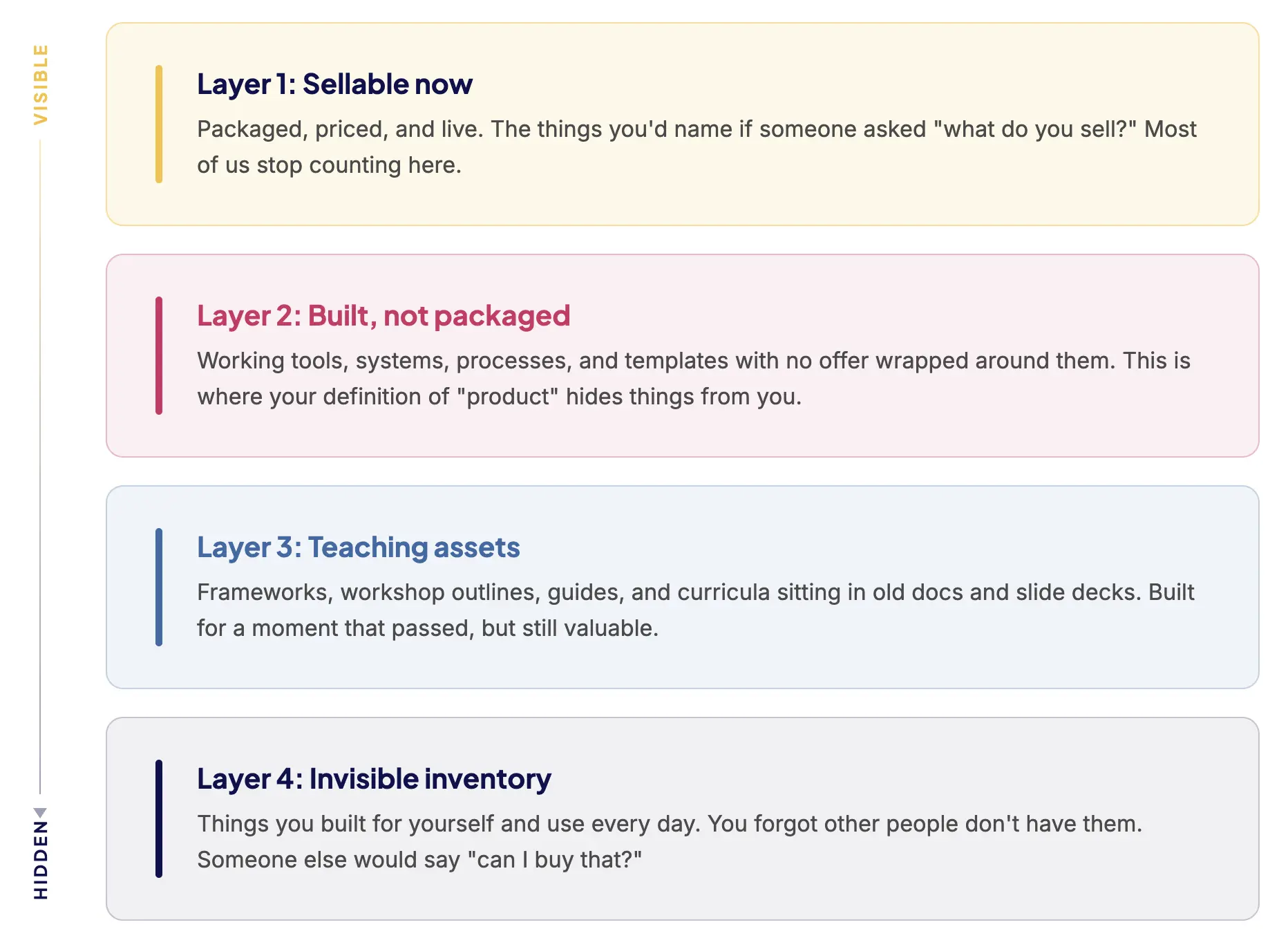
When I ran this inventory on myself, the framework that emerged had four layers. Not a hierarchy... think of this more like a geological survey. Each layer is a different kind of asset, and most of us can only see the top one.
Layer 1: Sellable Now. These are the things you'd name if someone asked what you sell. Packaged, priced, live. Most of us can count these on one hand and assume that's the whole picture. For me, this was seven offers. That felt like a reasonable number... until I kept going.
Layer 2: Built, Not Packaged. This is where it gets interesting. These are working things you've created... tools, systems, processes, templates... that don't have an offer wrapped around them. They exist, and you know they work... you're actively using them in your business. But you've never priced them because they don't feel "done" or "big enough." (Sound familiar?)
This is the layer where your definition of product is hiding things from you. And for most of us, this is where the real inventory lives.
Layer 3: Teaching Assets. Frameworks, workshop outlines, guides, curricula... the stuff you've created to explain or teach something. A lot of it lives in Google Docs or old slide decks or Notion pages that haven't been opened in months. You don't think of it as sellable because it was built for a specific moment, and that moment passed. But the framework itself? Still valuable. Still relevant. Still something someone would pay for.
I found nine of these. At least three were complete enough to sell within a week if I decided to.
Layer 4: Invisible Inventory. This is the sneaky one. These are things you built for yourself... internal workflows, automations, templates, systems... that you use every day and forgot other people don't have. You don't see them as products because they're just "how you work." But someone else would look at your setup and say, "Wait... can I buy that?" (or they might specifically ask, 'How do I do that?')
For me, this included AI skills I'd built, agents I'd configured, automations running in the background. Things I'd stopped noticing because they were just... running. Like that box in the storage unit you forgot you packed.
The four layers of digital products hiding in your business. Most of us can only see Layer 1.
Can You Create New Offers Without Building Anything New?
Yes.
And this is the part that changed how I think about it all.
Once the full inventory was in front of me, something else became obvious... I could assemble entirely new offers from things that already existed. No new builds required.
A framework I'd been using as a teaching tool could combine with a template I'd already made and a tool that was just sitting there... and suddenly that's a workshop. Or a productized service. Or a new tier inside something I was already selling. The raw material was already in my hands... I just hadn't seen the combinations because I was looking at each piece in isolation (or wasn't looking at it at all because it was simply part of what I do/use every day).
This is where things really opened up for me. I've built so much over the last couple of years, but much of what I was creating was for a marketing era that's on its last legs. I was looking at full-blown SaaS products instead of smaller products that solve very specific problems... problems I was experiencing and had built solutions for. This is about seeing what you can put together from assets you've already made, without starting from scratch.
Think about it like this... You didn't lose these things. You just buried them under everything else, moved a few times, and stopped opening the boxes. The inventory is the act of opening them all at once and realizing you already have what you need.
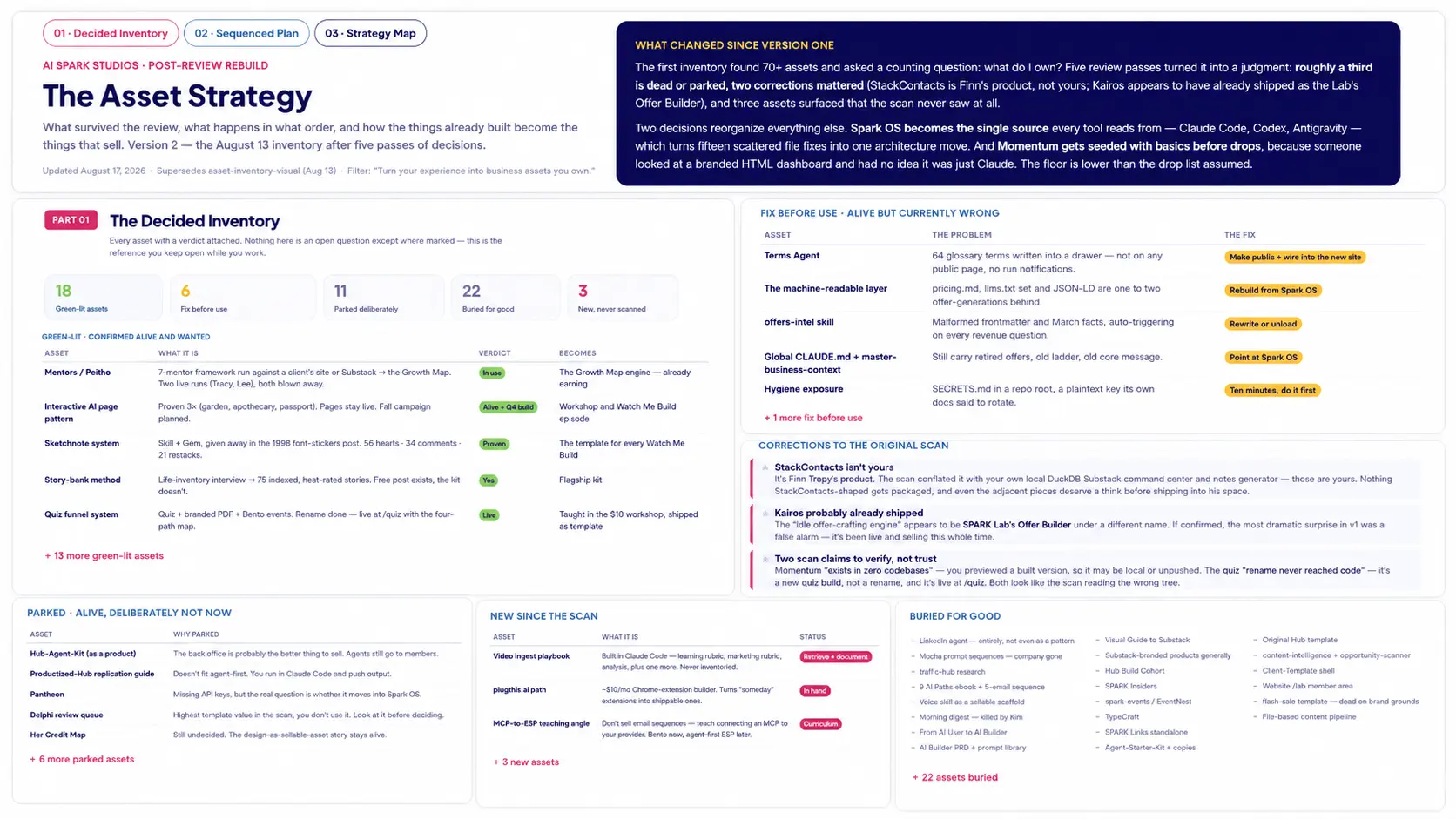
Here's part of my revised output (I went through the initial 70-item list, point by point, and cleaned it up):
The real inventory. 70+ assets sorted into what's alive, what's parked, and what got buried. This is what it looks like when you stop and count.
What If You're Not Sure You Have Enough to Inventory?
If you're reading this and thinking, "That's great for someone who's been building for 18 years, but I don't have 70 assets"... you might be surprised.
You don't need 70. You don't even need 20. The point of the exercise isn't the count... it's the lens correction. Even if you've only been in business for a few years, you've almost certainly built things in Layer 2 and Layer 4 that you're not seeing. A process you walk clients through. A template you made for yourself that saves you hours. A framework you explain on every sales call. These are digital products waiting to be packaged.
Also... a little clarification: Nothing about this process is suggesting you start selling a bunch of quick, crappy products (so subtle, I know, lol). No one needs more fluffy-filler ebooks that promise everything and deliver nothing (just like no one needs more of that type of content). This process helps you realize you've already created solutions to problems... problems your subscribers and customers already have (if it's a problem for you, it's probably a problem for someone else). Let go of what a product is "supposed to" look like and sell the solutions you've already created.
And if you're genuinely early and the inventory comes back short... that's useful information too. It tells you what to build next, instead of guessing.
If you're not even sure where you stand in your business right now, take the Build Path Quiz. It'll show you which of four paths fits where you are and what to focus on next.
How Do You Run This Inventory on Your Own Business?
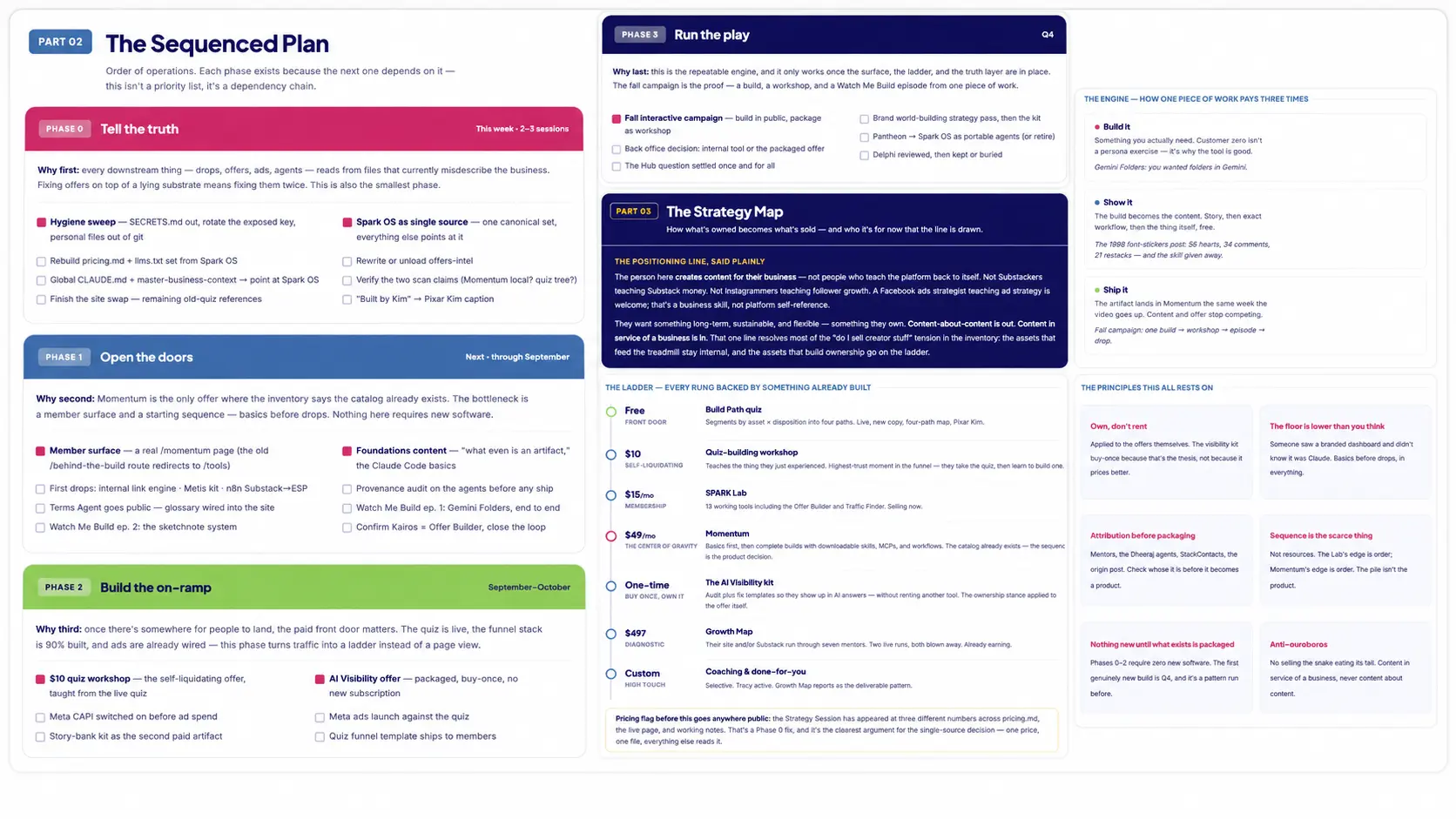
The inventory became a sequenced plan. What to fix first, what to open next, and how every rung of the ladder connects.
You can't do this exercise staring at a blank page. Your brain will do exactly what mine did, which is list the three or four things it already knows about and then go blank. The filter kicks in, and everything below the surface stays hidden.
You need one of two things (or ideally both).
An LLM as a thinking partner. Claude, ChatGPT, Gemini... set up as a dedicated conversation where you've given it real context about your business. That means uploading or pasting in your current offers, your processes, the frameworks you use, and a brain dump of what you actually do day to day. Not a one-off chat where you ask "what should I sell?" — a space where the AI has enough context to catch things you've stopped seeing because they're just part of your routine. That's exactly how this happened for me.
A second brain where your work already lives. Google Drive, Notion, Obsidian... somewhere your files, frameworks, templates, and notes actually collect in one place. If you've been building for years without a single location where your work gathers, start there. Daria over at AI Blew My Mind wrote a great piece on setting up Google Drive as your business brain, and it's what convinced me to go that route instead of Obsidian. (I'll link it below.)
What Prompt Should You Use to Start?
Here's something you can copy and paste into your AI thinking partner once it has context about your business. This is a starting point, not a magic formula... but it will surface things you've stopped seeing.
Copy and paste this:
I want you to help me inventory everything I've built in my business. Not just the things I currently sell... everything. Go through these four layers and list what you can find:
Layer 1 — Sellable Now: Things that are packaged, priced, and live or could be live this week.
Layer 2 — Built, Not Packaged: Working things I've created (tools, systems, processes, templates) that don't have an offer or price attached yet. Include things I use regularly but have never sold.
Layer 3 — Teaching Assets: Frameworks, workshops, guides, outlines, curricula... anything I've created to explain or teach something, whether or not I've sold it. Check old documents, slide decks, and notes.
Layer 4 — Invisible Inventory: Things I built for myself that I use regularly but have never thought of as a product. Internal workflows, automations, templates, systems. The stuff that's just "how I work."
List everything you can find in each layer. Don't filter, don't judge whether something is "good enough" or "finished enough." Just inventory it.
Then, look at the full list and suggest 3-5 recombinations... new offers I could assemble from assets that already exist, without building anything new from scratch.
That last line is where the real surprises show up. The recombinations. Because once you see the full inventory, the combinations start jumping out... things you never would have thought to put together if you were only looking at your "finished" products.
If you don't have this yet, I've got a prompt for you too.
And if you're reading the section above and thinking, "I don't have any of that set up"... you're fine. Seriously. You're not behind. There's no deadline on this, and the fact that you're even thinking about it puts you ahead of most people who are just heads-down working without ever stopping to look at what they've built.
You don't need a dedicated AI project or a perfectly organized Google Drive to start. You just need a conversation.
Open a fresh chat in whatever AI tool you use and paste this:
I want to figure out what I've actually built in my business, but I don't have everything organized in one place yet. I need you to interview me.
Ask me questions one at a time. Wait for my answer before asking the next one. Start broad and get specific. Here's what I want you to help me uncover:
What I currently sell (the obvious stuff)
Tools, templates, systems, or processes I've created that I use but have never sold
Anything I've built to teach, explain, or walk someone through something... even if it was just for one client or one workshop
Things I do every day in my business that other people would look at and say "wait, how did you set that up?"
After the interview, organize everything you found into these four layers:
Sellable Now — packaged, priced, live or ready this week
Built, Not Packaged — exists and works, but no offer around it
Invisible Inventory — things I built for myself and forgot other people don't have
Then suggest 3-5 recombinations... new offers I could assemble from what already exists, without building anything new.
This one works from a blank slate. The AI does the digging by asking you questions, and you'd be surprised how much comes out when someone (even an AI) asks the right ones in the right order. I've watched this happen with clients... the "I don't have much" person usually has more in Layer 2 and Layer 4 than they ever expected.
The point isn't where you're starting from... The point is that you stop and look.
What Happens When You Finally See the Full List?
Once you see it, you can't unsee it. And I think that's the real value of running this exercise... it doesn't just change your product list, it changes how you think about what you're building every single day. Every framework you create, every template you make for yourself, every process you document... it's inventory. It's an asset. It's a potential digital product.
Your experience is the asset. You can't leverage what you can't name.
If you ran the inventory and you're clear on what you have, amazing... go package something this week. If you're not sure where to start or which path makes the most sense for where you are right now, take the Build Path Quiz. It takes two minutes, and you'll walk out knowing exactly where to focus next.
Your obvious offer is hiding in plain sight.
Free. Tell it what you know and who you help, and it'll show you the offer everyone can see but you.
Kim Doyal is a digital marketing strategist and AI builder with 18 years of online business experience. She is the founder of AI Spark Studios and SPARK Lab, and the creator of The Hub — a custom 33-agent AI operating system that runs her entire business. She has also built kimdoyal.com, StackRewards, and multiple AI tools and agents using vibe coding, a natural language approach to building software without a traditional development background.