TABLE OF CONTENTS
Where Am I the Bottleneck?What kind of bottleneck are you actually dealing with?I don't need a second brain. I need a second pair of hands.Why did I stop performing on social media after 18 years?What does it actually mean to have content run without you?How did I build a social media automation pipeline that runs without me?Does automation have to be 100% to be worth building?What happens when you start building things that don't need your face?Questions You Might HaveWhere are you the bottleneck you don't need to be?I Don't Need a Second Brain... I Need a Second Pair of Hands
After 18 years of performing for platforms that don't care about you, here's what it actually looks like to build a system that runs without you.
April 21, 2026|5 min read
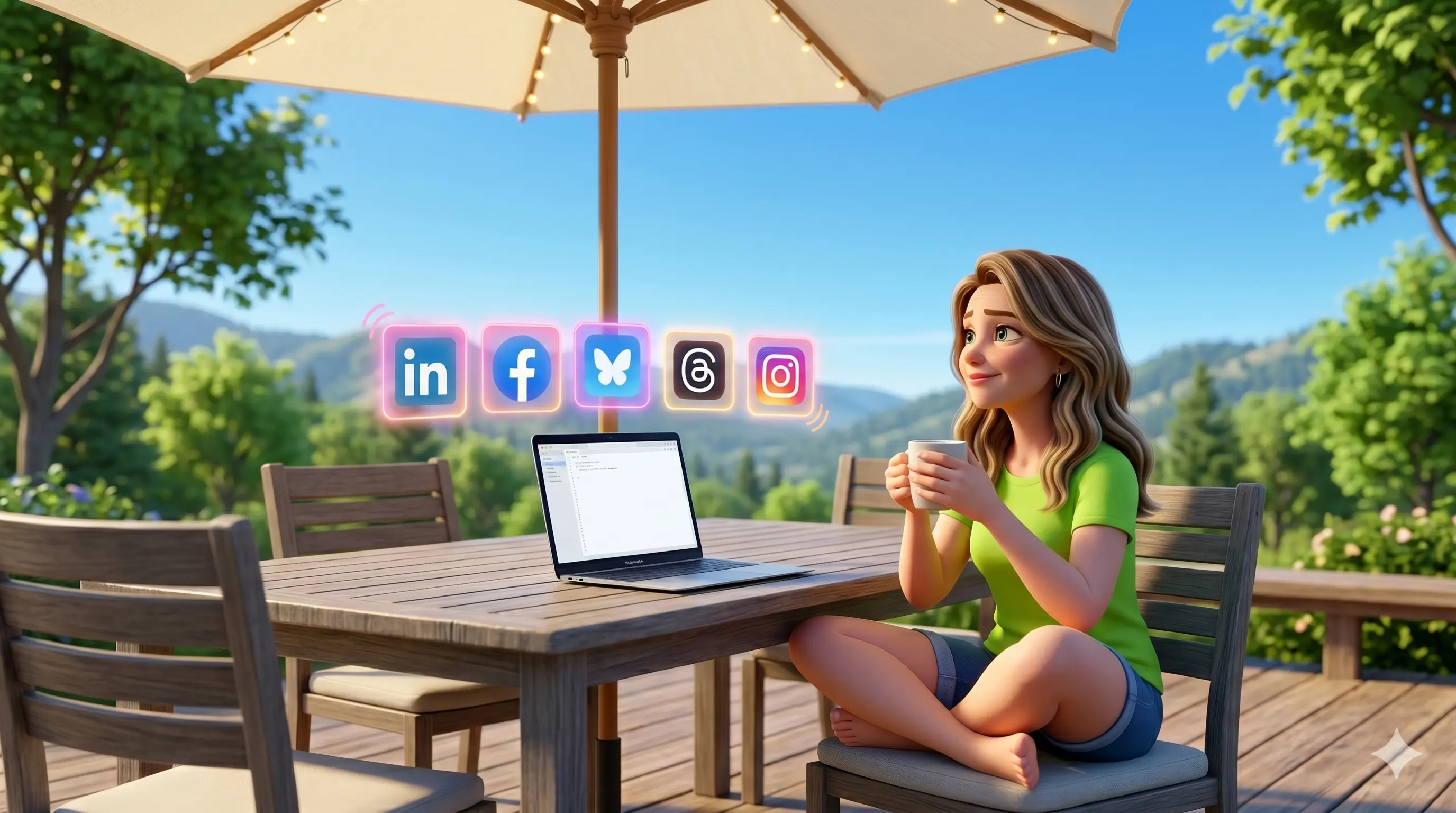
I came into Monday feeling off.
Not bad, not sad, not spiraling. Just... tired. I worked all weekend, spent time outside, doing the kind of physical work that uses different muscles than sitting at a desk (which I know my body appreciates. I'm so ready for Spring). By Monday morning, I had that specific low-grade exhaustion where the thought of showing up anywhere and engaging with anyone felt like more than I wanted to deal with.
So instead of forcing energy I didn't have, I regrouped.
I do this most weeks, but this one felt more necessary than others because I needed to brain-dump everything in my head (i.e., clear the chaos). The same one I do most Mondays, a check-in on what's moving, what's stalled, what needs my attention. And somewhere in the middle of it, content automation came up the way it always does when I'm tired: not as a nice-to-have, but as the thing that should already be running.
And then a question surfaced that ended up being the whole day:
Where Am I the Bottleneck?
Not "what should I do next" or "what's the priority." Where am I the bottleneck? Thanks again to my friend Jason, who gave me one suggestion for an automation last week that started all of this. There's a difference between tasks that need to be checked off a list and discovering where you're getting in your own way. And sitting with that question for a few minutes made everything else in the day click into place.
What kind of bottleneck are you actually dealing with?
Here's what I've figured out: when you feel stuck, behind, or like you can't get momentum, there are usually only two reasons:
✔️ The first is energetic. You're the only one who can generate the next thing. You're the creative source, the thinker, the person whose judgment and taste and hard-won experience is the actual product. There's no workaround for this one — it requires you, and the only solution is rest, or space, or getting your head right (and seriously, get the rest. Everything will be there later. There are no 'marketing emergencies').
✔️ The second is operational. Things are sitting somewhere, waiting on you to touch them, approve them, push them along. The work is done, or nearly done, but it hasn't moved because you're a step in the process that shouldn't require you.
Most people assume they're the first kind of bottleneck.
On this particular Monday, I knew I was the second.
And that distinction matters enormously, because the solutions are completely different.
If you're an energetic bottleneck, you need to rest, recharge, and clear your head. If you're an operational bottleneck, you need to remove yourself from the process. Build the thing that runs it without you... Stop being a required step.
That's when it landed:
I don't need a second brain. I need a second pair of hands.
And along with that, I don't want a dashboard showing me the status of everything. I want evidence of momentum. Proof that things are moving when I'm not looking. Not "here's where Project X is at,"...but "here's what happened while you were living your life."
This is also a huge part of why I stopped using Notion.
Managing Notion felt like a part-time job. I want simple and with as much automation as possible, but with all the iterations of my 'Hub', I realized I had built things I thought I was supposed to use, even though I rarely do 🙄.
Screw the productivity hacks. I've made it this far in life; I don't need anyone else telling me how to work more efficiently. Kindly F off.
Why did I stop performing on social media after 18 years?
Eighteen years. That's how long I've been in this space, publishing, posting, engaging, optimizing for platforms that, let's be real, don't give a damn about me or you or anyone who isn't paying them for reach (and I doubt they care much about people paying them either).
I'm done performing for them.
Not done building or creating, done performing. There's a difference, and I think a lot of us conflate the two because, for so long, they felt like the same thing.
Showing up because you have something to say? That's creating.
Showing up because the algorithm expects you, because consistency is the game, because you'll lose your "momentum" if you miss a Tuesday? That's performing. And after 18 years, I have enough data to know that performance doesn't build the business; it builds a habit of showing up on platforms.
I show up on Substack because of the people.
Is it for my business? Of course, and right now, it's a nice place to be. I want to read, comment, share, like, engage on Substack... because it's still enjoyable. AND... there are times when I don't want to log in and get sidetracked (distracted?). Sometimes I just want to work, without having to engage.
I engage on Substack because that feels like a real conversation. I'll respond if something real comes back on social, but I refuse to give any platform any more energy than it deserves. That era is over.
Here's the thing about a personal brand that nobody really talks about: you can love creating and hate performing at the same time. I love writing, building, and doing the work. I do not love the engagement theater, the constant presence, the treating every platform like a relationship that needs tending.
Which is also why this particular Monday's build mattered so much.
What does it actually mean to have content run without you?
I have three buckets of content.
The first is the in-depth stuff: the posts like this one, the behind-the-scenes, the longer thinking. That's me. My voice, my perspective, my experience. Can't automate it, wouldn't want to. That's where I show up.
The second is social content spun from what I've already written. Repurposed, platform-specific, derived from posts that already exist. This is where I've been the bottleneck. Content sitting there, written, useful, just... not moving because it required me to do something with it.
The third is automated content generation: I already have a glossary agent that publishes AI terms to my site every Monday at 6 am Pacific while I sleep. It's new, but so far so good.
The question that occurred to me on Monday was: why does the social piece still require me when the glossary agent doesn't?
There's also a practical reason to care about social presence right now, even if I don't love it: I'm jumping back into paid traffic. Do I want to give the platforms my money? Not really, but I'd rather pay for reach than give them my time. Regardless of how I feel about the companies that own the platforms, I know my audience is there.
Meta ads are more effective with an active presence on Facebook and Instagram. So this isn't about chasing organic reach or building a following. It's about maintaining a baseline so the paid side has somewhere to land.
Six months. That's what I'm giving it. If it moves the needle, great.
If it doesn't, I'll put the same budget into ads and skip the social presence entirely. But I'm not going to make that call until I've actually tried, and I'm not going to try in a way that costs me time I could be spending building.
How did I build a social media automation pipeline that runs without me?
Here's what the pipeline looks like:
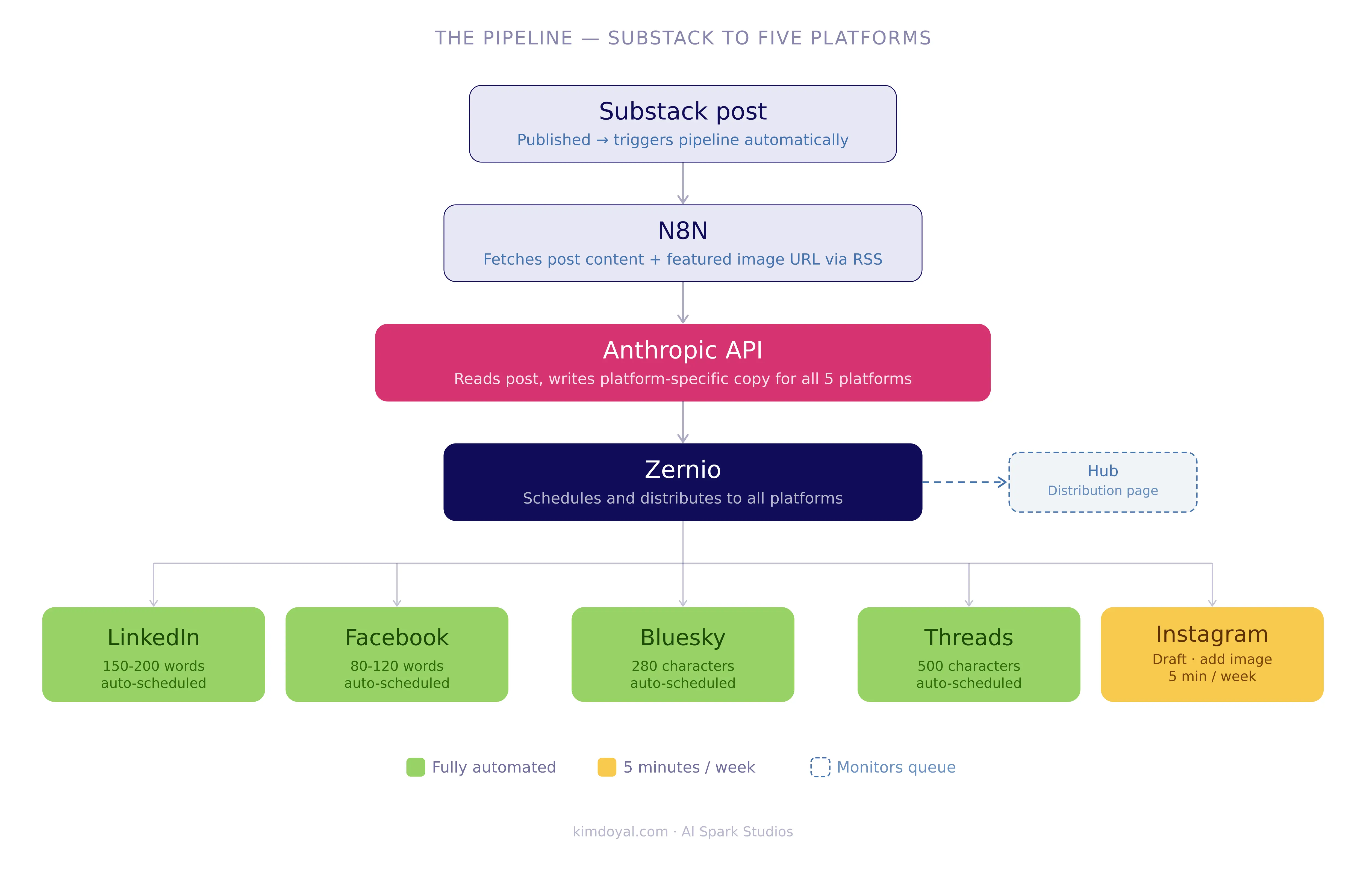
I publish a Substack post, n8n picks it up automatically via RSS feed. The Anthropic API reads the post and writes platform-specific copy; different voice and length for LinkedIn, Facebook, Bluesky, and Threads. Then Zernio schedules and distributes to all four. It goes out on my posting schedule, with my featured image, without me touching anything.
Instagram gets a draft; copy written, sitting there, waiting for me to add an image. That's my five minutes a week. I generate the image, attach it, and schedule it. Done.
I won't pretend this took an afternoon. It took a full day, a few wrong turns, a tool that didn't actually have the feature I thought it did (Nuelink), a JSON body that kept breaking for reasons that required a solid debugging session to figure out, and a few moments of genuine frustration. That's the practice-in-public part. It wasn't smooth, but I'm on a mission.
And now it runs without me.
Also, I should note that after two afternoons of working with Claude to get this working (after it hallucinated and told me Nuelink had an MCP. Little liar, it doesn't, lol), I KNEW there had to be a way to get what I wanted working.
So, instead of accepting defeat, I told Claude to find me a solution. What other tool could I use to get this working?
Enter Zernio.
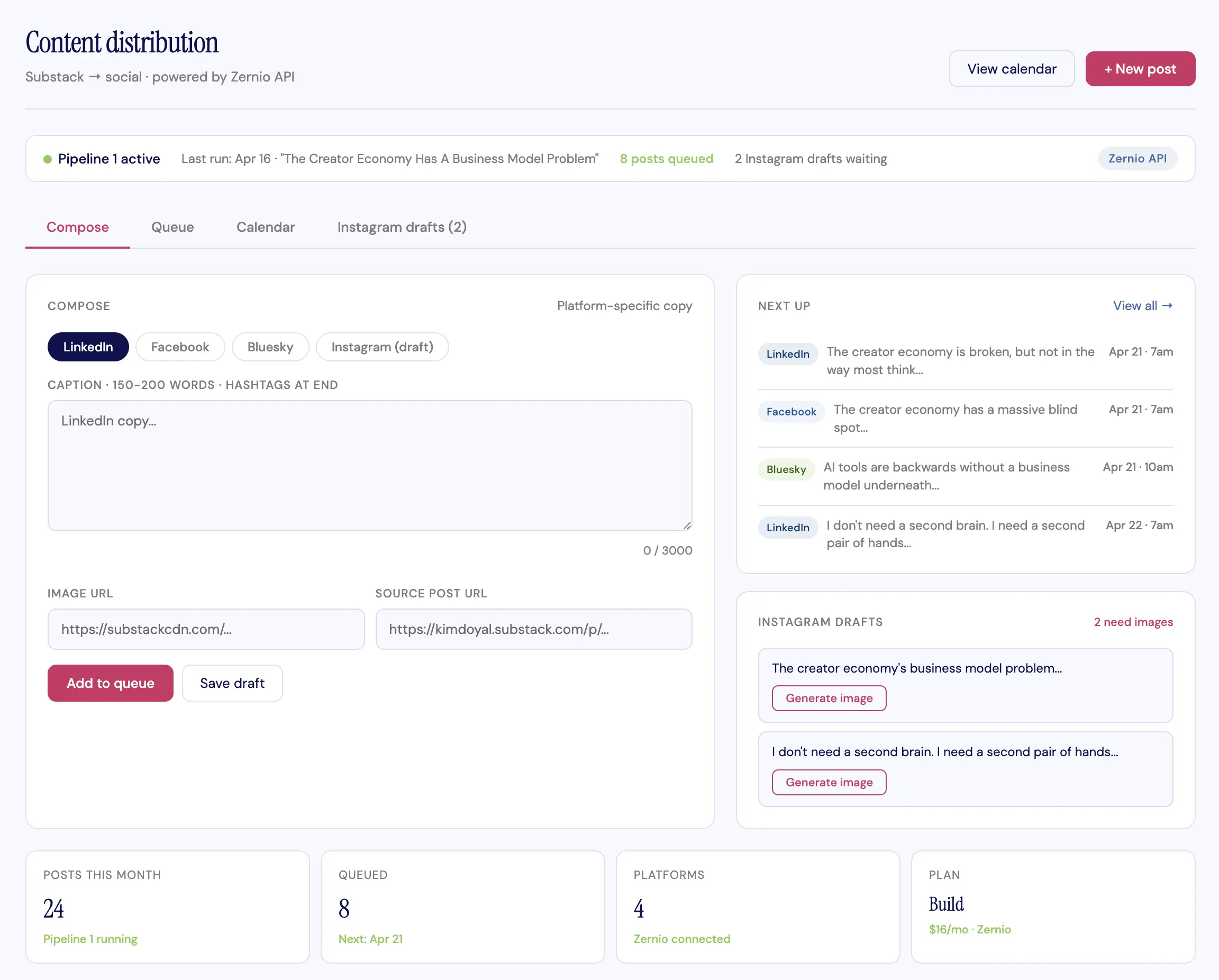
Zernio does the connecting & publishing; I do any formatting and edits in my Hub (updated post & video coming to my Hub soon). I've made tons of updates and deleted what isn't necessary.
Here's what that looks like in my Hub:
Does automation have to be 100% to be worth building?
I want to say something about automation that I think gets missed: it doesn't have to be 100% automated from start to finish to be worth building.
Four platforms running completely without me and one that takes five minutes is still a massive win. The five-minute one is Instagram, and honestly, I kept it manual because I like making images. It's one of my favorite parts of the whole content process. If it's fun to do and I enjoy it, I'm keeping that process.
So Instagram drafts sit waiting with the caption ready, and once a week, I show up, generate an image, attach it, and schedule it. Five minutes. That's a reasonable ask. The rest is completely off my plate.
What happens when you start building things that don't need your face?
Here's the part I want to sit with for a minute, because I think it's the most important thing I've figured out this year.
The personal brand was never the goal. It was the price of admission in an era when the only way to build an audience was to be the face of everything. Show up consistently, be relatable, perform authenticity, repeat. For a long time, that was just how it worked.
AI changes the economics.
I'm building things right now that have nothing to do with my name. Different niches, different audiences, completely separate from Kim Doyal or anything connected to my personal brand. AI runs them. I don't have to perform anything for them. I can test markets, build assets, generate revenue... without being the face of any of it.
That's new. That hasn't been possible at this scale before, not for someone working alone while maintaining a personal brand.
The personal brand becomes one channel in a larger system. Paid traffic does the reaching. Automation does the maintenance, and I do the building. The things I build don't all need my face on them.
For 18 years, the only way to scale was to hire people, or to be everywhere, or to trade more of your time. AI gives you a fourth option: build systems that run without you.
Questions You Might Have
Do I need to know how to code to build something like this?
No. I built this using Claude Code and n8n. I directed the build, I didn't write the code. The prompting, the logic, the decisions, that's all me. The actual code execution is AI. That's vibe coding, and it's exactly how I teach it. *Claude can generate the entire n8n automation - you just upload the file.
What if I only have one or two social platforms I care about?
Even better. Start there. One platform, one pipeline, running without you. Prove the concept, then expand. The whole thing took a day to build for five platforms. One or two platforms would take a couple of hours. A couple of hours invested today to save countless hours tomorrow? Totally worth it.
How much does this actually cost to run?
The Anthropic API costs pennies per post. n8n is self-hosted on Railway, five dollars a month. Zernio is 19/month on the Build plan. So roughly 24/month total to have social content going out to five platforms without me. Worth every penny.
What if my posts aren't on Substack?
Any RSS feed works. Most blog platforms generate one automatically. If you're publishing on WordPress, Ghost, or anywhere else with an RSS feed, the same pipeline applies, just swap the feed URL in n8n.
Where are you the bottleneck you don't need to be?
That's the question I keep coming back to, and the one I'd leave you with.
Not where are you adding value — you know that already. Where are you just... a step in a process that could run without you if someone had set it up properly? Where is something waiting on your approval, your attention, your presence, when it really doesn't need to be?
That's the work. Not more content. Not better content. The infrastructure underneath the content — the second pair of hands that keeps things moving when you're tired, or outside, or working on the next thing, or just living your life.
One more thing: this post started as a Monday morning regroup. The insight happened in real time, in conversation, while I was tired and not particularly inspired. The pipeline got built the same day. The post wrote itself out of the process.
That's what "everything is content" actually means. Not that you post everything. Not that every moment is content fodder. But when you're paying attention... really paying attention... the work and the story are the same thing.
I don't have to go looking for what to write about. I just have to show up and do the work.
Your obvious offer is hiding in plain sight.
Free. Tell it what you know and who you help, and it'll show you the offer everyone can see but you.
Find Your Obvious Offer →
Kim Doyal
Kim Doyal is a digital marketing strategist and AI builder with 18 years of online business experience. She is the founder of AI Spark Studios and SPARK Lab, and the creator of The Hub — a custom 33-agent AI operating system that runs her entire business. She has also built kimdoyal.com, StackRewards, and multiple AI tools and agents using vibe coding, a natural language approach to building software without a traditional development background.
Keep Reading

AI Building
How to Grow Your Substack Without Living on It... Built for Freedom — Part 01
I read the article on my phone in bed before I even got up, because I was genuinely excited about it. That kind of excitement means something right now. Here's what I started building, and why the how matters as much as the what.
April 26, 2026READ MORE
AI Building
What You Built Works... You Just Don't Want to Open It
I launched SPARK Lab minimum viable and then didn't want to log into it. It wasn't broken, it was flat, and flat is the harder problem because it doesn't tell you where to go. Here's the filter I ran on my own product, and the four prompts so you can run it on yours.
July 27, 2026READ MORE
Vibe Coding
How I Built a Custom AI App in 3 Hours (A Vibe Coding Case Study)
If you've been following my journey into "vibe coding," you know I'm always on the lookout for tools that make bringing ideas to life faster and more intuitive. While I've had success with other platforms, a new tool recently caught my eye and has completely changed the game for me.
August 28, 2025READ MORE