Every morning at 6:00, my Instagram carousels went out, and later, when I got to my desk, I got screenshots emailed to me so I could see what had been posted. I shared that setup with you a while back, and it was doing really well for a while. Then I started noticing that almost every carousel looked the same. The posts and topics were different, but the carousels kept coming out nearly identical, day after day, until I finally shut the whole thing off.
That carousel tool wasn't the only thing humming along in the background.
I also had an n8n automation hosted on Railway that pulled older articles from my archive, and every day Claude repurposed one of them into posts for five platforms. Those went over to Nuelink to be scheduled. I'd bought Nuelink as a lifetime deal on AppSumo ages ago, and it turned out my plan only allowed 365 posts... so once I hit that, it failed every single day.
I don't remember the last time I bought an AppSumo product, but note to self: read the fine print, lol.
The only thing that happened when the links started failing was that I kept paying for n8n to try to run it, and no social posts went out.
Each of those pieces lived somewhere different, each had its own login, and each needed me to fix it when it broke. I had too many pieces floating out there, and I was the one holding all the strings.
That's when I knew I owed you an update, and an honest look at what AI agents for small business can look like when it's just you.
What happened to my 33 AI agents?
A few became my real team, some became tools I pick up when I need them, and I've let go of others.
Back in March I wrote, "Inside My 33-Agent AI Operating System (and why I named them after Greek goddesses)." It's still one of the posts people find and read the most, and that's exactly why I'm writing this one.
If you read that post today, you could easily come away thinking, "Oh my God, she has 33 agents running her business, and I don't even have one." I'd hate for anyone to walk away feeling behind, because that's not the full story, and it's not how I work today. So I feel a genuine responsibility to show you what happened next, because this whole thing has been a process, and it still is.
I've accepted that working with AI is simply going to be an iterative process... always.
How did I end up with 33 AI agents? I leap before I look
I tend to leap before I look. I know that about myself, and I'm okay with it, because it's how I learn. I jump in, I get my hands dirty, and I don't mind course-correcting along the way.
That's pretty much how the agents started. I bought a handful of agents early on, and the first agent I really built was an implementation of somebody else's. It opened my eyes to what was possible, and once I saw that, I kept going. One agent turned into a few, a few turned into divisions, and before long I was writing a post about 33 of them.
Here's what I want to be clear about, though.
Not all 33 were running at the same time. A lot of them were sub-agents, which are smaller agents with one specific job. Some ran on a schedule, and many only ran when I triggered them. They weren't running my business on autopilot, and I never want my business to 'need' 33 agents running 24/7.
Some ran on a schedule (primarily research); some were triggered. For example: running an accessibility agent on any website. I'd run that before launching a site/app, fix anything that needed fixing, and then it would sit until I needed it again.
What did 33 AI agents actually teach me?
The biggest thing I got out of all of this wasn't the agents themselves. It was the education.
I've learned so much about building, about agents, skills, plug-ins, and projects, and about how all of those pieces fit together. It's been an incredible education. And the capabilities of agents right now are kind of mind-boggling... every time I think I understand what they can do, something new shows up.
My friend Jason has been so helpful to me through all of this, and he keeps asking me the same question: "Where are you the bottleneck?" (btw, Jason has shared his agent architecture with me, which is what I'm modeling mine after. I love having smart friends 😉).
Two questions helped me figure that out.
The first question comes down to what I want to hand off, what I want to keep, and how I streamline the rest. I'm still really hands-on with my content, and that's a choice. I like doing it. So instead of building an agent for everything I could hand off, I'm getting much more specific about what I actually want to hand off.
The other question that I now ask multiple times a day? (Claude or ChatGPT)
"Can you do this for me?"
Claude Duet has made this possible (I'm still on the fence about upgrading to try Dots in ChatGPT), so has the revised setup I'm building for my agents (more on that in a minute).
Now I want to go deeper with what I know and how I like to work, rather than wider, even as the technology keeps changing underneath me.
Who's on my AI agent team now?
Here's who's actually on the team now.
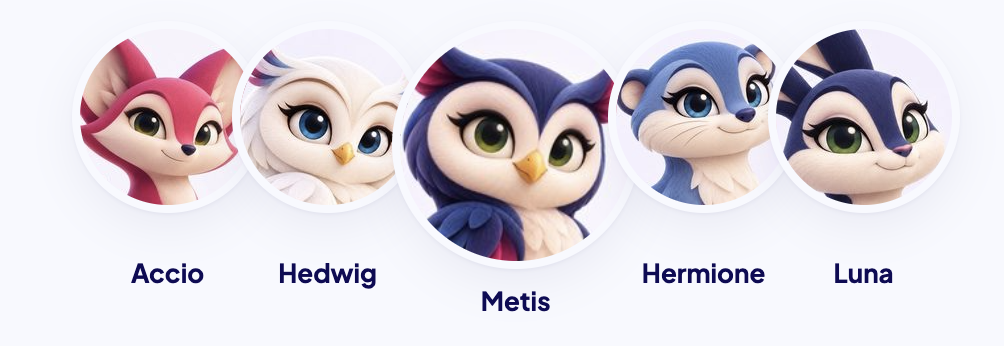
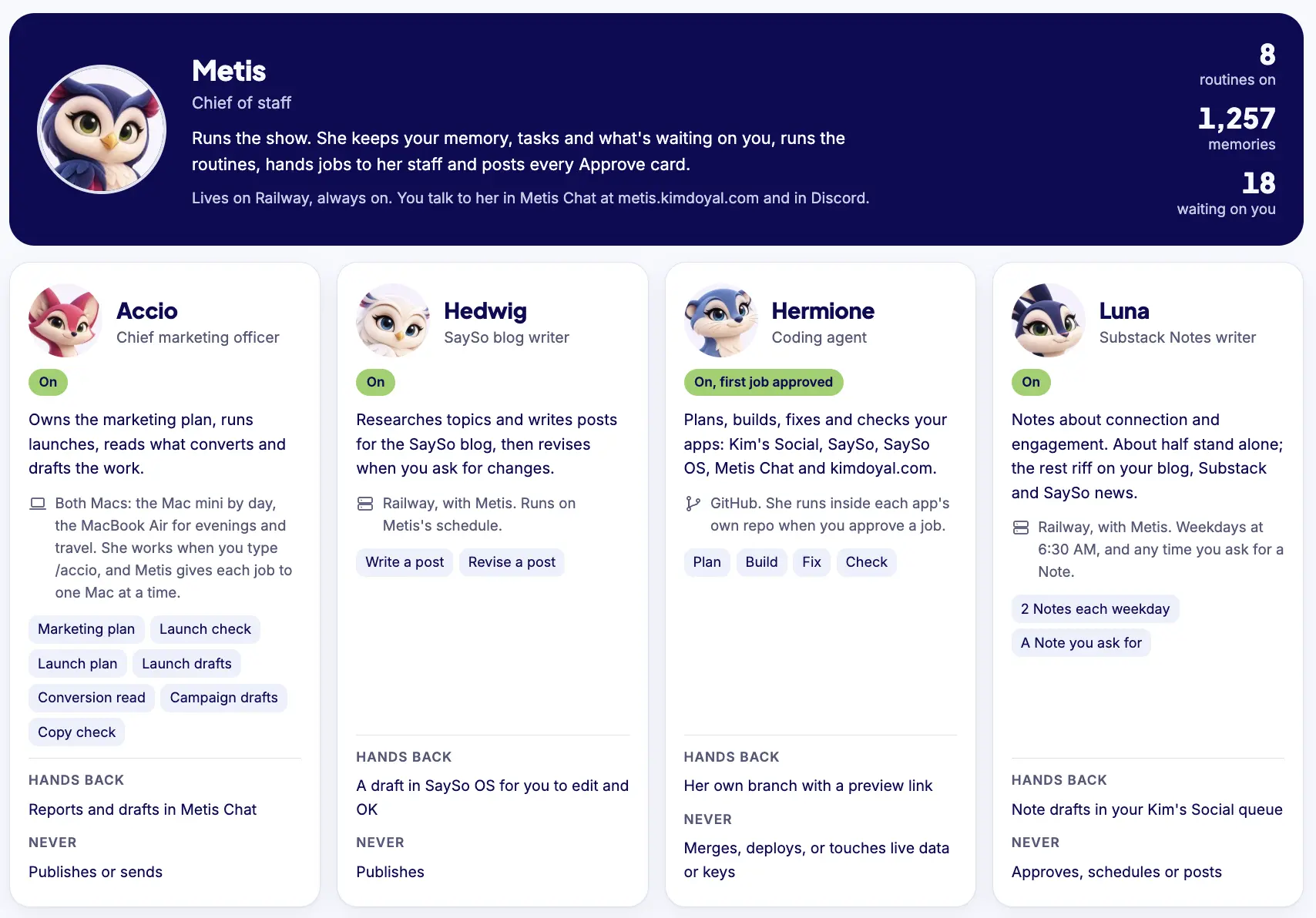
Meet the team: Accio, Hedwig, Metis, Hermione and Luna.
Metis is my chief operating officer. She orchestrated every division in March, and she's been promoted since then. I'm still building her, and she's doing more for me now than she ever did.
Accio is my new chief marketing officer, and she'll be Metis's first worker. She's built, but still evolving because I want Metis dialed in first.
Hedwig is my blog writer (yes, I'm mixing Harry Potter with my Greek goddesses, lol. Simple pleasures, right? I just decided I wanted animals for the avatars). Hedwig will write two posts a week for SaySo (based on keyword research, competitors, etc.) and 1-2 posts a week for my friend's Costa Rica rental property (I built the direct booking website).
Hermione is my coding agent. She's a blue otter, and she's pretty stinking cute. Her first job, a security check on Kim's Social, is already approved.
Luna is the newest, and she writes Substack Notes. She drafts two Notes each weekday, plus any I ask for, and they land in my Kim's Social queue as drafts, then I edit and tweak every one before it goes out (these are primarily for repurposing).
Beyond those five, the goal is a few more with very specific tasks, and that's it.
1. Team cards screenshot: What each agent does, what she hands back to me, and what she never does.
Where my agents live now
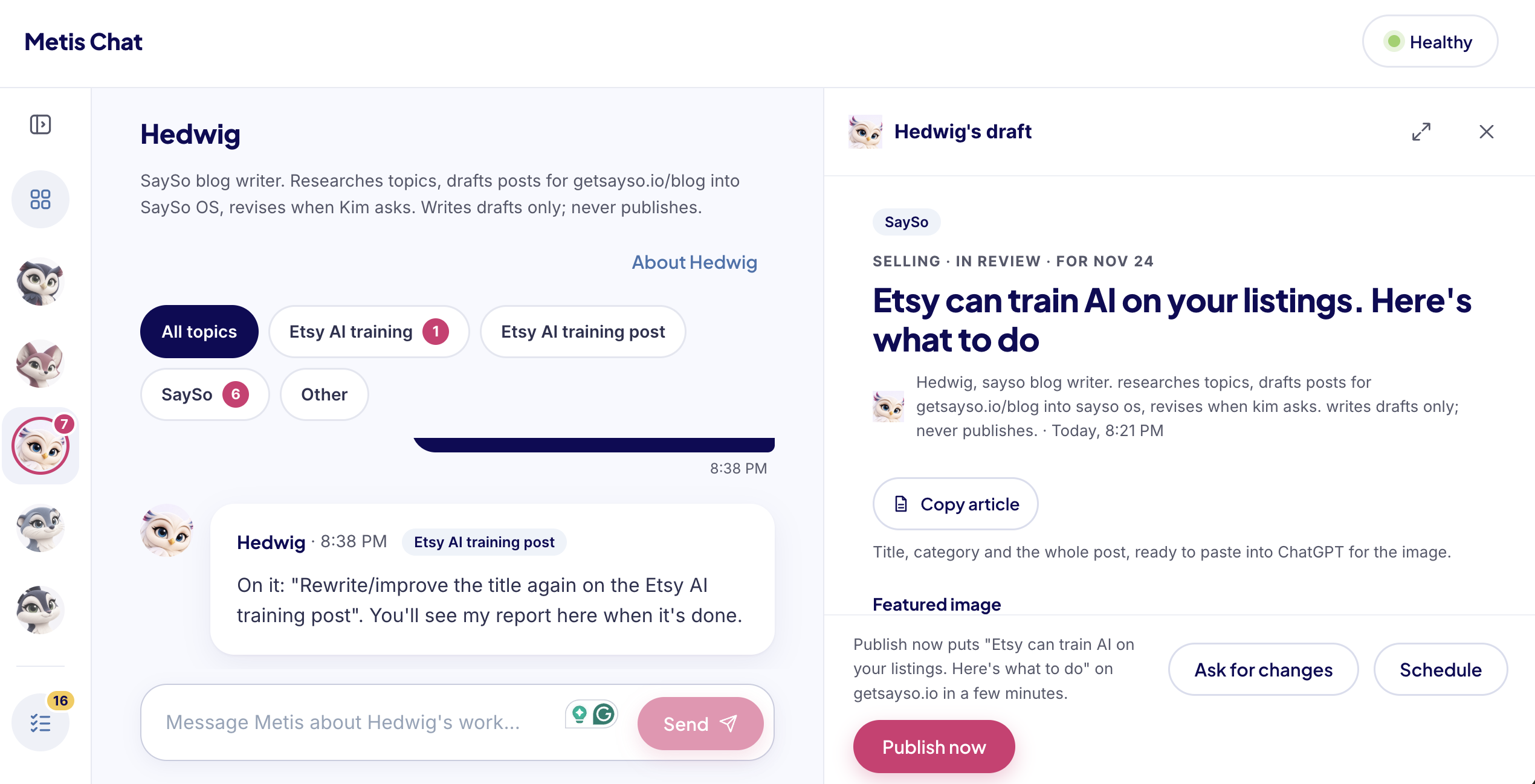
They all live in Metis Chat, an app I built myself (with a lot of help from Claude Duet) to replace Discord, and I don't use Discord for Metis anymore. Metis is the dark owl, Accio is the fox, Hedwig is the white owl, Hermione is the otter, and Luna rounds out the team. It's hosted on Railway, connected to Claude, and I have it on my laptop and phone.
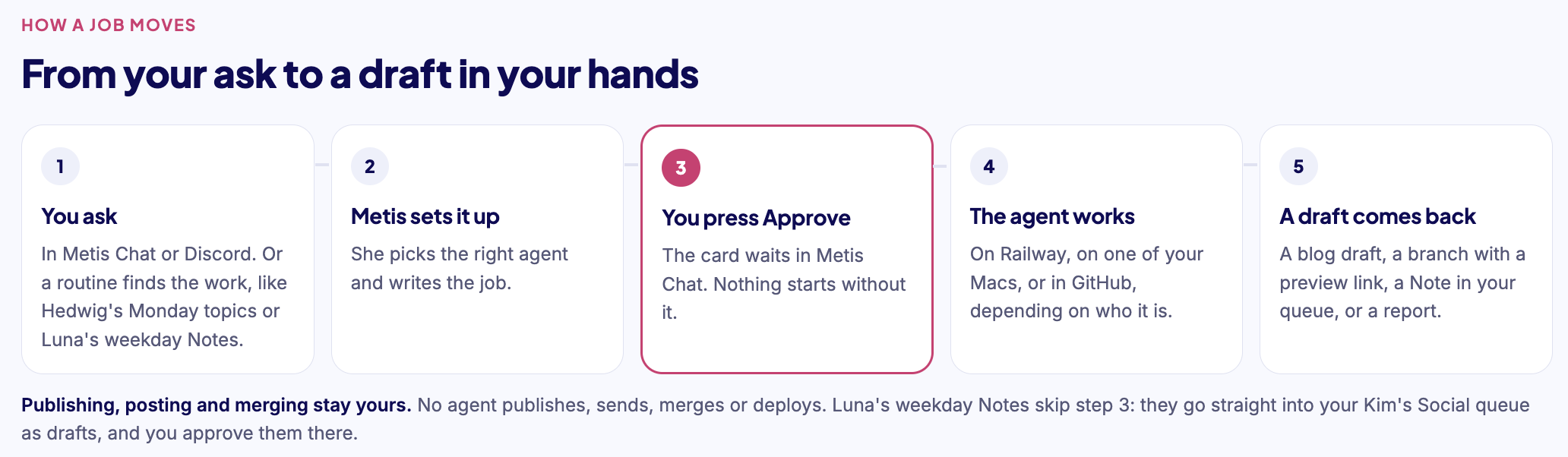
Right now they sit idle until I give them work, and where I'm heading is assigning them tasks to work on overnight. When Hedwig wants to start a new blog post, she asks first, and I approve it. She writes drafts only and never publishes, so I still decide what goes out.
Five steps from ask to draft: you ask, Metis sets it up, you approve, the agent works, a draft comes back
Tools, not team
Remember the security agent, the SEO agent, the accessibility agent, and the one that checks site speed? They still exist, and I run them when I need them. But I don't think of them as part of my team anymore. They're tools, more like a contractor I call when something needs checking, and that shift in how I think about them has made everything feel so much simpler.
Claude Duet is my right hand
The newest piece is Claude Duet, Anthropic's new agent. Because I can give it access to a lot of different things, it just gets stuff done, and it's helping me orchestrate all of this. Duet has turned into my right hand. (I dabbled a little with Muse, too, and I just can't bring myself to use Grok Bot because of Elon Musk. No judgment if you do.)
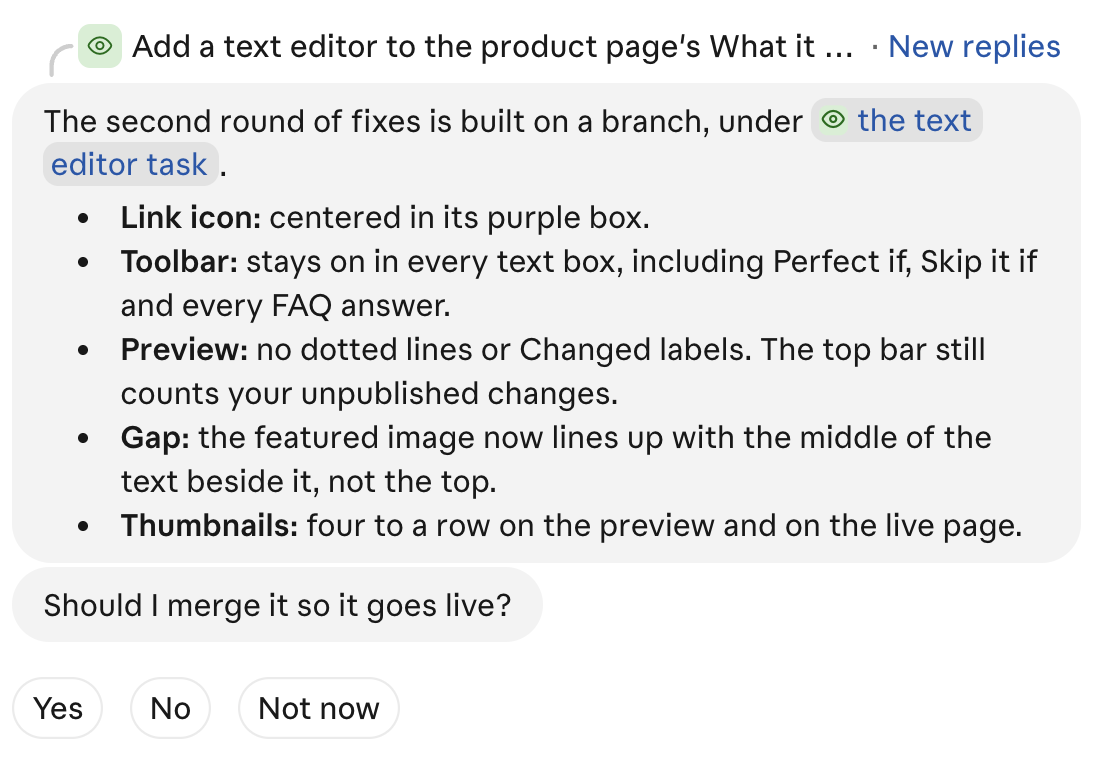
Duet always asks before anything goes live.
I've given Duet access to a handful of GitHub repos where it can update code, reference my SPARK OS (my business operating system), and all my projects. I have six different channels, and it follows what's going on in each of them (it can move chats to other channels. It also creates visuals in my brand colors. All the Metis and her team images were created in Duet.
What I don't need is a personal assistant reminding me of appointments or nudging me about little tasks. My life isn't that busy, and that just feels like one more thing to manage. Maybe that would have helped when my kids were little and still at home, but I've managed this far, and one more thing checking in on me would make me crazy. Adults have managed their lives forever without personal agents, and that's not a judgment on anyone who loves having one. I just don't need it.
Why did I retire my agent hub?
I also built myself a hub, a dashboard where my agents lived and where I could see what they were doing. I haven't opened it in months, so I'm retiring it.
The truth is, I'd much rather work inside Claude. Everything I'm doing now happens in Claude or in a couple of places with a UI I actually like using, and I'm trying hard to cut down the number of things I have to log into.
The same goes for where my agents live. Metis used to run through Discord, and Discord just doesn't work the way my brain works, which is a big part of why I built Metis Chat. I've looked at a lot of different tools with agents in the cloud (that say they're alternatives to Grok Bot), but I keep coming back to what I'm building with Metis and don't think I'll need them.
Metis Chat, the app I built to replace Discord, on my laptop and my phone.
The proof: I built my own social posting app
Remember the n8n automation and the Nuelink limit from the top of this post? That's where this part of the story picks up.
When Nuelink kept failing every day, I asked Claude to look at the automation and tell me why. Well, like I mentioned earlier, the Nuelink account I have (purchased many years ago via AppSumo) was limited, and I was running 5 posts a day, so it didn't take long to hit the limit. 🙄
So, another moment of frustration led to a custom tool that runs circles around anything I would pay for. One simple question to Claude: "Can't we just build this?" and voila! (Obviously not that simple, but you get the idea). The only reason I knew I could was because of everything I'd already built. Months ago I'd tested a LinkedIn agent that ran through Telegram. I hate Telegram, and I don't want to use anything on my phone if I don't have to, but that experiment showed me the pieces were possible.
So I built Kim's Social (creative name, I know, lol).
Now everything is pulled into one place, and I'm creating exactly what I want based on how I know I like to work.
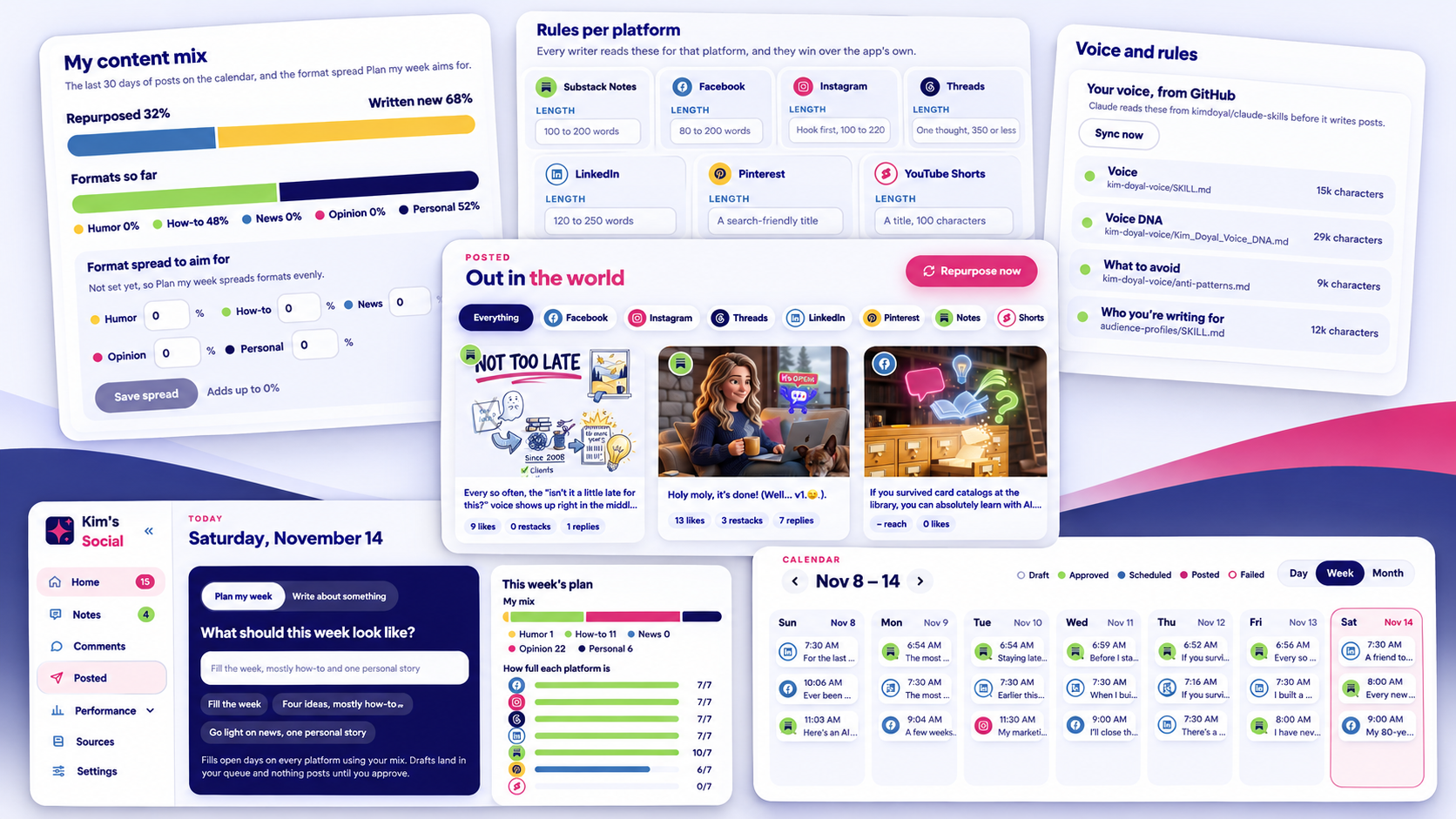
A peek inside Kim's Social, the posting app I built for myself.
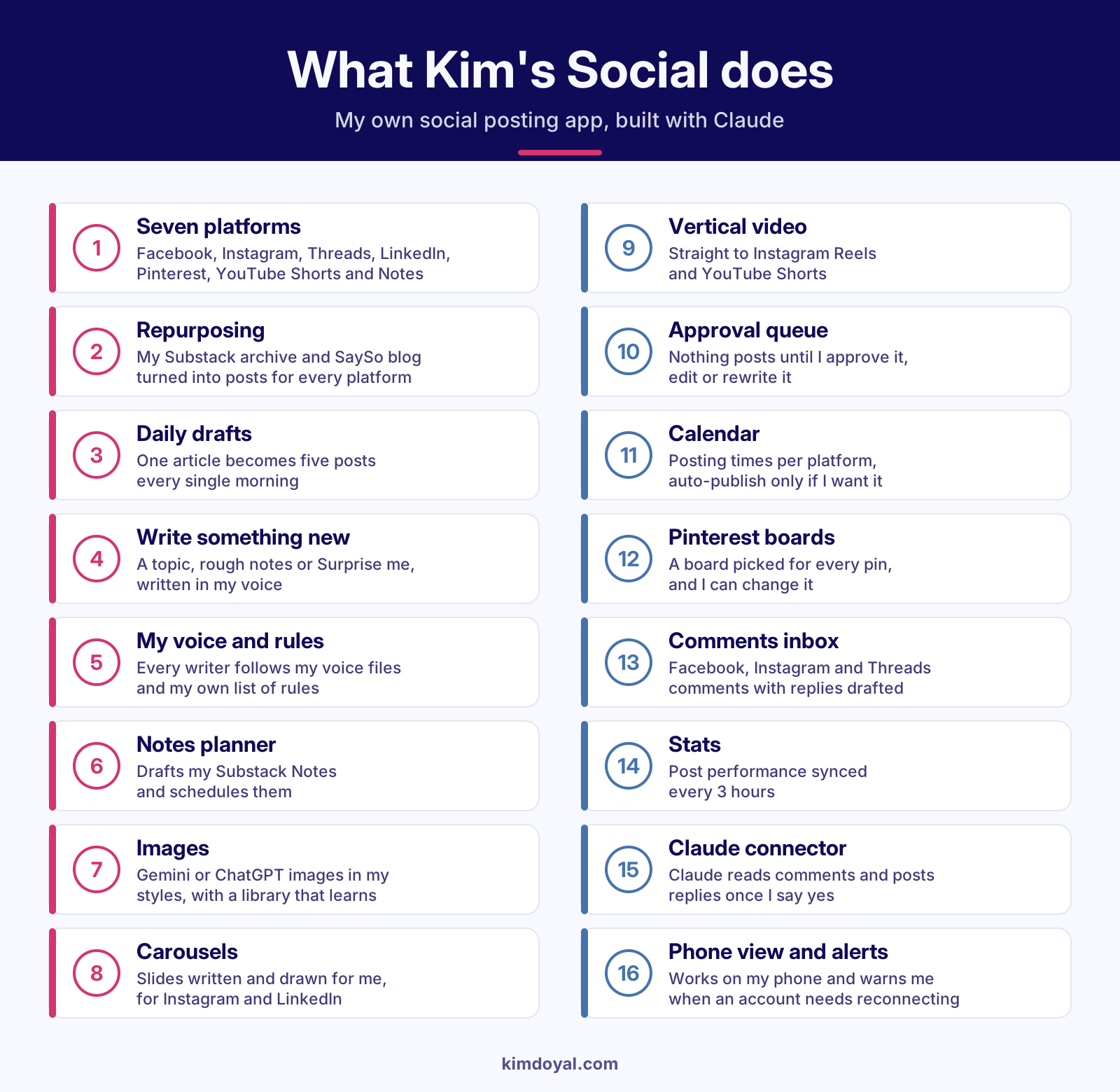
Kim's Social is my own posting app, and it covers seven platforms from one place: Facebook, Instagram, Threads, LinkedIn, Pinterest, YouTube Shorts, and Substack Notes. Every morning it turns one of my articles into posts in my voice.
When I want something fresh, it writes from a topic or my rough notes. It makes the images, carousels, and vertical videos, then queues everything until I say yes. It also drafts replies to my comments, tracks how posts perform, and lets Claude handle the rest once I approve it.
All 16 things Kim's Social does for me now.
I'm sure some people think I'm a little cuckoo for building my own social app, but this is the whole point. Every one of those earlier builds, including the ones I stopped using, taught me something that made this one possible.
The bigger proof: SaySo
SaySo is the same idea on a bigger scale. It's an agent-first digital storefront, which means once your store is up, you can manage it from Claude instead of logging into one more dashboard.
I built it because it's exactly how I want to work, and I believe in it. To me, it's a kind of software democratization, and I absolutely love it. I'll do a longer, more in-depth post about SaySo this week, but if you're looking for a place to sell your digital products and services, you can check it out here (and physical products are coming soon! Probably within a week, including print-on-demand!).
Frequently Asked Questions
Do you need 33 AI agents to run a small business?
No. I have five on my team now, and the rest are tools I run when I need them.
What's the difference between an AI agent and a tool?
For me, a team agent has an ongoing job, like Hedwig writing blog drafts or Luna drafting my Notes. A tool is something I run when I need it, like the accessibility agent before a site launches, and then it sits until next time.
Do your agents publish anything without you?
No. They hand back drafts, and I edit and approve everything before it goes out.
Where do your agents live?
In Metis Chat, an app I built with a lot of help from Claude Duet. It's connected to Claude, and I have it on my laptop and my phone.
Are you behind on AI agents for small business?
Short answer: no. This stuff is moving so quickly, and as the technology improves, how you use it will depend on your business and how you like to work. That's really all I've done here. I tried the big version, I learned a ton, and I kept what fits.
So give yourself some grace as you learn. You can do as much of this as you want, as little, or none of it at all, and you're still not behind.
And if you want to build alongside someone, the only client work I'm doing right now is coaching people to build with AI. If you're interested in working with me, just reply to this or email me.
Your obvious offer is hiding in plain sight.
Free. Tell it what you know and who you help, and it'll show you the offer everyone can see but you.
Kim Doyal is a digital marketing strategist and AI builder with 18 years of online business experience. She is the founder of AI Spark Studios and SPARK Lab, and the creator of The Hub — a custom 33-agent AI operating system that runs her entire business. She has also built kimdoyal.com, StackRewards, and multiple AI tools and agents using vibe coding, a natural language approach to building software without a traditional development background.