HOME/BLOG/BRING YOUR OWN AI, SKIP THE PLATFORM SALES FEE
AI Building
Bring Your Own AI, Skip the Platform Sales Fee
When your Claude subscription does the work, there's nothing left for a platform to take a cut of.
September 7, 2026|5 min read
A few weeks ago I built a store on my own site. It's not in the navigation yet, and there's nothing in it, but the whole thing works... products, checkout, delivery, all of it sitting there waiting for me to have a spare afternoon (it's coming!).
Then I had a workshop coming up and needed a checkout for it, and instead of building a one-off, a friend mentioned that ThriveCart had new owners and was worth another look. I've had a lifetime license parked there for nine years, so I logged in expecting to still feel disappointed with its dated UI/UX and mildly guilty about not using it.
I was pleasantly surprised. The UI had changed... Not dramatically, and it still looks a little like 2017 in there, but it was cleaner than it was, and I thought, sure, why not. This is what I paid for. Let's use it.
Then I went to add a coupon.
Coupons are now in Pro, which is an upgrade. So another $300 for a product that I'm only sort of happy with, but was going to use it because "it works and I owned it."
Nine years of "lifetime," and the one thing I wanted to do that afternoon was now behind a wall that didn't exist when I bought it (they should have grandfathered people in who bought years ago).
And I'm looking at this thinking... I'm not paying more for something that looks so-so when I can just build it.
So I closed the tab and built the checkout myself.
It took about twenty minutes (I never believe Claude when it says something will take a long time. Claude's "a week to build" is usually a couple of hours, lol).
That twenty minutes is the whole reason I'm writing this, and it isn't a flex. The reason I bought ThriveCart in the first place is no longer true... And I have a feeling we'll see this happen more and more with older products that are trying to stay relevant.
In 2017, building your own cart was a project... a real one, with a developer or a very long weekend and a bunch of things that break silently. Renting it made obvious sense. The monthly fee bought me capability I didn't have, and that's a fair trade (I've also had a WooCommerce store, and that's a huge hell no for that, too). Multiple paid add-on plugins were needed to get the basics running.
Here's the part I want you to think about, because it isn't about me.
The reason you've been renting software is that building it was out of reach, and that stopped being true for you at roughly the same moment it stopped being true for me. Not because either of us learned to code. Because the twenty years you've spent knowing exactly what a checkout needs to do, what a customer will abandon, what an email has to say... that was always the hard part. The building was just the expensive part... And the expensive part got cheap.
Which brings me to agent-first products, the shape I keep running into, and why I think some software pricing models are about to look ridiculous.
*And if you don't want to build, I think there will be more and more options moving forward that are agent-first.
*Also:I want to state that I know there are hard costs with running software. I don't begrudge any company any of that. What I do mind is the gatekeeping of necessary features, which essentially makes the lower tiers almost worthless. Not to mention, customer service is usually an afterthought.
Why does this keep happening?
Because platform pricing was built for a cost structure that's quietly changing underneath it.
I have a coaching client on Stan Store right now. Twenty-nine dollars a month, which is fine, and she's happy with most of it. She wanted to run a discount on something. Discounts live on the ninety-nine-dollar plan.
Sixty dollars a month for a coupon.
In all fairness, Stan does offer a lot for $29 a month, but here's what's gated and requires an upgrade:
order bumps and upsells
coupons
affiliate program
Google analytics & Meta pixel
Remove Stan Store branding
Email marketing
Now let's look at Gumroad.
Gumroad takes ten percent of everything you sell, on top of your Stripe fees. If you want to be in their marketplace, they take THIRTY PERCENT (maybe the Gumroad founders worked for one of the Big Banks back in the day 🙄).
Luma, an event platform, charges a five percent platform fee on paid events, or you can move to Luma Plus at fifty-nine dollars a month billed annually or $69 month-to-month, and the monthly fee drops to zero. Stripe's cut sits on top of the platform fee either way, and I'll give them credit for saying so plainly right there in the pricing footnotes.
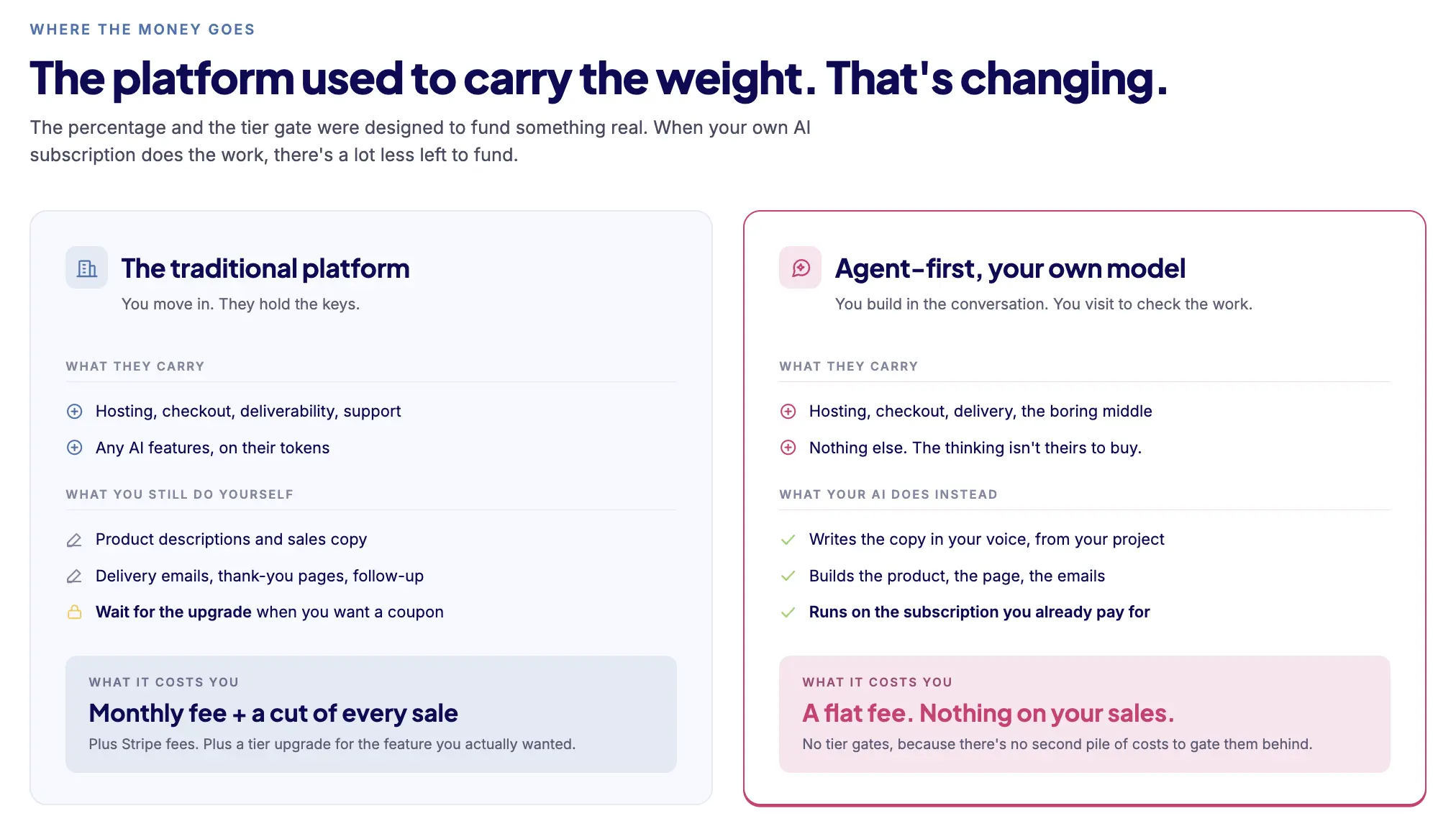
I've watched this model work beautifully for a long time, because it was honest. The platform was carrying real weight. Hosting, checkout infrastructure, deliverability, fraud, support- the whole unglamorous middle of a transaction. A percentage or a tier gate was a reasonable way to fund that.
But over the last several months, I've noticed the weight shifting, and pricing hasn't caught up yet (it'll be interesting to see which legacy software platforms are still around in a few years, how they've changed... or changed hands).
I wrote a while back about AI washing, where a company bolts a chat box onto an existing product and calls it AI-powered. This is the opposite, and it's why I keep paying attention. These tools aren't adding AI to software. They're built differently because AI exists, and the pricing works out differently too.
This is an incredible opportunity right now for many reasons.
Let's jump into them.
The agent-first products I keep running into
Four of them, solving four unrelated problems, all built the same way.
Email Marketing
My friend Jason is building an email tool called 'Roost.' You connect it to Claude and write your campaigns in the conversation. Sending runs on Amazon SES, which is somewhere around ten cents per thousand emails, so the delivery cost is a rounding error (and Amazon takes care of all the DMARC, safe sending, etc.) There's a dashboard, and it's a good one... You log in to edit an email, check a workflow, look at your conversion rates. But you don't live in it. It's where you go to see what you made, not where you make it (unless you want to). It's also built by someone who's spent the last 10+ years setting up email accounts, optimizing conversions, maximizing email lists, and building custom tools that provide data the big ESPs won't (well, without gating... again). I can do some of this with Bento right now, but I will absolutely switch when Jason is done with this (he's building this for a client who has a $1M/mo. ecommerce business - I know this is going to work great).
Vibe Coding
Then there's Floot, which I came across a week ago and tested it by building my own event app (EventNest) on it (like Luma, without the fees, gatekeeping, and managed with Claude). It's in the Lovable category, except you connect your own Claude or ChatGPT subscription, and it runs on that. (That's a referral tracking link that I asked the team for. They reached out, offered me a paid account, and I was blown away. They don't have an affiliate program; I just wanted to track any traffic I sent.
Social Media
There's a social media one working the same way. Not where an existing platform adds an MCP to connect and post, but where the connection is the default.
Events
And EventNest itself, where someone hosting a paid workshop connects it to their own Claude and says, "Create the workshop for 'insert workshop name' or 'Write the confirmation email for Thursday's session, and the reminder that goes out that morning," and it happens, and then they open the dashboard to make sure it reads the way they'd say it.
Four different problems, one underlying shape.
That's usually the tell that something is a category and not a coincidence.
What makes a product agent-first?
Two things: the work happens in the conversation, and the tool runs on your AI subscription instead of its own.
The first half is the one people notice. The agent is where the work happens, and the interface is where you go to look at it and fix it or make changes.
That's a genuine shift, because it removes the part of software that eats the most of your life, which was never the pricing... it was the two hours of clicking around figuring out where they hid the thing you need. If you're already working in Claude with your business context sitting in a project, then "connect to this and set up my workshop" isn't a new skill you have to acquire. It's the thing you were already doing, pointed somewhere new.
The second half is the one that rewrites the business model... and the one that makes me feel like a 5-year-old on Christmas morning.
You bring your own AI. Your Claude subscription, or your ChatGPT subscription. You're not buying the intelligence that does the work. You already bought it and work with it all the time. Now you get to take the work you've already done, and instead of copy/pasting into another platform, you simply tell Claude or ChatGPT to build your product (or email sequence, event, or social campaign).
Some tools will still resell tokens, and that's a legitimate choice... it smooths onboarding, and some problems genuinely need the tool to own the whole pipeline. Depending on what you're solving, that might be right. But when you don't need it, the math underneath the business changes completely.
What is that ten percent actually buying?
Less than it used to, and that's the whole argument.
Look at what Gumroad gives you for the ten percent. It's the garage and the clicker that opens the door. You still have to build the car, park it, and write the sign. You can give them an additional 20% if you want to park your car on their road (i.e.,marketplace... bear with me, it was the only example my brain could come up with to go with the garage analogy, lol).
Every product description, every bit of sales copy, every delivery email, every thank-you page... that's still your afternoon. Gumroad holds the file and takes the payment. The work of turning a thing you made into a thing someone can buy is entirely on you, and that work is most of it.
And the percentage isn't the only thing worth looking at, because there's a second arrangement underneath it that gets discussed a lot less. Gumroad holds your money before it reaches you. Their help docs say you need a minimum balance of a hundred dollars before a payout goes out, and every sale sits in that balance for at least seven days before it's even eligible. Some countries have higher minimums.
So if you sell sixty dollars of something this month, that sixty dollars stays where it is until it has friends. There's an instant option if you're in the US and your Stripe account has been processing with them for 60 days or more, but it costs a fee to get your money sooner.
I want to be fair here, because holding periods exist for real reasons and chargebacks are one of them. Gumroad is also the merchant of record, which means the sale legally happens between your customer and Gumroad, and that structure genuinely solves things like sales tax that you'd otherwise have to handle yourself.
None of this is a scandal.
But it's worth knowing that when a platform takes a percentage of your sale, the percentage is rarely the whole arrangement. There's usually also a question of whose account your money sits in, and for how long, and what it costs you to get it out early. (Go look at your own payout settings before you take my word for any of this. Terms change, and mine aren't your terms.)
Now picture the version where you're sitting in Claude, which already has your voice and your product in a project, and you say "add this skills pack to my store, write the description and the checkout copy, and set the delivery email."
The storefront gets built.
The copy sounds like you because it is you.
The product goes live.
And the intelligence that did all of that was already on your credit card this month.
So what's the ten percent funding?
Bring-your-own-AI is what makes flat pricing obvious rather than generous.
When the tool isn't buying the thinking, there's very little left for a revenue share to cover. It stops being a nice gesture toward creators and becomes the only structure that makes sense.
It's also why I'm not taking a percentage of anyone's sales in anything I build, and this isn't me being noble about it. There's nothing there to take a percentage for.
Same two jobs, two very different bills. The difference isn't generosity, it's that the intelligence is already on your credit card.
Toolbox or machine: which one should you build?
A toolbox holds a lot of small jobs behind one lid. A machine does one bigger job and keeps running after you walk away. That's the whole distinction, and picking the wrong one is the most common way this goes sideways.
Agent-first isn't a single thing, and the two versions are not a ladder. You don't start with the small one and graduate to the real one. They solve differently shaped problems.
The toolbox is an MCP. You connect it once in Claude, then you just say what you want, and the tool you need is right there. Daria's Amplifiers is the clearest one I've used... 276 tools, one connection, and after setup you never think about the plumbing again. You say "run the Pinterest research Amplifier," and it runs.
Mia Kiraki of Robots Ate My Homework just launched hers. You can access her skills, workflows, and more directly with the custom MCP.
If what you have is a body of work you've already built... prompts, frameworks, research processes, checklists, the stuff you know cold and have refined over years... a toolbox is how you hand it out. It turns everything you already made into something that lives inside your customer's daily work instead of a PDF they downloaded once.
The machine is agent-first software. Events, email, a storefront. It has a database; it has state; things happen on schedule whether anyone is in the conversation or not. It's a real application with a real dashboard, and the agent is simply the fastest way in.
The way I'd tell them apart: if you're describing a lot of small jobs someone would want to do inside a conversation, you're building a toolbox. If you're describing one job with moving parts that have to persist after the conversation ends, you're building a machine.
Neither one is the beginner version. Some of the best MCPs I've seen took more thinking than the software did.
Three prompts to find yours
Run these in order. They assume Claude has your business context in a project, and they'll work in ChatGPT with minor tweaks.
1. Audit what you're already paying for.
I want to audit my software stack for tools that underdeliver relative to what I pay.
Here's what I currently pay for, monthly or annually:
[list every tool, what it costs, and what you use it for]
For each one, tell me:
1. What I'm actually using it for, in one sentence
2. Roughly what portion of its feature set I touch in a normal month
3. Whether the thing I most want from it sits behind a higher tier
4. What leaving would actually cost me (data, integrations,
audience, muscle memory)
Then rank them from "clearly worth it" to "I'm paying for the exit cost, not the tool." Be blunt with me. Don't soften it.
2. Find the gap.
That first list tells you where the money goes. It doesn't tell you where the hole is, and those are different questions. Sometimes the tool is fine, and the real problem is that nothing exists for what you need.
Now I want to find the gaps... the things I do regularly in my business where no tool fits well, so I do it by hand, in a spreadsheet, or by duct-taping two tools together.
Walk me through my week and ask me about:
- Anything I repeat that takes longer than it should
- Anything I copy and paste between two places
- Anything I've avoided because setting it up is a project
- Anything I've explained to a person or an AI more than twice
Ask me one question at a time and wait for my answer. Don't summarize until we've found at least five. Then show me all five and tell me which one is costing me the most... in time, in money, or in avoidance.
3. Design it, and find out which one you're building.
Take the biggest gap we found and help me design an agent-first solution... something where the work happens in a conversation with Claude or ChatGPT, and any interface exists to inspect and edit what was made rather than to create it.
First, classify it. Two options:
TOOLBOX (an MCP) — the problem is many small jobs someone wants to do inside a conversation. Connect once, then just say which one. Nothing needs to persist beyond what the conversation carries.
MACHINE (agent-first software) — the problem is one bigger job with moving parts that persist after the conversation ends. It needs a database, needs state, and things happen on a schedule.
Tell me which one this is and why. If it's honestly both, say so and tell me which to build first.
Then give me:
- The one problem it solves, in a sentence
- What a person says to their AI to use it
- What lives in the interface and what never needs to
- Whether it can run on the user's own AI subscription or has to
carry that cost itself, and what that means for pricing
- The smallest version that would still be useful to someone
The third one is where it gets interesting, and I'd love to hear what came out of it.
Questions I keep getting
Frequently Asked Questions
Do I need to know how to code to build an agent-first product?
No. I've built full applications this way, and I'm not a developer by training. What you need is to know your business well enough to describe the problem precisely, which is the part that can't be outsourced. The building is the part that got cheap.
What if I already sell through Gumroad or Stan Store? Do I have to move?
Probably not right now, and I wouldn't move for the sake of it. What I would do is run the first prompt above and find out what you're actually paying for. If the answer is "the exit cost," that's worth knowing even if you stay another year.
Isn't an MCP just a fancy PDF?
The opposite, honestly. A PDF gets downloaded and forgotten. An MCP lives inside the tool your customer already opens every morning, so your framework runs when they need it rather than sitting in a folder called Downloads.
What if I don't have a body of work to package yet?
Then build the machine instead of the toolbox. The fork isn't about experience level... It's about whether your problem is a lot of small jobs or one big one. Someone three years into their business with one very specific recurring headache is a better candidate for agent-first software than someone with twenty frameworks and no clear problem.
Will these tools still exist in two years?
Some won't, and that's a real risk with anything early. It's also why I care about whether a tool takes a percentage of my sales... a flat fee I can walk away from is a much smaller commitment than a revenue share that's been quietly compounding.
What I'd watch for from here
Take the pricing lens with you, and ask what the percentage or the tier gate is actually funding.
Sometimes the answer is real, and you pay it happily, because they're carrying something you don't want to carry. Increasingly, the answer is that it's funding a model set in a year when costs were different, and that's worth noticing before you move your whole product catalog in there.
The other thing, and this is the one I care about more... agent-first products aren't only a story about software companies. This is about what we sell.
The digital product used to be information, and then it became a container for information, and what I'm watching now is products that go do work inside the customer's own AI. That's available to you. It doesn't require a dev team or permission.
I've got a couple of these going. EventNest is the one I've talked about most, and there's another one I'm not ready to name that I'm more excited about than is probably reasonable.
Run the prompts. Tell me what the third one gave you, because I don't think the best ideas here are going to come from the people building developer tools. 😉
Your obvious offer is hiding in plain sight.
Free. Tell it what you know and who you help, and it'll show you the offer everyone can see but you.
Kim Doyal is a digital marketing strategist and AI builder with 18 years of online business experience. She is the founder of AI Spark Studios and SPARK Lab, and the creator of The Hub — a custom 33-agent AI operating system that runs her entire business. She has also built kimdoyal.com, StackRewards, and multiple AI tools and agents using vibe coding, a natural language approach to building software without a traditional development background.