Not Everything You Build Needs a Launch... Most of it is How You Get Good
The paid thing comes out of the practice, not the other way around. Here's 18 months of proof.
September 14, 2026|5 min read

Someone reached out last week asking to be listed on Guanacaste Direct, which is a directory site I built for vacation rental owners in Costa Rica who'd rather take direct bookings than hand a chunk of every stay to the big platforms. The best part? I didn't pitch this person. There's no ad running, no cold emails, and no launch sequence pushing anyone toward the site. It's been sitting there doing exactly what it was designed to do: get picked up by search engines over time (and that part is slow, no matter how well you build it), and somebody found it and wanted in. It wasn't not working... It was working slowly, and those are two very different things.
That one message did more for me than any launch I've run, and I've run a few.
I've been trying to figure out why it landed the way it did, and I think the honest answer requires me to back up and tell you about the last 18 months of building with AI in a way I haven't quite shared or talked about.
The moments I don't post about
Over the years, I've had a handful of moments where I found myself scrolling job listings. I wasn't applying; I was just curious and would scroll through them, doing the math on what a paycheck would feel like after however many years of figuring it out on my own. My body would sort of cringe every time I did it, but I still did it. I'm not going to make that a bigger deal than it was, because it wasn't a crisis and I'm still here, but every one of those moments had the same thing in common, and it took me some time to figure out what that was.
I wasn't struggling with the business; I was struggling with what I was building. Whether it was the audience, the niche (although I've always been in the marketing/content space), the offers, or the work itself.
The clearest example is the second planner. My friend and I had built a content planner brand together that did really well, and after we closed it, I did another one on my own. And it sold, and I want to be clear about that because this isn't a failure story. But physical e-commerce is a beast in its own right- all inventory and shipping and margins and the thousand small things that eat a day- and I was already tired of that going into it. I built the second planner because I knew how, not because I couldn't wait to. My heart wasn't in it, and I felt that every time I sat down to work on it (this is my go-to example for not making big decisions when I'm not feeling grounded, aligned, etc. I should have given myself the grace and distance from the first planner to see if it was something I truly wanted to do. Lesson learned).
I've watched this play out enough times now that I treat it as a rule: if I'm not in alignment with what I'm building, I know it won't work for me, even when it technically works. And every time I've caught myself on a job board, it wasn't because I was unqualified or because the business was broken. It was because I'd drifted into work I didn't want to be doing.
I want you to hold onto that, because it's the whole reason the last 18 months make sense.
The first thing I built that lit me up
Content marketing, which had been my thing for a very long time, wasn't doing it for me anymore. I kept working, because that's what you do, but I was waiting for something without knowing what I was waiting for.
Then I opened Lovable and built something, and that's when I learned what vibe coding was.
I'd been using AI for strategy, outlines, copy, and thinking for a while by then, but this was different, because what came out the other side actually worked and actually looked good, and I don't mean good for something I made; I mean I would have used it if someone else had built it. And the thing that hit me wasn't "I could sell this." It was much smaller and much bigger at the same time: I can build the things I've always wanted to exist, tools just for me, little bespoke solutions to problems I'd been living with for years because the only options had been to pay for bloated software or go without. You don't have to want to build the next ClickFunnels. You can just build the thing you need.
Which is what I did when I built my first quiz with Lovable.
After that, I got a little overly excited with building almost immediately, which is very "me." Instead of the tried-and-true "minimum viable product," I jumped in with every possible feature I wanted (I still "sort of" do that, but now I approach it when I'm building out the spec so I can wire things in from the beginning in case I want them later. It's easier than retrofitting later, but that doesn't mean the product gets the feature).
Discovering vibe coding was the first time in a long time I felt what I felt at the very beginning of the planner. It wasn't "this will make money"; it was more like Oh, I get to make this. And I knew from every moment on a job site looking for a job that this feeling is not a nice-to-have for me. It's the whole operating system. When it's there, things work; when it's not, they don't, so I did the only reasonable thing: follow it.
I was having fun. That was when I knew.
I've spent the last 18 months building apps, tools, the directory, quizzes, and agents for different functions in my business. Some of it is live, some of it is half-finished on purpose, and a good chunk of it never got a sales page and probably never will. If you've been reading along, you've watched me start things, rewire things, and walk away from things, and I'm aware that from the outside it can look like a lot of motion without a launch.
Two things were going on underneath that, and I only understand them now because I've had enough distance to look back.
The first is the tools. I started on Lovable, and when I hit the edge of what I could do there, I moved to Mocha (higher usage for a better price; they unfortunately didn't raise enough funding but I had moved off prior to them closing shop), and when I hit the edge of that, I moved to building locally with Claude Code. Every one of those moves came from the same frustration: I'd build something, get it most of the way there, and then run into a wall that had nothing to do with my idea and everything to do with what I did and didn't have access to inside somebody else's platform. And then I'd rebuild it.
I got tired of rebuilding things.
That's not a knock on those platforms, because Lovable is the reason I'm building at all (and naturally, as the models have improved, so have those platforms); I just didn't stay there, and if you're just starting, that's where I'd tell you to start. It's just that I outgrew the box faster than I expected to. And if you haven't opened one of these tools yet, the version of this that applies to you is simpler: you might outgrow whatever you start with, and that's the point, not a problem.
The second thing is harder to admit, and it's the real point of this post.
For a long time, my default was to build my own version of something that already existed. Something I'd used and didn't like, usually because it looked dated; if a tool feels like it was designed a decade ago, I don't want to open it, no matter what it does. So I'd rebuild it, cleaner, prettier, mine. And I was having so much fun, way more fun building than I'd had in years doing anything else.
But the things I was building weren't things I'd be excited to own, operate, or market (which is just a wee bit of a problem), and that's the piece I hadn't realized until recently.
I was building for the joy of the build, and the joy was real, but I'd get to the end and realize I didn't want to run this thing, didn't want to support it or promote it or live inside it for the next five years. The quiz platform is the cleanest example. I built my first lead-gen quiz, and it worked, and because I am who I am, I went straight from "I built a quiz" to "I should build a quiz platform." By the old scoreboard- the one where everything you build has to become a launch- that project went nowhere.
It's not on a pricing page anywhere (although there is a YouTube video out there, lol... note to self to check the description on that!).
But I want to share what I didn't know going in, because it wasn't the quiz. I've known for a long time what has to happen before a quiz gets built: who it's for, what she ends up with when she finishes it, and how that result leads into your offers, so the whole thing does a job in your business instead of handing out cute labels. That's the planning layer, and it's the part I could do in my sleep, because it's the same thinking I've used on every piece of marketing I've ever built. What I didn't know was whether I wanted to own a quiz platform, and the only way I could find that out was to build enough of one to feel the answer, which turned out to be no (more like, "why the hell am I building this?!").
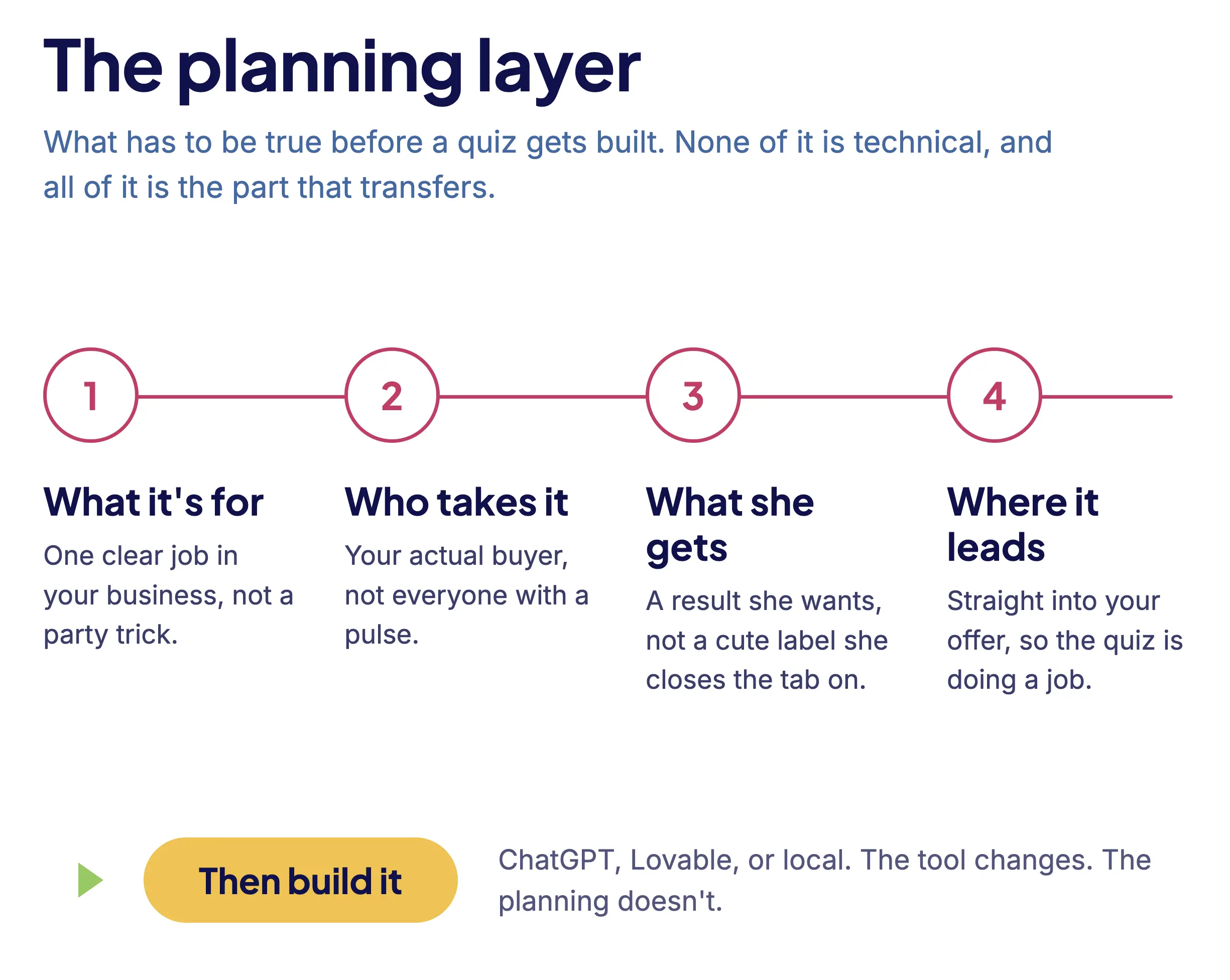
And once I could see what was going on- that I'd been building things I loved making and didn't want to own- the alignment rule kicked in the same way it had with the second planner. Except this time I knew what I was looking at. So I stopped building versions of other people's tools and started asking a different question: what would I be excited to own? What's the thing I'd want to still be running in five years?
That question is why I'm several days deep into infrastructure right now on something I haven't talked much about yet. It's not features, and it's not the fun part; it's wiring, making sure the plumbing is right so it can hold weight later (this is an absolute test of my patience...haha, but it's also showing me the depth of my conviction with this. I know this solves a huge problem, and I want it done well). Eighteen months ago, a stretch like that would have made me itchy, and I'd have gone looking for the next shiny build so I could feel productive (or at least something else to design). Now I can sit in it, because I've finally learned the difference between "this is boring" and "this is wrong." Boring is fine, because boring is just the part of the work that never gets screenshotted, but wrong is the job board feeling, and I know that one when I see it.
The hard part was leaving it alone
Three words keep coming up for me about this stretch, and Guanacaste Direct is where all three of them live.
I built it, wired it correctly, and then did the hard thing: I left it alone. Search engines take time; there's no hack for that and no ad budget that makes Google trust a new site faster, and I knew that going in. So I didn't forget about it or abandon it. I trusted that it was doing what it was designed to do. I was patient while it did, and I kept working on other things instead of poking at it every week to feel better.
That's what the last 18 months have actually been about, underneath all the building: learning to tell the difference between something that isn't working and something that's working slowly...as was intended.
And somewhere in there I stopped thinking of building as a series of launches and started thinking of it as a practice. Sports analogies always come to mind for me, so bear with me (says the non-athlete, lol). Often an athlete practices and plays for years before she makes the team she actually wants to be on, and no one looks at those years and calls them wasted, because that's obviously how you get good. But in business we don't look at it that way. If you built something and didn't sell it, the assumption is that something went wrong, and that needs to shift. (Bro-marketers be damned for preaching "ship it fast!" That said, of course, there's value in getting people to use your product, but let's stop looking outside ourselves for answers to everything. Most of the time, when we allow ourselves a little grace, we can feel in our gut what is right for us).
You don't have to be doing something just so you can sell it.
The more you stick with it, the more you learn... and that's the practice. So when I say none of it was wasted, I don't just mean the apps. I mean the systems, processes, skills, and workflows I've built along the way; the way I plan a build now before I ever open an editor; and the fact that I finally know what I want to own. None of that shows up on a sales page. All of it shows up in how fast I can go from idea to working thing, and in how much I enjoy the getting there.
If you've spent the last year or two learning and building and tinkering without putting a price on any of it, you have not fallen behind the people who launched loudly. You've got a different pile of assets.
Yours are just harder to screenshot. 😉
Which is what I'm teaching on October 1st
When I look back at everything that's ever worked for me, it's the same pattern. I was frustrated with something, figured it out, practiced it, and then taught it. And the one thing from the last 18 months that I both figured out the hard way and still light up about is the planning layer underneath a quiz. It isn't the platform; it's the thinking, so that's what I'm teaching.
Turn Strangers Into Buyers is a live 90-minute workshop on Thursday, October 1st at 10 am Pacific, and we're building a lead-gen quiz together in ChatGPT, so there's nothing to install and no repo to touch. What I actually care about you leaving with isn't "I made a quiz (or an assessment, you can call it whatever you like)."
It's the part I described up top... how to decide what the quiz is for, how to write questions that sort people usefully instead of just entertaining them, how to design results that make someone want the next thing, and how the whole piece connects to an offer so it's doing a real job in your business.
One more thing. I had this scheduled sooner, and I moved it out a couple of weeks, because I refuse to push something out the door just to hit a date. Given everything I just wrote, that felt like the only defensible choice. 😂
It's $45. The replay is included, so if 10 am Pacific doesn't work for you live, you still get everything.
I'm not going to tell you a 90-minute workshop changes your business, because that's not what forty-five dollars buys, and you know it. What it buys is the part I spent 18 months figuring out the slow way, so you don't have to build a quiz platform you don't want to own in order to learn it.
That listing request still makes me happier than it probably should, and it might be the best summary of 18 months of building with AI that I have: something I built, wired correctly, and then had the patience to leave alone did exactly what it was supposed to do, and it did it without me watching.
What have you built that's working slowly, and are you giving it the time?

Kim Doyal
Kim Doyal is a digital marketing strategist and AI builder with 18 years of online business experience. She is the founder of AI Spark Studios and SPARK Lab, and the creator of The Hub — a custom 33-agent AI operating system that runs her entire business. She has also built kimdoyal.com, StackRewards, and multiple AI tools and agents using vibe coding, a natural language approach to building software without a traditional development background.
Keep Reading

AI Building
How to Grow Your Substack Without Living on It... Built for Freedom — Part 01
I read the article on my phone in bed before I even got up, because I was genuinely excited about it. That kind of excitement means something right now. Here's what I started building, and why the how matters as much as the what.
April 26, 2026READ MORE
AI Building
What You Built Works... You Just Don't Want to Open It
I launched SPARK Lab minimum viable and then didn't want to log into it. It wasn't broken, it was flat, and flat is the harder problem because it doesn't tell you where to go. Here's the filter I ran on my own product, and the four prompts so you can run it on yours.
July 27, 2026READ MORE
Vibe Coding
How I Built a Custom AI App in 3 Hours (A Vibe Coding Case Study)
If you've been following my journey into "vibe coding," you know I'm always on the lookout for tools that make bringing ideas to life faster and more intuitive. While I've had success with other platforms, a new tool recently caught my eye and has completely changed the game for me.
August 28, 2025READ MORE