HOME/BLOG/THE LOUDEST PROBLEM IN YOUR BUSINESS IS ALMOST NEVER THE REAL ONE
Business Growth
The Loudest Problem in Your Business Is Almost Never the Real One
Three things every business leans on, and why you probably can't see yours.
August 30, 2026|5 min read
I was incredibly lucky that my parents always made the holidays magical. My Mom was amazing at decorating and passed that on to my sister and me (my brother appreciates it all, but I can't say he's ever quite gotten into it the way we do, lol). Every year, without fail, it's the reason I decorate the way I do now... even if I've pulled back a bit in terms of how much I decorate.
I'm not one of those people who swaps out holiday decor based on what's trending. I decorate with things that hold meaning. Things that came from somewhere and carry a memory with them. Every so often I'll add something new or retire something, but the whole point is that it accumulates.
My dad started this. He had a Dickens village he set up every year, and I loved it, so at some point my parents started me on the North Pole series. Then my kids got old enough to care, and the three of us turned it into a production.
We bought a sheet of foam, something like three feet by six, and used a wire cutter to carve it so it looked like real snow drifts instead of a flat white slab. We built an ice skating rink. We made waterfalls out of resin. We took two thick PVC pipes and wrapped them in red ribbon so they'd read as candy canes holding up the front edge of the board.
(We got into it.)
Hours of prep you can't see in the photo, which is exactly why it looks like this.
But here's the part I've been thinking about lately. There was an order of operations, and it wasn't negotiable.
We had to set up the outlets (power packs), and make sure we had all the extension cords ready to go. Then the plywood, which was enormous, and I hauled it in and set it on top of a buffet over a layer of padding. Then the candy cane supports (think PVC pipes, wrapped with red ribbon to hold the front of the plywood up). Then the batting, then the foam. Only after all of that could anybody open a box and start placing buildings.
My kids loved opening the buildings (obviously). The buildings are the fun part, the accessories are the fun part, the little lit windows are the entire reason anyone does this. But if you place them first, you've got a village sitting on a buffet with no wiring underneath it and nowhere for any of it to go.
Here's the thing though...nobody looking at the finished thing is thinking about the plywood. Which is kind of the point of the plywood. 😉
It was never a 'one and done' event. It took a few days. Especially as my kids got older and we started using a wire cutter to carve the foam and use resin to make the ice skating rink and waterfall (my son was so great at that stuff).
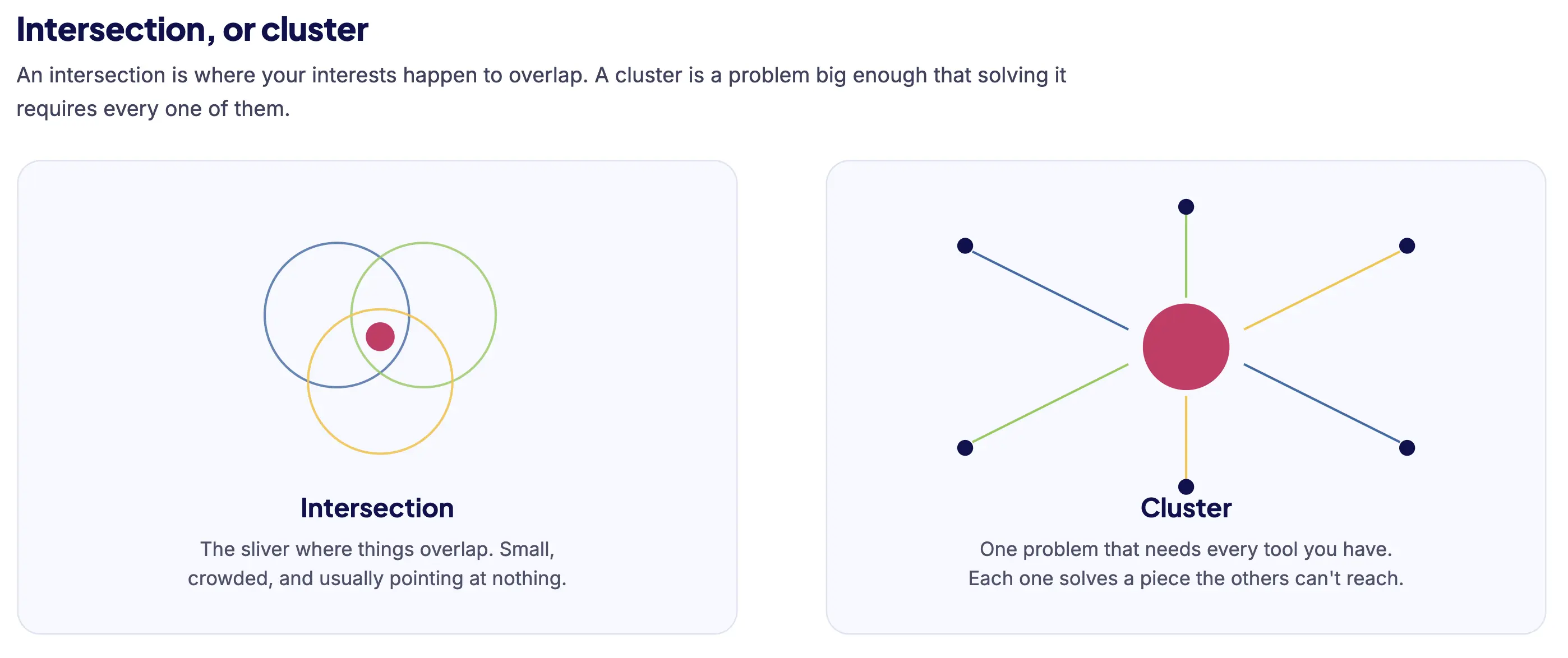
They draw a distinction between an intersection and a problem cluster. An intersection is where your interests happen to overlap. A cluster is a problem big enough that solving it actually requires every one of them, where each interest handles a piece the others can't touch. Read his version; it's his idea, and he explains it better than a paraphrase can.
An intersection is where your interests happen to overlap. A cluster is a problem that needs every one of them.
I ran the test on my own work, which is the kind of thing you do late at night when you should be sleeping.
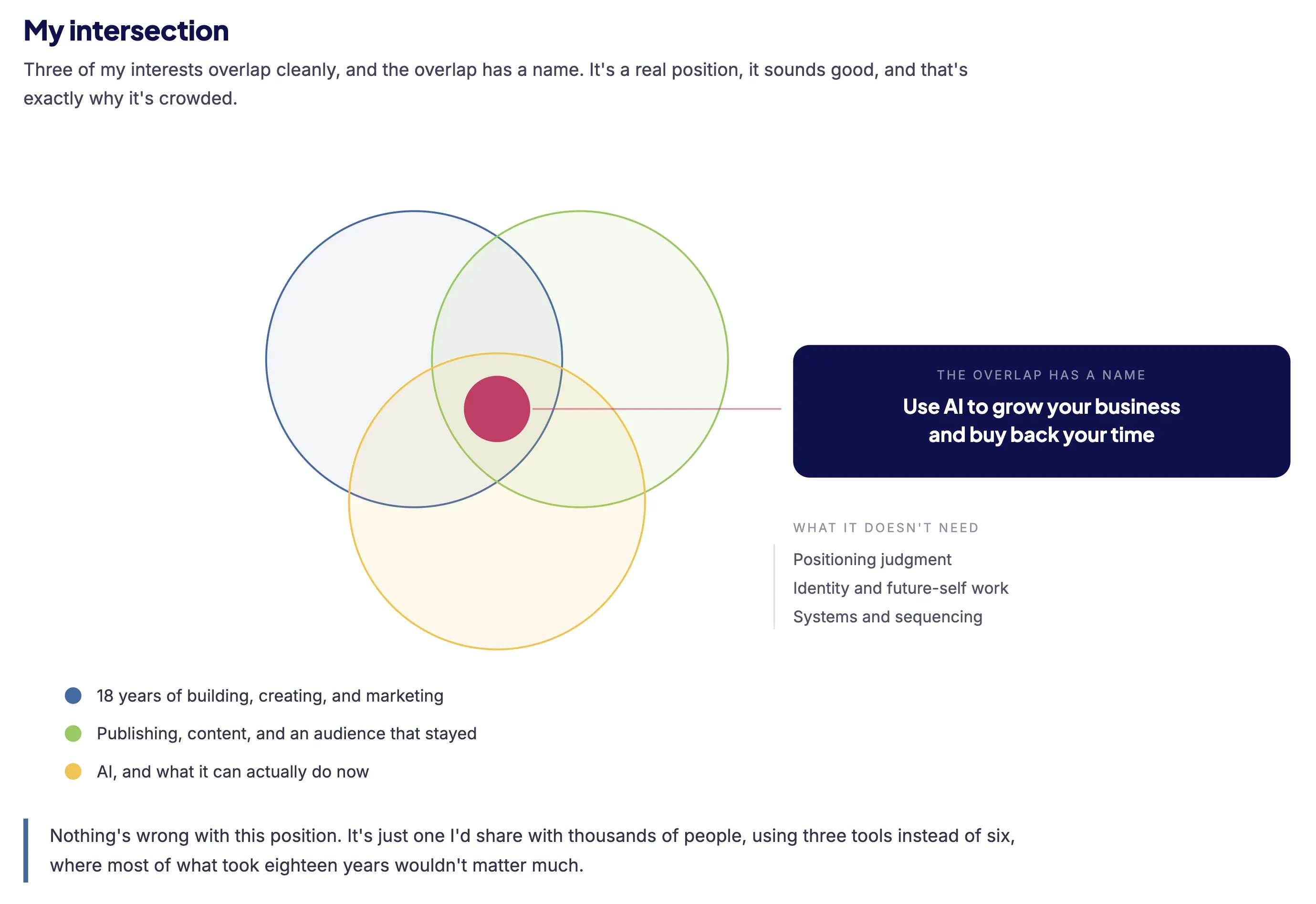
The intersection came first, because intersections are easy to find. Eighteen+ years of building and marketing, plus publishing and an audience that stayed, plus AI and what it can actually do now.
Three circles, one clean overlap, and the overlap has a name: use AI to grow your business and buy back your time.
An intersection is where your interests happen to overlap. A cluster is a problem that needs every one of them.
Nothing is wrong with that position.
It's just one I'd be sharing with thousands of other people, using three tools instead of six, in a spot where most of what took me eighteen years wouldn't matter much. Somebody two years in can stand there too, and honestly they can stand there louder (I have zero desire to be the loudest in the room).
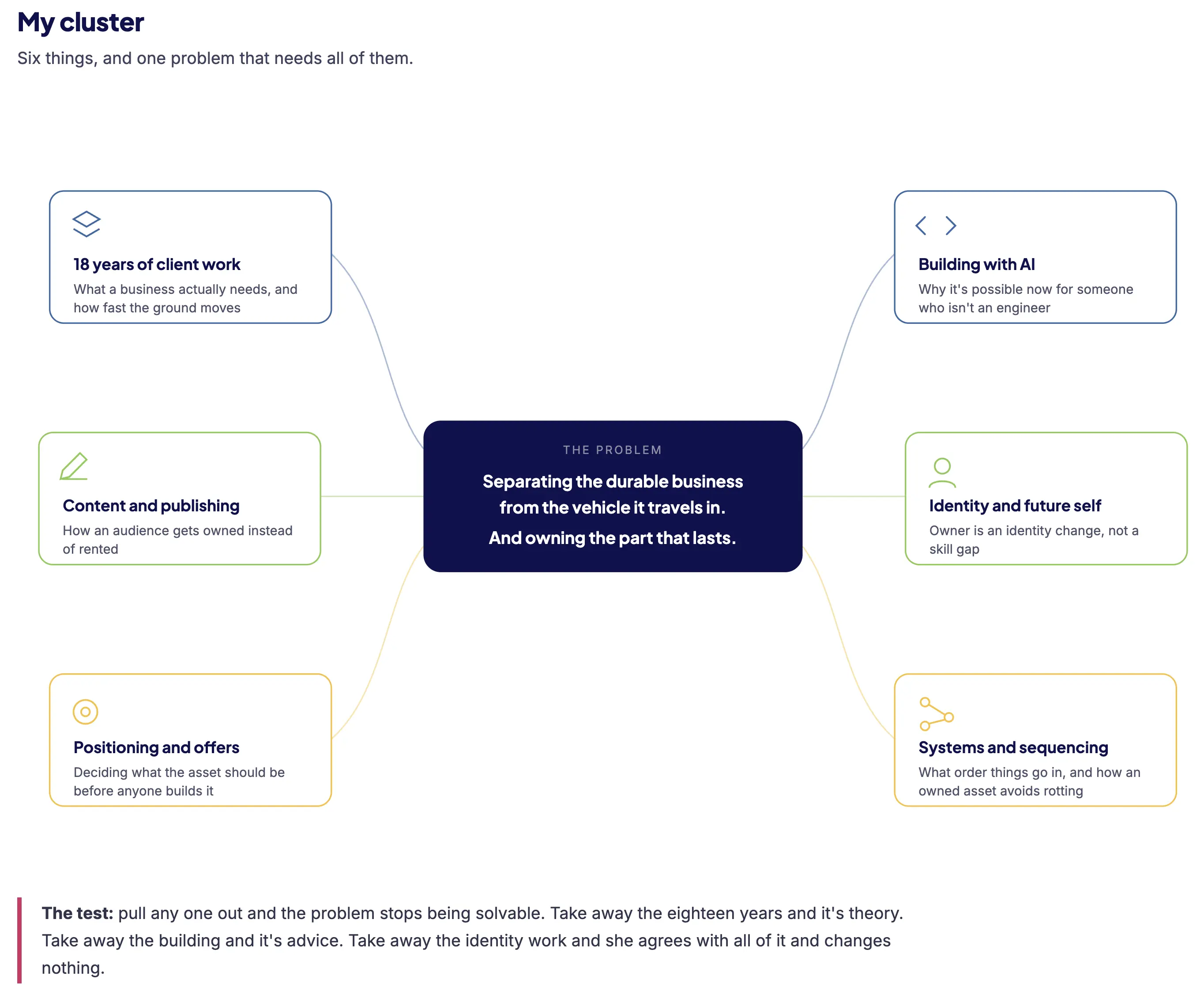
So I kept going, and the cluster looks different.
Pull any one of these out and the problem stops being solvable. That's the test.
Six things instead of three, and one problem underneath them that I've apparently been solving for years without ever naming it: separating the durable business from the vehicle it's currently traveling in. And then owning the part that lasts.
The test is whether you can pull one piece out. Take away the eighteen years, and it's theory. Take away the building, and it's advice. Take away the identity work, and she agrees with every word and changes nothing on Monday.
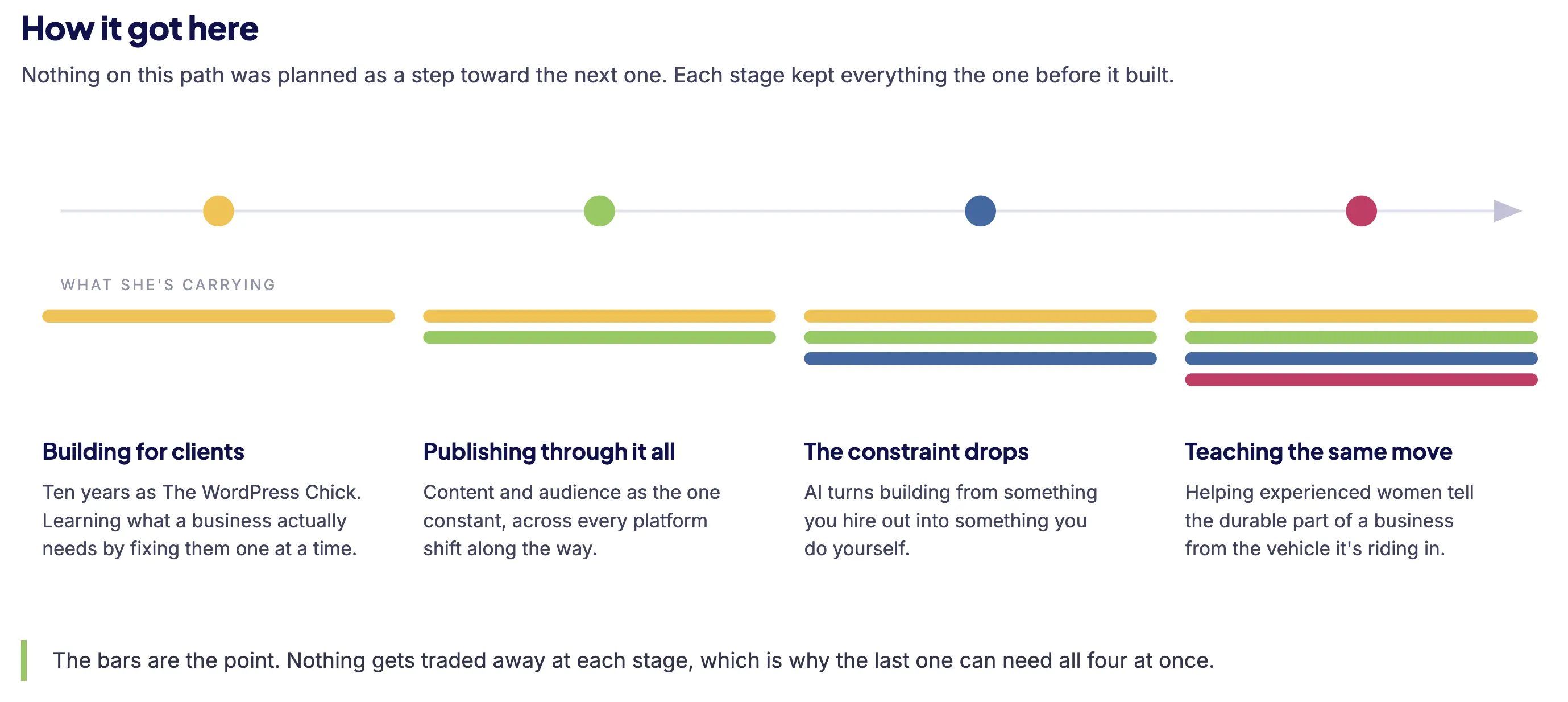
What got to me is that none of it was planned. Ten years as The WordPress Chick learning what a business actually needs by fixing them one at a time, publishing straight through every platform shift, then AI dropping the constraint so building became something I do instead of something I hire out.
None of this was planned as a step toward the next thing. The bars are the point... nothing got traded away.
Nothing on that path was a step toward the next thing. Each stage just kept everything the one before it built.
What is your business actually dependent on?
Every business I look at is leaning on something it doesn't control, and there are three candidates. The owner almost always names the wrong one.
Dependent on your clients. Revenue arrives from a small handful of people, any one of whom could leave. It looks like a business from the outside... invoices, contracts, a Stripe dashboard with real numbers in it. From the inside it behaves like a job with four bosses instead of one, and the tightness you feel when a client goes quiet for a week is a job feeling, not a business feeling.
Dependent on a channel. Your audience lives somewhere else. Traffic comes from an algorithm, the list lives on a platform, and discovery happens inside an app that changes its mind twice a year. You built something real, and you built it on rented ground, and every time the rules shift you have to relearn how to be seen.
Dependent on yourself. The work only happens when you're in the room. Every deliverable, every decision, every piece of content runs through one person, and that person's capacity is the ceiling. This is the quiet one. It doesn't announce itself, because from the inside it just feels like working hard.
Two things about this matter more than the list.
The first is that these coexist. They aren't stages you graduate through. I've never once looked at a business and found exactly one. There are usually two running at the same time, sometimes all three, and what you feel is whichever one is loudest that week.
The second is that the loudest one is almost never the deepest one.
Dependent on yourself is the floor.
It sits underneath the other two. And it's the hardest one to see, because it doesn't look like a structural problem. It looks like a normal busy workweek.
So somebody drowning in client work will diagnose it as a lead flow problem. She'll go buy something about filling her pipeline, because more clients feels like the obvious answer to the low hum of not knowing whether the work will be there in ninety days. And she'll add volume on top of a capacity ceiling that was already the real constraint. The dependency gets worse, and the receipt says she was solving it.
Naming the wrong dependency is expensive. Not just in money, although yes, in money. It's expensive in the year you spend fixing something that wasn't broken.
What Tracy actually has
Tracy came to me wanting to learn how to build with AI and was building a business around her success on Substack. That was the premise. Substack was working; that's where she was getting traction, and on the outside it looks like she has a business about Substack.
Except that's not what she has.
What Tracy has is the judgment to look at somebody's publication and see what isn't connecting. Not the surface stuff. The actual gap between what the person is writing and what a reader would need in order to care. And then she can guide them toward something stronger, which is a different skill from noticing, and rarer.
That travels. It works on a Substack, it works on a newsletter that isn't on Substack, it works on whatever the next thing is that we're all supposed to be on in three years.
A course about this quarter's Substack algorithm does not travel. It has a shelf life measured in months, and it's dependent on a channel she doesn't control, by design, from the day it launches.
Substack is the vehicle.
Her strategic judgment is the business.
That distinction is worth real money to her, and she was one decision away from building the other thing.
Why does all of this feel so tiring?
Because it isn't AI making you tired. There's something I hear from women at every stage, whether they're two years in or twenty, and it predates any of this.
They're tired of performing.
The daily posting, the format of the month, the thing where you learn a new video length because an app decided. And it's easy to point at AI as the cause of that fatigue, except AI is about three years old in any practical sense, and this feeling is much older.
Social media has been the price of doing business for two decades now. That's a long time to be on.
I think it hits differently if you remember an analog life.
If you had a stretch of adulthood where nobody could reach you after six, where a weekend was actually a weekend, then part of you knows what the alternative feels like and keeps registering the difference.
That's not nostalgia.
It's a comparison point, and having one is why the pull feels like a pull instead of weather.
(Younger folks who came up entirely inside this probably can't picture what we're comparing it to, which is its own thing and not a lesser one.)
It gets costly when the performing gets mistaken for the business itself. When being tired of it starts to feel like evidence that something's wrong with you, rather than evidence that you've built on ground you don't own and the rent is due daily.
That's a structural condition. Structural conditions can be changed.
Now the AI question gets easier
Once you know what your business depends on, the AI question stops being infinite and starts being answerable.
Here's why that matters.
I don't think many people are walking around consciously thinking "I'm falling behind on AI." It's not that loud. It's more of a hum, a low-grade background thing given how fast everything is moving, and it surfaces as a vague sense that there's a list somewhere and you're not on top of it.
That hum has a source: the question you're carrying is too big to ever finish answering.
"What should I be automating?" takes in everything.
Your inbox qualifies, your invoicing qualifies, the way you write a proposal qualifies, and so does every tool demo you scroll past. A question that big doesn't get answered; it just accumulates.
But once you know what your business is actually leaning on, the question changes shape entirely.
It becomes: what's holding this up, and what would actually relieve it?
That has edges, and it's answerable (or at least it's a much better place to start). And the part I genuinely love is that everything outside the boundary becomes a legitimate no instead of a thing you haven't gotten around to yet.
It stops being "I should probably automate my social scheduling eventually" and starts being "that isn't touching my constraint, so no," which is a completely different feeling to walk around with.
The two reasons to keep something
There are two, and the order matters, because leading with the wrong one turns this into a rules exercise.
Reason one: you keep it because you enjoy it.
That's a whole reason.
It doesn't need a business case stapled to it. The creating is the fun part for a lot of us, and handing it off because AI could technically do it is the fastest route I know to ending up with a business you don't want to be in. You built this thing so you could do work you like. Automating the work you like in order to have more time for the work you don't is a trade nobody would make on purpose, and yet.
I've watched people hand over the exact piece that made them want to do this in the first place, because a tool existed and existing felt like an obligation.
Reason two: you keep it because it requires your judgment.
This one's harder, because it's a standard rather than a comfort. Some work carries your discernment in it and produces something meaningfully worse without you. That's not sentiment; that's a quality floor, and it's worth defending on those terms.
I drop articles into my own site and do the editing and formatting myself, in a CMS I built. Every step of that could be automated. I've built harder automations than that one. I'm not auto-publishing anything I haven't looked at, and I have no plans to start.
That is not a gap in my automation. It's a choice. It's reason one and reason two at the same time, and I can say why in one sentence, which is the actual test.
How do you find your real bottleneck?
Run a structured diagnostic on yourself instead of guessing, because guessing is what produced the wrong answer in the first place.
I built one for exactly this. It's called The Bottleneck Breakthrough, and it walks you through a set of questions and tells you which of the three your business is actually leaning on, which one you're most likely to blame instead, and what to do about the real one first.
It exists as a tool rather than a checklist because dependency makes self-diagnosis hard. You can't reliably spot the constraint you've been living inside. A structured set of questions can, because it asks about things you wouldn't think to mention.
If you'd rather not hand over an email address to find out something about your own business, fair enough. Here's the manual version.
Open a chat with whatever AI you use.
Paste the prompt below, filling in the bracket with your actual situation.
Answer the five questions one at a time, honestly, including the parts that feel too small to mention.
I'm going to describe my business, and I want you to help me find the real constraint, not the loudest complaint.
Here's my situation: [describe your revenue sources, roughly how many clients or customers, where your audience comes from, and what you personally do every week that nobody else does].
Ask me five questions, one at a time, to figure out which of these three my business depends on most: a small number of clients, a channel I don't control, or my own capacity.
After my answers, tell me which one is load-bearing, which one I'm most likely to misidentify as the problem, and one specific thing I could change in the next 30 days that would relieve the real one. Be direct with me.
The one-at-a-time part matters. If you dump everything in at once, you'll get a tidy summary of what you already told it. The questions are what surface the thing you didn't mention because it didn't seem relevant.
So... remember the Christmas Village I shared above?
We got faster and fancier every year. The last few Decembers we did it, my kids could have run the whole setup without me, and their creativity was wonderful to watch.
But not one of those years did anybody suggest starting with the buildings.
The prep wasn't the boring part standing between us and the fun part. The prep was the reason the fun part held together, and the reason the whole thing lit up when we plugged it in, and the reason it looked, from the outside, like it had assembled itself.
Your business has plywood under it somewhere. Worth knowing what shape it's in before you decide what to add on top.
Kim Doyal is a digital marketing strategist and AI builder with 18 years of online business experience. She is the founder of AI Spark Studios and SPARK Lab, and the creator of The Hub — a custom 33-agent AI operating system that runs her entire business. She has also built kimdoyal.com, StackRewards, and multiple AI tools and agents using vibe coding, a natural language approach to building software without a traditional development background.