HOME/BLOG/AI TRAFFIC INTELLIGENCE - WHAT I RUN BEFORE I CREATE ANYTHING
AI Building
AI Traffic Intelligence - What I Run Before I Create Anything
Seven research agents, real findings, and the prompts that get you 80% of the way there.
July 6, 2026|5 min read
QUICK ANSWER
AI traffic intelligence means using AI tools and agents to map your competitive landscape, find content gaps, audit your search visibility, and spot paid ad opportunities... all before you create a single piece of content or spend a dollar. You can start with a single prompt in ChatGPT or Claude, go deeper with research tools like Perplexity and the Meta Ad Library, or build automated agents that run the full analysis for you. This intelligence layer is what separates "posting and hoping" from "knowing exactly where the opportunities are."
Last week I mapped the six AI traffic channels that actually work in 2026: Discovery engines, AI search visibility, automated distribution, paid amplification, relationship traffic, and traditional SEO. If you missed it, start there, because this post lives underneath all six of them.
But let me tell you what kicked off this whole series in the first place.
I'm part of a Meta paid traffic community, and a few weeks ago I was on a call where a woman mentioned she uses Manus... that it connects to everything in Meta's ad suite. I'd already been poking around Manus, but hearing that got me a little excited. It's been a few years since I've run any Meta ads, and working with the ad manager is one of my least favorite things, lol (not to mention there have been massive changes since I've used it). If I can have Manus set up the technical side from the beginning, then I go through and check everything? I'm all in (it can't actually publish the ads for you).
I opened it up and typed one question: "What can you help me with in terms of Meta ads?"
One question. That's it.
What came back was a six-section strategic plan. Audience positioning for Sandra (my actual customer persona), a hybrid funnel architecture with an engagement layer feeding a conversion layer, three fully written creative angles with ad headlines and copy, a technical implementation roadmap covering pixel setup and Conversions API, budget allocation, and a QA checklist using my own Sandra Test.
In one afternoon, from one prompt. Because someone on a call mentioned it.
I'm not sharing this to tell you to go use Manus for ads. That's a whole post in itself (and it's coming after this traffic series and I've launched my ads). I'm sharing it because that afternoon felt like a huge "duh!" to use AI for traffic. It made me realize that the research layer... the intelligence you gather before you create anything or spend anything... is the part that makes every other channel work. And almost nobody is talking about it as an AI strategy that helps drive traffic.
That realization became this series. And the research layer became Layer 1.
Why Does AI Traffic Research Come Before Content?
Doing research before creating content is hardly a new concept, and I know many of you do this. With AI, though, we can do it in a fraction of the time. AI traffic research uses AI to understand where your audience already is and what they're already looking for before you create or spend anything. It's the intelligence layer. You're gathering the map that tells you what's worth making (obviously this is contingent on the type of content you're going to create and what your goals are).
I've been doing this for 18 years, and I'll be honest with you: It was easy to skip this step. Not because I was lazy, but because the research part used to be genuinely miserable. Hours of scrolling competitors, squinting at search results, guessing at what my audience wanted, and calling the guess "strategy" (and I hate logging in to Google Analytics as much as I hate using Meta's ad manager).
Here's what changed. The research layer used to cost time I didn't want to spend. Now it costs a prompt. And the gap between running research and not running research is the gap between knowing where the opportunities are and hoping your next post finds one.
So instead of explaining the concept, let me show you what it looked like this week.
What Did Seven Research Agents Actually Tell Me?
I pointed seven different agents at my own business... competitive analysis, content gaps, ad intelligence, YouTube, Pinterest, Substack, and SEO... and they all came back pointing at the same door. These aren't new agents; I built them a while back (the Content Gap Analysis was created by Dheeraj Sharma of Gen AI Unplugged. I'm incredibly grateful to Dheeraj for creating that because it inspired me to take the leap and learn how to set these up, which spurred many more).
The point of running seven instead of one is that each looks at a different surface. You learn the most from where they agree.
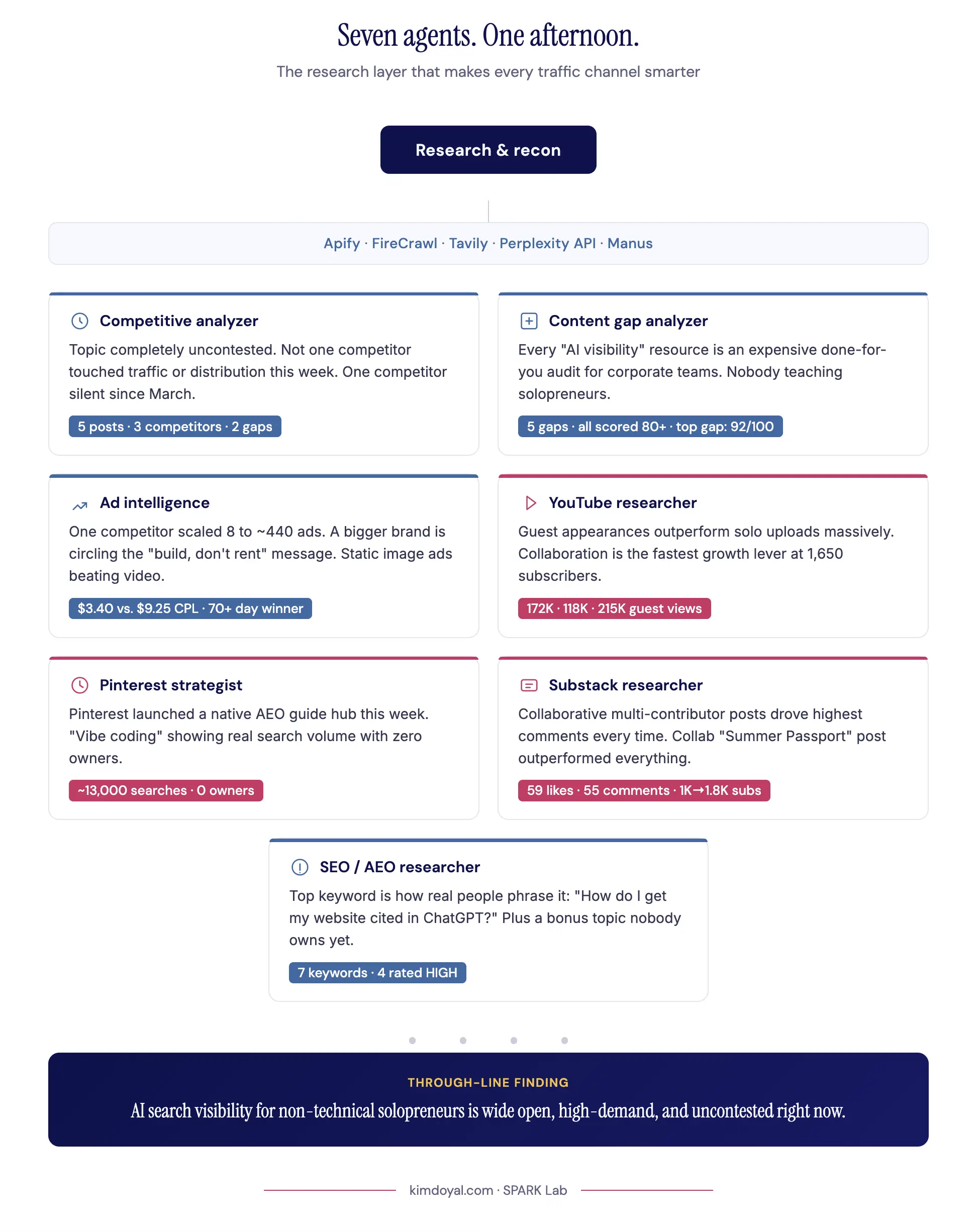
Seven agents, one afternoon. Every number here came from a real run against my own business this week.
Competitive Analyzer looked at what other people in my space published this week. Not one competitor touched traffic or distribution as a topic, which means the whole angle I'm building right now is uncontested. Five new posts across three active competitors, two flagged as high-opportunity gaps, and one competitor has gone completely silent since March.
Content Gap Analyzer scored where the demand is high, and the coverage is thin. It found five content gaps, and all five scored 80 or higher out of 100 (the top one hit 92). The pattern was clear: every company moving into "AI visibility" is selling it as an expensive done-for-you audit for corporate marketing teams. Nobody is teaching a solopreneur how to check and fix her own AI search visibility.
Ad Intelligence Researcher read what my competitors are paying to say. One competitor scaled from 8 Meta ads to roughly 440 in a few months, with her best-performing ad running 70+ days straight. But the more interesting finding? A bigger, better-funded brand is quietly circling the exact "build your own tool instead of renting one" message I've been making. And static image ads are beating video on cost... $3.40 vs. $9.25 per lead.
YouTube Researcher found that the creators winning in my niche aren't growing on their own channels. They're borrowing other people's audiences through guest appearances. Guest spots pulled 172K, 118K, and 215K views while their own uploads lag. My channel sits at 1,650 subscribers and 33 videos, so collaboration is a faster lever than waiting on organic growth.
Pinterest Strategist surfaced something I didn't expect. Pinterest itself just added a native "Answer Engine Optimization" guide hub within the last week. And "vibe coding" is showing real search volume with nobody teaching it yet... roughly 13,000 searches on Pinterest, with essentially zero owners in that space.
Substack Researcher found the single most consistent pattern across every publication scanned: collaborative, multi-contributor posts drove the highest comment counts. Every time. My own collaborative "Summer Passport" post (59 likes, 55 comments, 20 restacks) beat everything else I published.
SEO/AEO Researcher pulled the highest-opportunity keyword, and it's almost word-for-word how real people already phrase it on Reddit and Quora: "How do I get my website cited in ChatGPT?" Seven keyword opportunities surfaced, four rated high. Plus a bonus find... an Instagram Reel warning that "vibe-coded websites look good but don't get found," pointing to a topic nobody owns yet (not sure I believe that re vibe-coded websites. I'll do more research on that. If the structure is correct, it shouldn't matter how it's built).
The through-line all seven agreed on: AI search visibility for non-technical business owners is wide open, in high demand, and uncontested right now. And yes, maybe I should be more cautious in sharing 'wide open' opportunities here, but I truly don't have the energy to be bothered about that. There's enough to go around for everyone, and I trust my processes.
That decision to talk about "AI search visibility" for non-technical business owners isn't an opinion... it's based on research.
What Tools Power The Research Agents?
Five tools, each handling a different piece of the intelligence pipeline. You don't need all of them. You don't even need any of them to start. But knowing what's possible helps you see where the ceiling is.
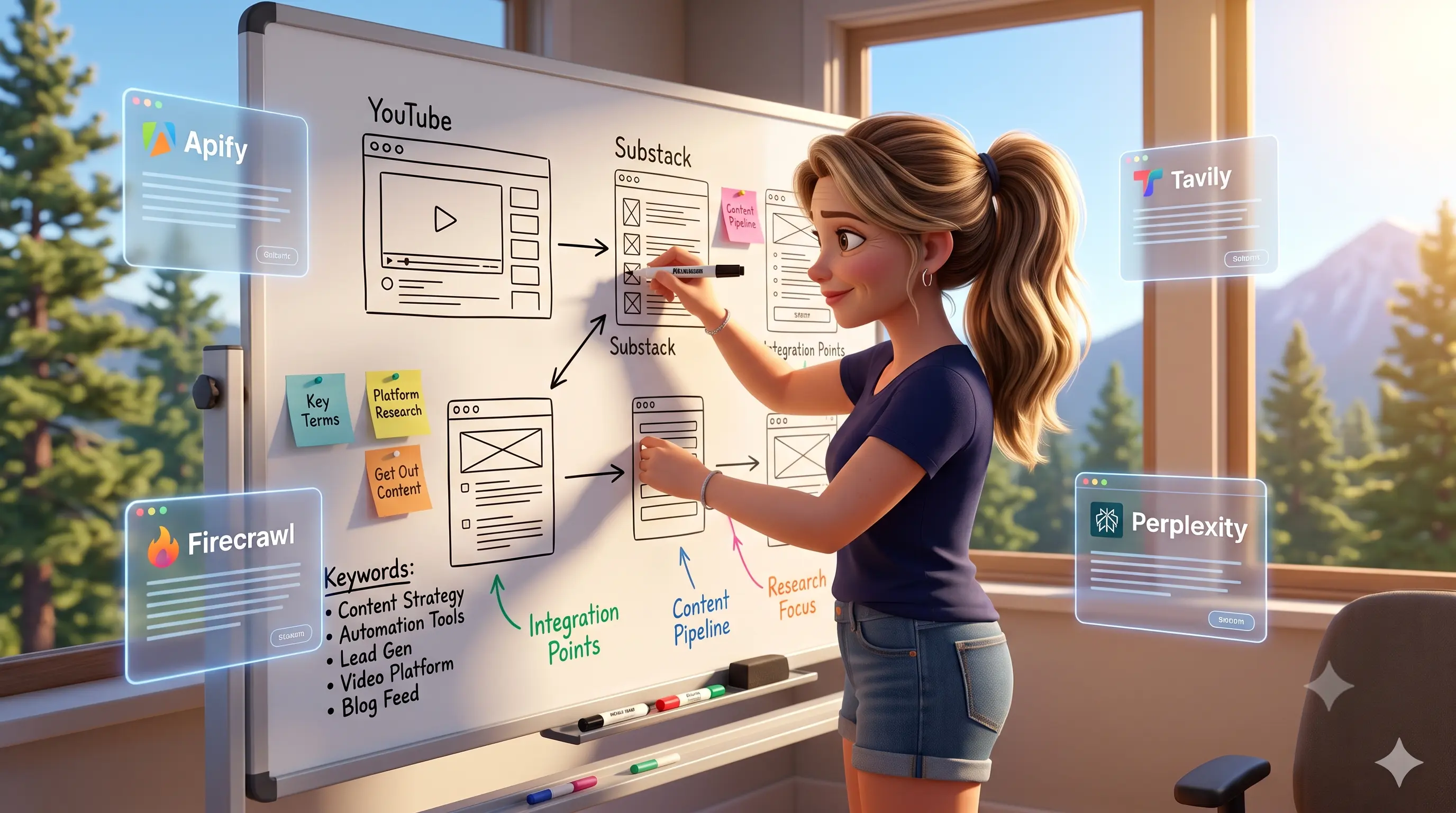
Apify handles web scraping at scale. It pulls structured data from websites, social platforms, and directories. This is the data collection layer... the part that goes out and gathers raw information.
FireCrawl crawls and extracts content from websites, turning messy web pages into clean, structured data that an AI can analyze. If Apify is the scout, FireCrawl is the translator.
Tavily is an AI-native search API. It's built specifically for AI research workflows, which makes it better than asking ChatGPT to "search the web" when you need structured competitive intelligence.
Perplexity API does research-grade AI search. It pulls from real-time sources, cites everything, and is excellent for competitive and market research where you need current, verified data.
Manus is the autonomous agent. You give it a goal, it executes across multiple steps, and you come back to a finished report. That Meta Ads Master Plan I mentioned at the top? Manus built that without me sitting there clicking through tabs.
These tools aren't the point. The questions they answer are the point. And you can ask those same questions without any of them.
What If I Don't Want to Build Agents?
You don't have to. I already built tools that cover the core research functions. Inside SPARK Lab. There are four tools that feed this exact step:
Niche Scout gives you competitive landscape intelligence and content gap analysis in one run. It's the "who's in my space and what are they missing" tool.
Search Presence Audit answers the question of where you show up in traditional search. If you're invisible on Google for your core topics, this tells you and tells you why.
Visibility & Authority Audit goes further... it checks where you show up in AI engines. When someone asks ChatGPT or Perplexity a question your business should answer, are you in the response? This is the tool that maps the gap between where you are and where you should be.
SEO Keyword Research, aka Content Compass, surfaces the keyword opportunities you're missing, ranked by difficulty and opportunity size.
I built these tools because I was already doing this research by hand and wanted it faster. They exist inside SPARK Lab at $15/month so you don't have to wire your own agents if you don't want to. (Not sure where you fit? Take the Build Path quiz to find out where you should start.)
But notice the order.
The tool followed the habit. If you don't have the tools yet, build the habit first. The habit is what drives everything and is the true asset. The tool just makes the asset cheaper to run.
How Do I Start Building AI Traffic Intelligence Today?
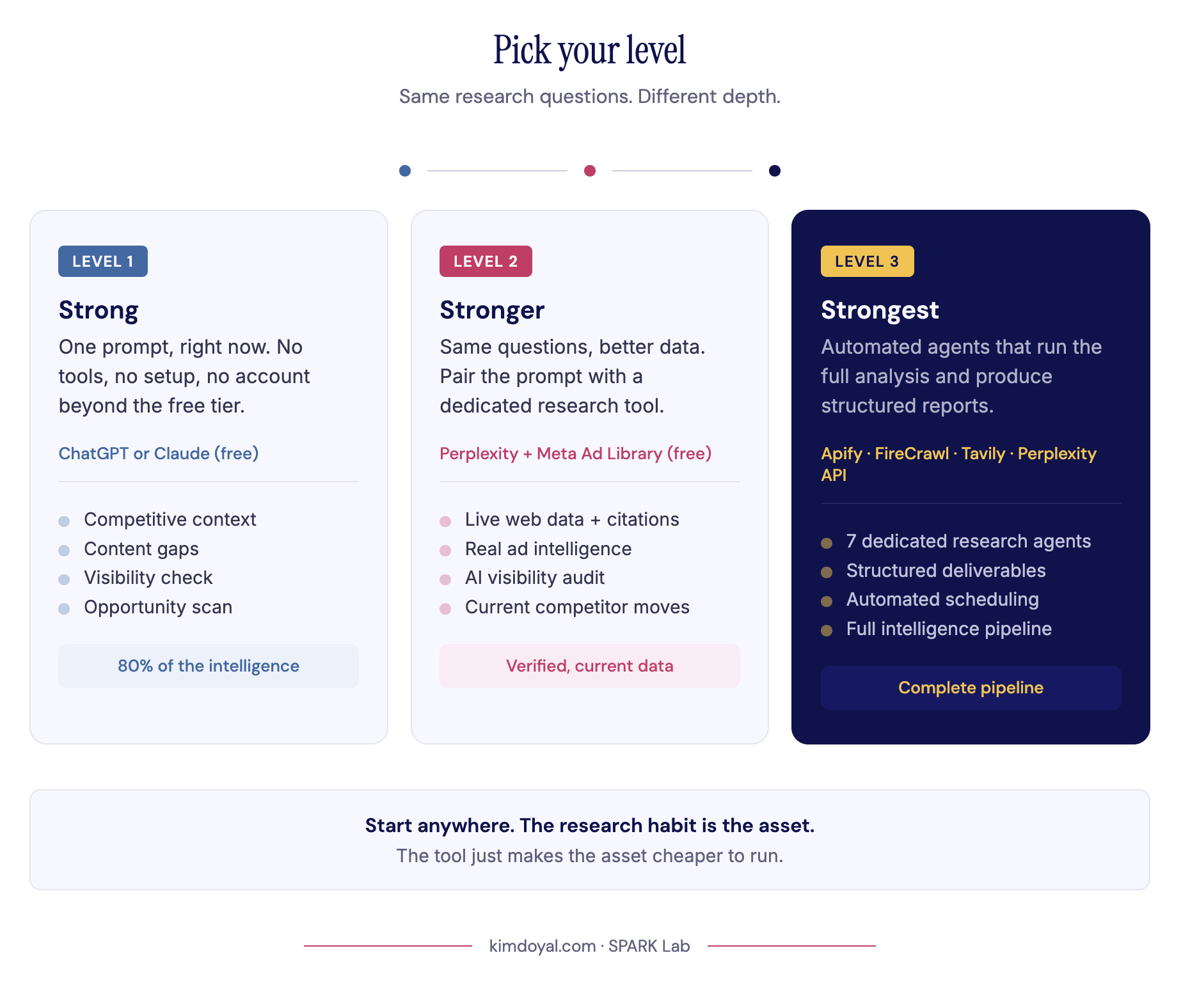
Pick your level. Every option below answers the same core research questions... the difference is depth, automation, and how much of the work AI does for you versus with you.
Same research questions at every level. The difference is depth, not difficulty.
LEVEL 1: STRONG (One prompt, right now)
What it is: A single prompt you paste into ChatGPT or Claude. No tools, no setup, no account needed beyond the free tier. Who it's for: You're using AI for chat and ready to ask it smarter questions.
Open Claude or ChatGPT and paste this in, filled out for your business:
I run [your business, in one sentence]. My ideal customer is [who they are]. I want to understand my traffic and visibility landscape before I create content. Based on what you know: What questions is my ideal customer asking that I could answer? Who's already covering this well, and where are the gaps? If someone asked you a question my business could answer, what kind of content would you cite as the source? And what are the three most specific content opportunities you see right now?
That single prompt gets you competitive context, content gaps, and a visibility check in one shot. It's not the full seven-agent treatment. But it's the same instinct, and it'll get you 80% of the way there.
LEVEL 2: STRONGER (Prompt plus a tool)
What it is: The same research questions, but now you're pairing the prompt with a dedicated tool that gives you better data. Who it's for: You're comfortable using AI and ready to add one more tool to the mix.
Competitive research: Use Perplexity (free tier) instead of ChatGPT for your competitive landscape questions. Perplexity searches the live web and cites every source, so you're working with current data, not training-data memories.
Search the web for the top 5-10 businesses, creators, or publications actively covering [your topic] for [your audience] right now. For each one: What are they publishing this month? What positioning or angle are they using? How are they driving traffic... organic, paid, social, or email? What gaps do you see in their coverage that a solopreneur with real experience could fill? Cite your sources.
Ad intelligence: Open the Meta Ad Library (completely free, no account needed) and search your competitors' names. You'll see exactly what ads they're running, how long they've been running, and what angles they're testing. This is the same data my ad intelligence agent pulls... you're just doing it manually. This is also a great place to look at what offers your competitors are selling (think of this as a small piece of validation: competition means people are buying).
AI visibility check: Search your name, your brand, and your core topics in ChatGPT, Perplexity, and Google's AI Overviews. Screenshot the results. Then ask Claude to analyze what's showing up and what's missing. You just did a manual version of what my SEO/AEO agent does.
Here are screenshots of what comes up when I search for [my name/brand/topic] in AI tools. What's showing up and what's missing? Where am I visible, where am I invisible, and what's the single highest-impact thing I could do to improve my AI search visibility?
LEVEL 3: STRONGEST (Automated agent pipeline)
What it is: Dedicated research agents that run the analysis automatically and produce structured reports. This is what I showed you at the top of this post. Who it's for: You're building with AI, comfortable with tools, and want the full intelligence pipeline running on a schedule.
This is seven agents wired in Claude Code, running on Apify, FireCrawl, Tavily, and the Perplexity API. Each agent has a specific job and produces a specific deliverable. I run them before making content, advertising, or platform decisions.
Run a competitive analysis for [your business URL]. Use Apify to scrape the top 10 ranking pages for [your primary keywords]. Use FireCrawl to extract their content structure, publishing frequency, and topic coverage. Use Tavily to check their backlink profiles and domain authority. Use Perplexity API to verify their AI search visibility... are they being cited in AI-generated answers? Produce a competitive landscape report that includes: who's ranking, what they're publishing, how they're positioned, and where the coverage gaps are. Flag any competitor who has gone silent in the last 90 days.
You do NOT need to be at this level to get value from AI traffic intelligence. The "Strong" prompt above will give you more competitive intelligence in ten minutes than scrolling your competitors' feeds for a month. Start there. Build up when you're ready.
What Should I Do With The Research Once I Have It?
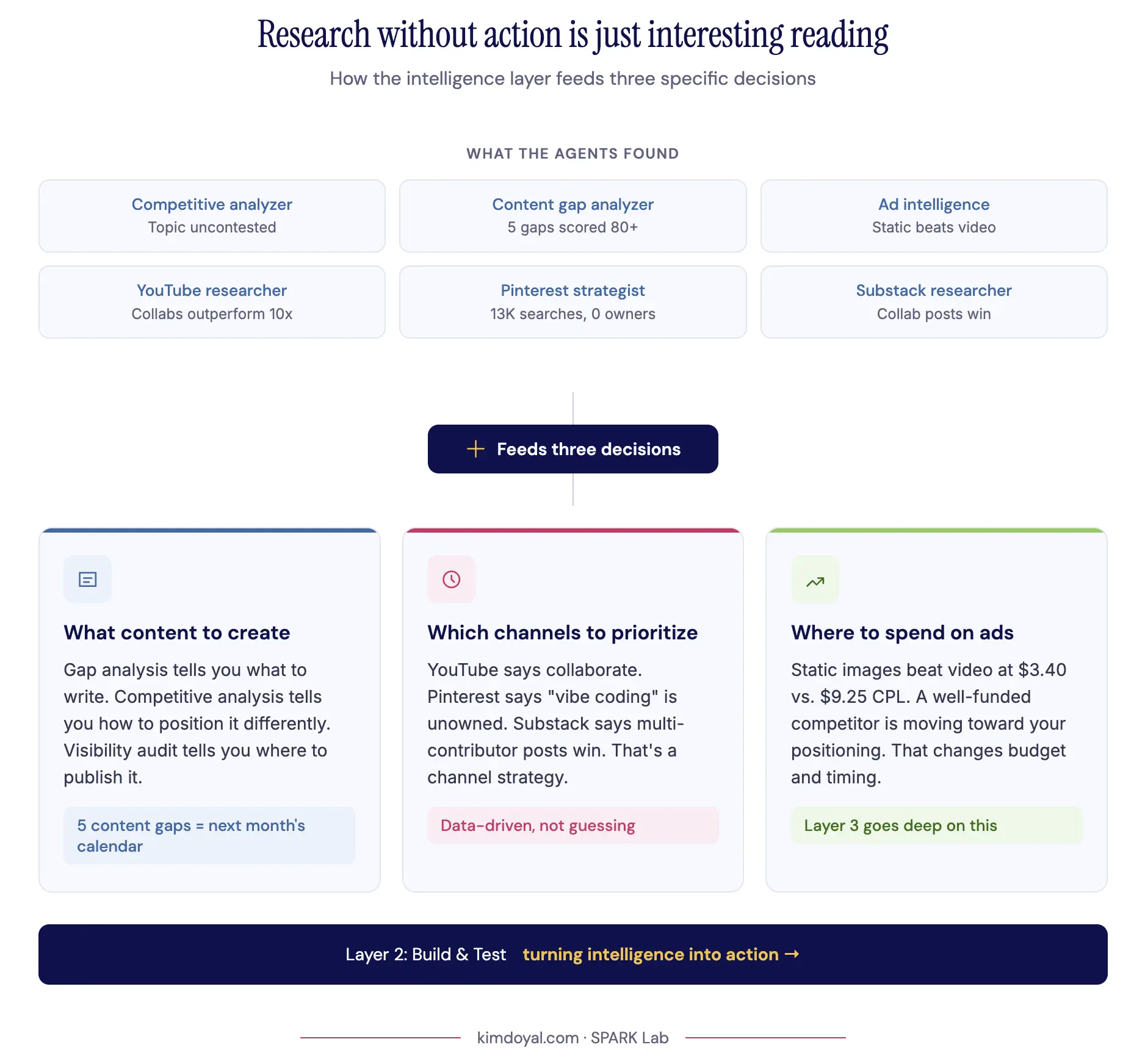
Research without action is just interesting reading. The output from any level above should feed three specific decisions:
Research without action is just interesting reading. These three decisions are the whole point.
What content to create next. Your gap analysis tells you what to write. Your competitive analysis tells you how to position it differently. My content gap agent scored five topics at 80+ out of 100... that's my content calendar for the next month, handed to me by data instead of guessing.
Which channels to prioritize. My YouTube agent told me guest appearances outperform solo uploads by 10x or more. My Pinterest agent found 13,000 searches for a topic nobody's teaching. My Substack agent showed that collaborative posts consistently beat solo ones. That's not a hunch... that's a channel strategy.
Where to spend your first dollar on ads (if and when you're ready). My ad intelligence agent showed me that static images are beating video on cost-per-lead right now, and that a well-funded competitor is moving toward my positioning. That changes how I allocate budget and when. We'll go deep on paid amplification in Layer 3.
Your Move This Week
Same format as last time.
One thing, not ten.
Open Claude, ChatGPT, or Perplexity and ask it a question your ideal customer would ask... the kind of question that should lead them straight to you. Then read the answer like a scout, not like a person checking your ego.
Are you in it?
Who is?
What did the AI pull from, and what made that source easy to cite?
Now take it one step further than last time. Screenshot what comes back. Compare it to your last three blog posts or emails. Is there a gap between what you're creating and what the AI is actually citing? Write that gap down. That's your AI traffic research telling you exactly what to build next.
Next in this series, we go from intelligence to action. Layer 2 is Build & Test... turning this research into actual content, assets, and campaigns across all six traffic channels. My gap analysis told me AI search visibility for solopreneurs is wide open and uncontested... next post, I'll show you exactly what I'm building there. Because knowing where the opportunities are is only valuable if you build something there.
Pick your question, screenshot the answer, and find the gap.
Just one.
Frequently Asked Questions
Frequently Asked Questions
Do I need to use all seven research agents to get started?
No. Start with one prompt from the "Strong" level above. You'll get more competitive intelligence from a single well-crafted Claude or ChatGPT prompt than you'll gather in a month of scrolling competitors' feeds.
How much do these research tools cost?
The "Strong" prompts are free... ChatGPT and Claude both have free tiers. Perplexity has a generous free tier. The Meta Ad Library is completely free, no account needed. The agent-level tools (Apify, FireCrawl, Tavily) have free tiers for light usage and paid plans starting around $30-50/month each. SPARK Lab is $15/month and covers the core research functions without any agent setup. *For my personal agents I run them with Claude Code in VS Code on my desktop, connected to my Claude Max Plan. I have an API key connected to SPARK Lab (required for any 3rd party paid aps. VS Code is free, which is why I'm able to use my Claude plan there).
How often should I run this kind of research?
Competitive and content gap analysis: quarterly. Search visibility audit: monthly. Ad intelligence: before any new campaign. The agent-level setup makes this easy because it's automated, but even the manual version takes 30-60 minutes per quarter. I have some of these running on schedule twice a month, with an email being sent to log into my Hub to check the output. I may switch this to once a month. It depends on your niche and how quickly things change.
Is this different from regular SEO keyword research
Yes. Traditional keyword research tells you what people search for on Google. AI traffic research tells you where you're visible (or invisible) across all discovery channels... search engines, AI assistants, social platforms, and paid ads. Keywords are one input. This is the full picture.
What if my competitors aren't running ads?
That's useful intelligence too. My competitive analyzer found that not one competitor in my space touched traffic or distribution this week. That gap is the opportunity. If nobody's there, you don't need to out-spend anyone. You just need to show up.
What if I don't know who my competitors are?
That's actually the perfect reason to start with the "Strong" prompt. Ask Claude or ChatGPT: "Who are the top 5-10 people or businesses covering [your topic] for [your audience]?" You'll have a competitive landscape in two minutes that would have taken you a week of manual research. You can't analyze competitors you haven't identified, so this is legitimately step one.
Can I use this research for my clients' businesses too?
Absolutely. The prompts and frameworks work for any niche. If you run the agent-level version, you can produce client-ready research reports. (This is actually one of the most valuable applications for service-based solopreneurs.)
Your obvious offer is hiding in plain sight.
Free. Tell it what you know and who you help, and it'll show you the offer everyone can see but you.
Kim Doyal is a digital marketing strategist and AI builder with 18 years of online business experience. She is the founder of AI Spark Studios and SPARK Lab, and the creator of The Hub — a custom 33-agent AI operating system that runs her entire business. She has also built kimdoyal.com, StackRewards, and multiple AI tools and agents using vibe coding, a natural language approach to building software without a traditional development background.