HOME/BLOG/I ALMOST BUILT MY COMMUNITY ON SKOOL. HERE'S WHY I'M BUILDING MY OWN.
AI Building
I Almost Built My Community on Skool. Here's Why I'm Building My Own.
Gated fundamentals, a $99 plan to reach your own members, and no refunds. My instincts were right.
September 29, 2026|5 min read
A few years ago, a friend replied to one of my emails with a line I still think about.
"You change tools more often than I change underwear."
She wasn't wrong. I've tried most of the big course, community, and coaching platforms at one point or another, and back in my WordPress days, I went through plugin after plugin looking for one that felt right. Nothing ever quite hit.
The switching was never about chasing something new. So many of these tools felt like they'd been built by developers who never asked users what they actually needed. The experience was clunky, or the one thing I cared about was buried three menus deep, or it did most of what I wanted and made the rest impossible. So I'd move on to the next one, hoping that one would finally get it right.
That was all before I started vibe coding and saw what was possible.
Since then, I've been building a lot... the tools inside SPARK Lab, and now SaySo, a platform for selling digital products. And somewhere in the middle of all that building, a few questions started converging for me. What do I actually want long-term? Where do I see things heading? And where am I willing to compromise?
That last question is what sent me looking at Skool. Maybe this was the place to compromise. A lot of people are building their communities there right now, and if it could save me from building one more thing, it deserved a real look.
So I did a deep dive, and everything I found confirmed what my instincts had been telling me all along, both what I liked about Skool and what I didn't.
I'm building my own community platform instead.
Why did Skool make sense on paper?
Skool makes sense on paper for three reasons: one login, built-in payment handling, and discovery. I want to give it a fair hearing, because the case for it is real.
The biggest thing is the login. People are already on Skool. If you're in two or three communities there, you're used to the interface, you know where everything lives, and joining one more is a click. That matters more than it sounds. Every new login you ask someone to create adds a little friction, and friction is where people drop off.
Skool also handles payments as the merchant of record, which means it collects and remits sales tax and VAT when people join from other countries. For a solo business owner, not having to think about international tax is a genuine relief.
And then there's discovery. Skool has a discovery page where people browse communities, which means there's at least some chance of being found by people who've never heard of you.
When I started looking, those three things (one login, the payment handling, and discovery) felt like a pretty strong argument.
Different people, different strategies
As I dug in, I noticed that the people doing well on Skool aren't all doing the same thing.
One community I really like is the AI Automation Society, run by Nate Herk. He's a big YouTuber, and his free Skool community has around 463,000 members and 16 admins. His paid upgrade has about 3,500 members at $129 a month. That's the free-community-as-front-door model... bring people in for free, give them a ton of value, and a percentage upgrade.
Another YouTuber I follow does it completely differently. Her checkout runs through Systeme.io, and her Skool community is paid only. There's no free tier at all, and Skool is just the room where paying members hang out.
I've also watched plenty of people skip the free community entirely and send their traffic straight to a paid offer.
So Skool isn't really one strategy. It's a room, and people wire it into their business in very different ways. That turned out to matter, because the more I looked at how other people were using it, the clearer it got that I didn't need Skool to do any of the things I actually cared about.
The realization that actually tipped it
SPARK Lab, as it exists right now, is all tools. I built it that way on purpose. Tools, skills, MCPs... things you can use without needing me in the room.
I still love that part. But while I was asking myself what I want long term, I realized tools alone aren't enough. Not for something I want to be a sustainable part of my business, and honestly, not for how I want to spend my time.
What I actually want is the relationship. I want to run live workshops and build alongside people. I want to see someone get a win, watch them start implementing, and hear directly from them what would be helpful next, instead of guessing from a dashboard. That kind of live feedback shapes what I build in a way nothing else can.
This is the part that hit me like a ton of bricks.
I'd been resisting the idea of a community because I didn't want to be stuck in chat threads all day. That was a real hesitation. Then I looked at how I actually spend my time and realized I'm already doing it. Substack asks it of me, and social media asks it of me constantly. I'm engaging in comments and Notes and replies, and a good part of that is feeding someone else's algorithm.
So if I'm going to show up in threads anyway, why wouldn't I show up for the people who actually chose to be in the room with me?
I'm not talking about Substack chat, either. I don't love the experience there, and I'm not counting on Substack alone for my traffic. I mean a private space where the conversation builds on itself instead of scrolling away by tomorrow.
Once I saw it that way, the question stopped being "should I have a community" and became "where do I want that community to live?"
Gating for members, gating for owners
Skool gates the fundamentals on both sides of the room. Members have to level up to reach training, and owners have to pay $99 a month to reach their own members' emails. This is where my instincts about Skool started proving themselves, and it's the same thing that kept me switching tools for years... decisions that make sense for the platform, not for the people using it.
As a member. When I log into a Skool community, I'm there to get training. I don't want to level up just to access the fundamentals. In one community I'm in, classroom content is marked "unlock with premium." In another, you can unlock things either through engagement or by paying. I understand why those mechanics exist, and I know they drive activity. But I don't want anyone in my space to have to earn the basics by posting and commenting enough. If you're in the room, the fundamentals should be yours.
I'm personally just not a fan of gamification in a learning environment. Points and levels make sense for some things. Figuring out how to build your first AI tool isn't one of them.
As an owner. This one surprised me more. I wanted to know what it would take to get my members' email addresses into my own email platform, because that's the part of the business I actually own.
Skool doesn't have a public API. The only official integration is a Zapier plugin, and it's only available on the $99/month Pro plan. So first you're paying for Pro, and then you're paying for Zapier on top of it, depending on your volume.
Even then, what you get is limited. Paying members' names and emails can come through when they subscribe. Free members' emails only come through if you ask for their email as one of your three membership questions and they choose to answer it. There's no trigger for cancellations, so nothing tells your email platform when someone leaves.
Reaching your own people is something you have to upgrade for, pay for a second tool, and then work around.
To me, that's gating something essential to your business. Members get gated from the fundamentals of the training, and owners get gated from the fundamentals of running a business. It's the same thing I don't like, just showing up on both sides.
It's also worth noticing where the big creators' email lists come from. I'm on Nate's email list, and I got there by subscribing through his YouTube channel, not through Skool. Even the people winning on Skool are building their list somewhere they own.
Then there's discovery, which was one of the strongest arguments for Skool in the first place. When I looked through the discovery page, the first two pages of tech and AI communities looked to be about 95% men. I serve women, many of them at midlife, who are building real businesses with AI. That discovery engine isn't pointing at my people. I'd be doing all the traffic work myself anyway, through my own YouTube channel and eventually ads, so why would I send that traffic somewhere I don't own?
And also, maybe this is silly, but I think Skool is ugly. There, I said it. 🤷♀️
The fine print: does Skool give refunds?
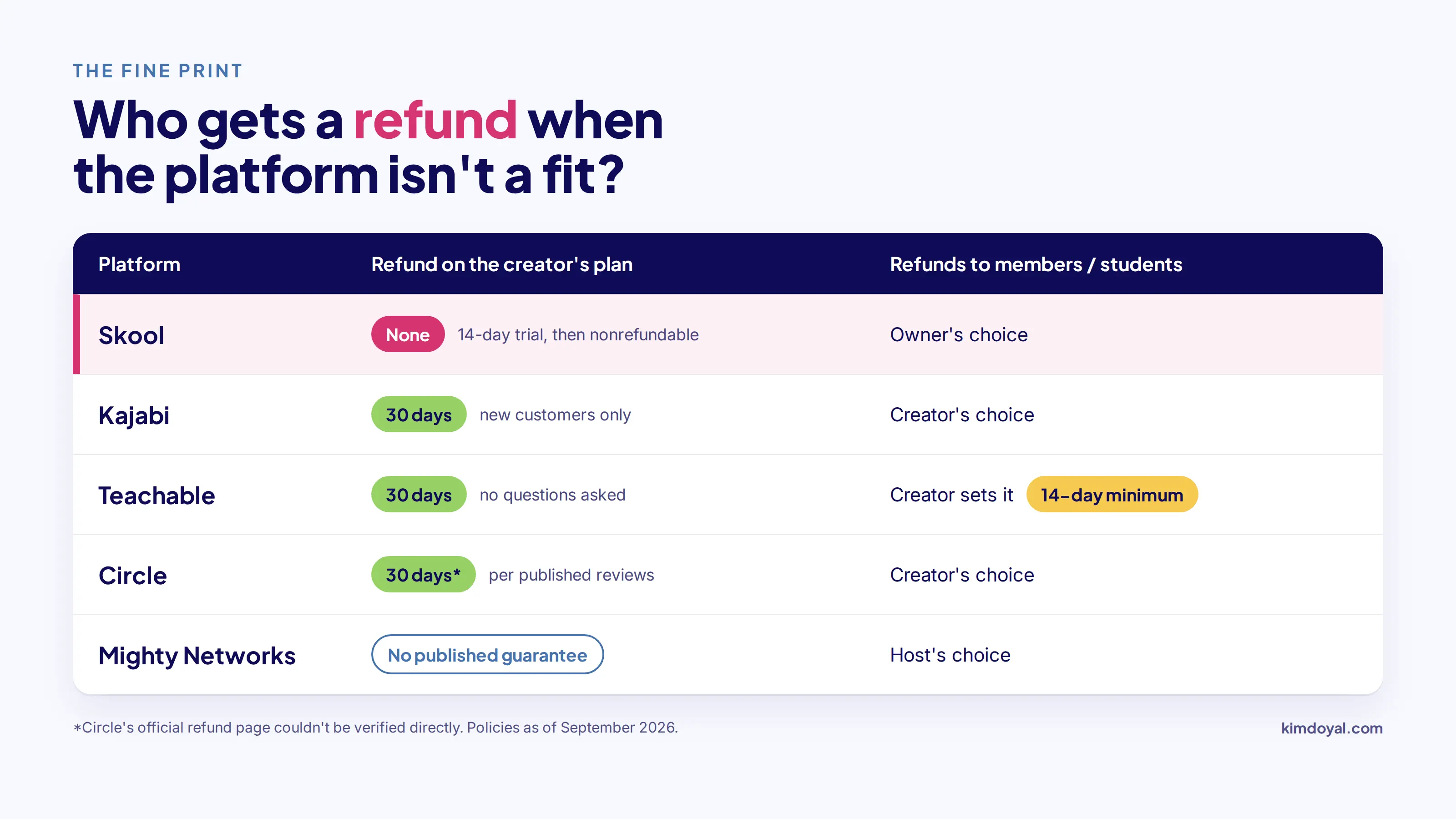
No. Skool's creator plans are nonrefundable, and refunds to members are up to each community owner. This is the part where I got a little fired up.
Skool's creator plans come in two options: $9 a month or $99 a month. There's nothing in between. The $9 plan looks like a way in, but it doesn't really support a business. The things you'd need to actually run one, like getting your members' emails into your own email platform, only exist at $99. So the $9 plan becomes a place to spend a lot of time building before you find out you need to upgrade.
And you usually find that out after you're already in. You set up your classroom, invite people, start building momentum, and then you learn the integrations you need sit behind Pro.
On top of that, the fine print stacks up. Skool's 14-day free trial converts to a paid plan on day 15, and once you've paid, subscription fees are nonrefundable. Transaction fees are nonrefundable too. None of it is hidden, exactly... It's all published in their help center. I just think it's something they could be a lot more upfront about.
Here's the part that really gets me. As creators, we're expected to offer guarantees. Put up a sales page without one, and people want to know why. Some platforms even require it of us. Teachable won't let creators using its payment system offer students a refund window shorter than 14 days. But the platforms themselves don't always hold to the same standard. Welcome to capitalism, I guess.
So I looked at how Skool compares to a few other platforms creators use.
Skool is the only platform here with no refund on the creator's plan, while Kajabi and Teachable give you 30 days. Policies as of September 2026.
Kajabi and Teachable give you 30 days to figure out a platform isn't right for you. Skool gives you a 14-day trial, and on day 15 you're paying for a plan you can't get refunded.
When you strip away the platform question, what I really care about is the environment.
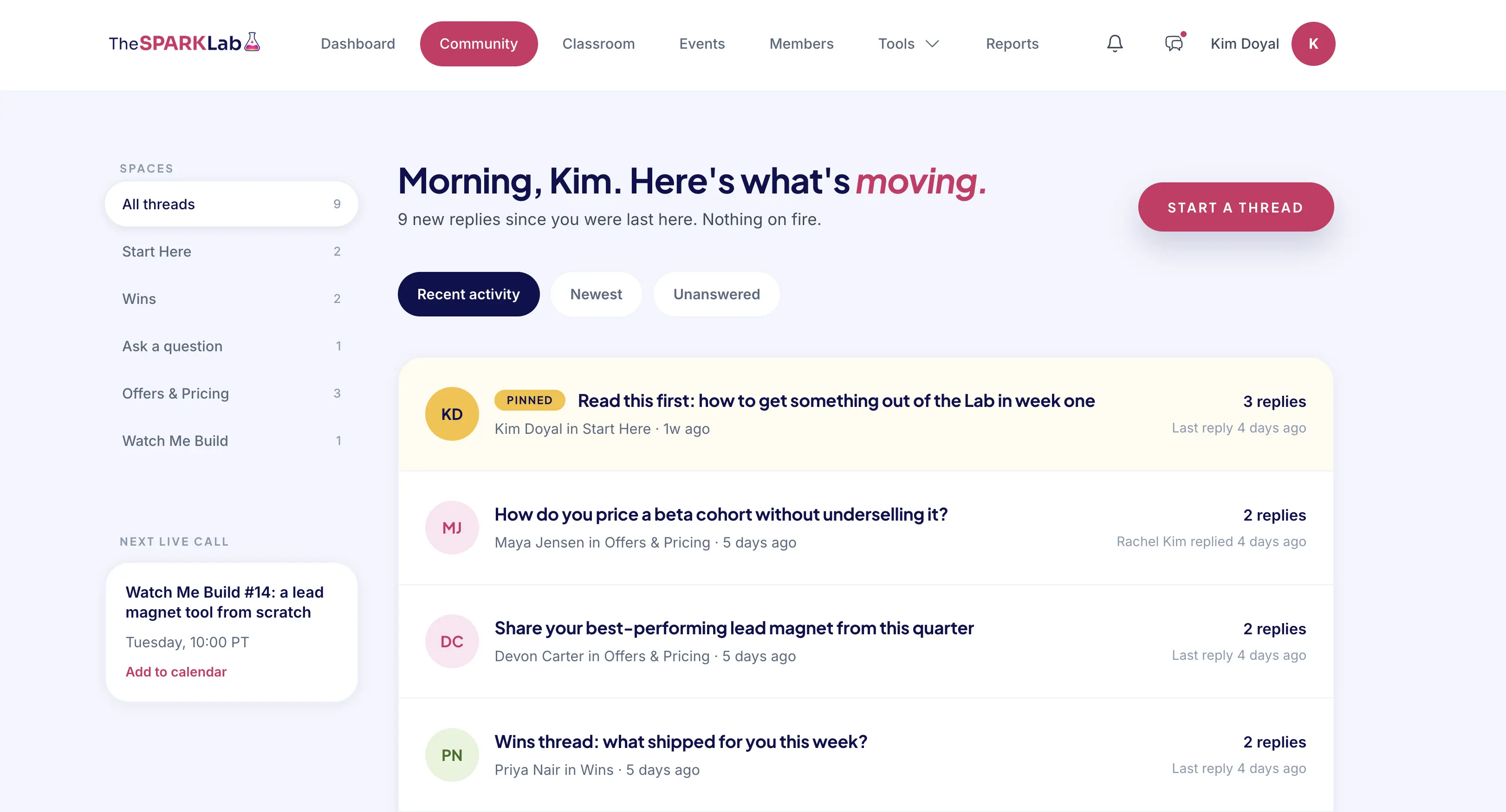
I want threads, not a feed. A feed rewards whoever posted most recently and creates pressure to keep posting so the room doesn't feel dead. Threads let conversations live as long as they're useful. Someone can ask a question on a Tuesday, and someone else can add something helpful a week later, and it's still right there.
I want no gamification. No leaderboard, no levels, no unlocking the basics by being loud enough.
I want the fundamentals available to everyone who walks in the door.
And I want it to feel like somewhere you'd actually want to spend time... calm, useful, and easy to find what you need.
There's something else in this for me, too. With SaySo, I've been thinking a lot about what a platform owes the people using it, because I spent years on the other side of that equation, switching tools that weren't built with me in mind. Building my own community is me eating my own dog food. If I'm going to talk about what a good platform looks like, I should be willing to build the one I'd want to join and live in every day.
That's what this is. I'm building the room I'd want to learn in, for the people I want to learn with.
Threads, not a feed. Inside the SPARK Lab community, conversations are organized into spaces, and the next live call is right there in the sidebar.
What this means for my Substack paid tier
Substack stays my publication, and the live workshops, tools, and community move into SPARK Lab. The details are still taking shape, and I'd rather be honest about that than pretend it's all figured out.
I love publishing on Substack, and that isn't changing. But the money side looks different when you see it clearly. Substack takes 10% of paid subscriptions, and Stripe takes its processing fee on top of that. For that cut, I'm also working inside Substack's features and limits, and feeding its algorithm to stay visible.
My paid tier needs to deliver value that's commensurate with what someone pays for it. Right now, the real value I want to deliver (the live workshops, the tools, the community, building alongside people) doesn't live on Substack, and I don't want it to.
So here's where things stand. I'm leaving the Substack paid tier as it is until I know exactly what it's going to look like. Current paid members are going to get access to the $49 community, because I didn't want the people who've been supporting me to wait while I finish figuring out the rest.
This is where building my own platform really pays off. Because it's mine, I can add a tier below SPARK Lab for the Substack paid tier to feed into. I already have the whole automation set up, so I just change names and access levels. If I decide I want a free tier someday, I can add that too.
With Skool, every one of those decisions would come with a plan limit, an upgrade, or a Zapier workaround.
What's going into SPARK Lab
Everything I'm doing is going to live in one place. That includes the tools, the live trainings and workshops, and the community threads in a space that isn't gamified.
Momentum is also evolving. I think it's going to become more of a cohort, where we build together. I'm still working through exactly what that looks like, and I'll share more when it's ready.
I'm also going to do a full, in-depth piece and video on SPARK Lab itself... how it's built, what's in it, and why I made the choices I did. This article is the why. That one will be the what.
Should you use Skool or your own community platform?
The answer depends on a few questions, and these are the ones that mattered most for me. You don't have to build your own platform for them to matter, either. They apply to any platform you're choosing, whether that's Skool, Circle, Kajabi, or something you haven't found yet. Building my own is now possible for me, because vibe coding changed what one person can build.
Who's driving the traffic? If the answer is you, regardless of where it lands, it's worth asking why you'd send it somewhere you don't own.
Can you reach your people? Not just inside the platform, but outside it. Your email list is the part of your business that stays yours when everything else changes.
What's gated, and for whom? Look at what your members have to do to reach the basics, and what you have to do to reach your members.
What kind of room do you want people learning in? This one doesn't have a right answer. It just has your answer.
Where are you willing to compromise? This was the question that sent me looking at Skool in the first place. Sometimes the answer is "here, and that's fine." Sometimes the research tells you it's not.
My instincts were right
I want to be clear that plenty of people are building real, thriving businesses on Skool, and different strategies work for different people.
This isn't about Skool being wrong.
When I think back to that email, I can see that all those years of switching tools weren't me being fickle. My instincts kept telling me something was off, and they were right. I just didn't have a way to act on them yet, so I kept waiting for someone else to build the thing I wanted.
Now I can build it myself. This was the first time in a long time I seriously considered compromising, and the research only confirmed what I already knew. I want a room where members can reach the fundamentals without jumping through hoops, and where I can reach my members without paying for the privilege.
If you've been bouncing between tools too, it might not be a focus problem. It might be your experience telling you exactly what you need... and now, with AI, you can actually build it.
And I'm building my own so I can course-correct as needed based on user feedback.
I'd love to hear where you've landed.
Are you on a platform you love, or one you've been quietly tolerating? Reply and tell me.
Frequently Asked Questions
Can you get member emails from Skool?
On the $99/month Pro plan, Skool's Zapier integration can send paying members' names and emails to your CRM or email platform. Free members' emails only come through if you ask for them in a membership question and they answer. The Hobby plan has no Zapier access.
Does Skool have an API?
Skool doesn't have a public API or developer documentation. The only official integration is the Zapier plugin on the Pro plan, which offers two triggers (new paid member and membership question answers) and two actions (invite a member and unlock a course).
How much does Substack take from paid subscriptions?
Substack takes 10% of paid subscription revenue, and Stripe charges its processing fee on top of that.
Why build your own community platform instead of using Skool?
For me, it came down to three things: owning my member relationships and email list, creating a learning environment without gamification or gated fundamentals, and having the flexibility to adjust tiers and features based on what members actually need.
What's in SPARK Lab?
SPARK Lab brings together tools, live workshops, and a non-gamified community in one place. A full breakdown is coming in a separate article and video.
Your obvious offer is hiding in plain sight.
Free. Tell it what you know and who you help, and it'll show you the offer everyone can see but you.
Kim Doyal is a digital marketing strategist and AI builder with 18 years of online business experience. She is the founder of AI Spark Studios and SPARK Lab, and the creator of The Hub — a custom 33-agent AI operating system that runs her entire business. She has also built kimdoyal.com, StackRewards, and multiple AI tools and agents using vibe coding, a natural language approach to building software without a traditional development background.