HOME/BLOG/THE FUTURE OF DIGITAL PRODUCTS IS MORE USEFUL THAN ANOTHER PDF
AI Building
The Future of Digital Products Is More Useful Than Another PDF
Build something so useful, it's your acquisition strategy
September 20, 2026|5 min read
In 2006, a friend and I went to the Wealth Expo in San Francisco. The Learning Annex put it on, and I'm not sure you could pay me to go to an event like that now. 😂
There were keynote speakers and a bunch of smaller sessions. We wandered into one where a guy was selling an internet marketing kit and talking about making money while you sleep. He said he was making $8,000 a month selling ebooks on topics like kids' birthday parties and pet rats. Yes, pet rats. No judgment; I still remember it twenty years later, so clearly he was onto something.
The Kindle wouldn't come out until the following year. I'd spent ten years in the book industry, and the idea of selling little books that people downloaded from the internet felt pretty futuristic to me.
My friend and I walked out with an expensive home study course, complete with binders and CDs, and every intention of figuring out internet marketing. That was the last we heard from the guy. No follow-up, no support, no one to ask when we got stuck. He sold us the dream and moved on to the next room.
I kept going anyway. Around that time, I bought another CD set at an event about becoming a speaker, which feels very meta now. I listened to it during my Bay Area commute, along with my actual books on tape. One of the speakers talked about internet marketing, and I remember thinking, “Okay, maybe I really am onto something.” I didn't yet know what keywords or affiliate marketing were, but I wanted to learn.
In 2008, I started my business. I took an online course about Facebook and hired a mentor. Neither was particularly earth-shattering, but the course introduced me to an online community where I could talk to people doing this work. That made it real for me.
For years, though, if you wanted software built, you hired someone. WordPress got me a long way, but I still had a developer because I was much more interested in creating content than learning PHP. I even took an in-person CSS workshop. Look at me, leaving the house to learn code. 😂
Then, in 2025, I started vibe coding: describing what I wanted to build to AI and working through it together. I asked at least as many questions as I gave instructions. My WordPress years and my sense of what makes a tool pleasant to use helped, but every time I hit something I didn't understand, I could ask and keep going.
Sitting in that breakout room in 2006, I could feel that the way we created and sold things was changing.
I feel that again with digital products.
This is why I'm so interested in the future of digital products
We can build things that once required a development budget, and we can make a product useful in ways a download often isn't. It can take information someone gives it, do some work, and help them with the next step. For people who want to grow without building a big team or spending fifteen hours a day at a computer, that's a big deal.
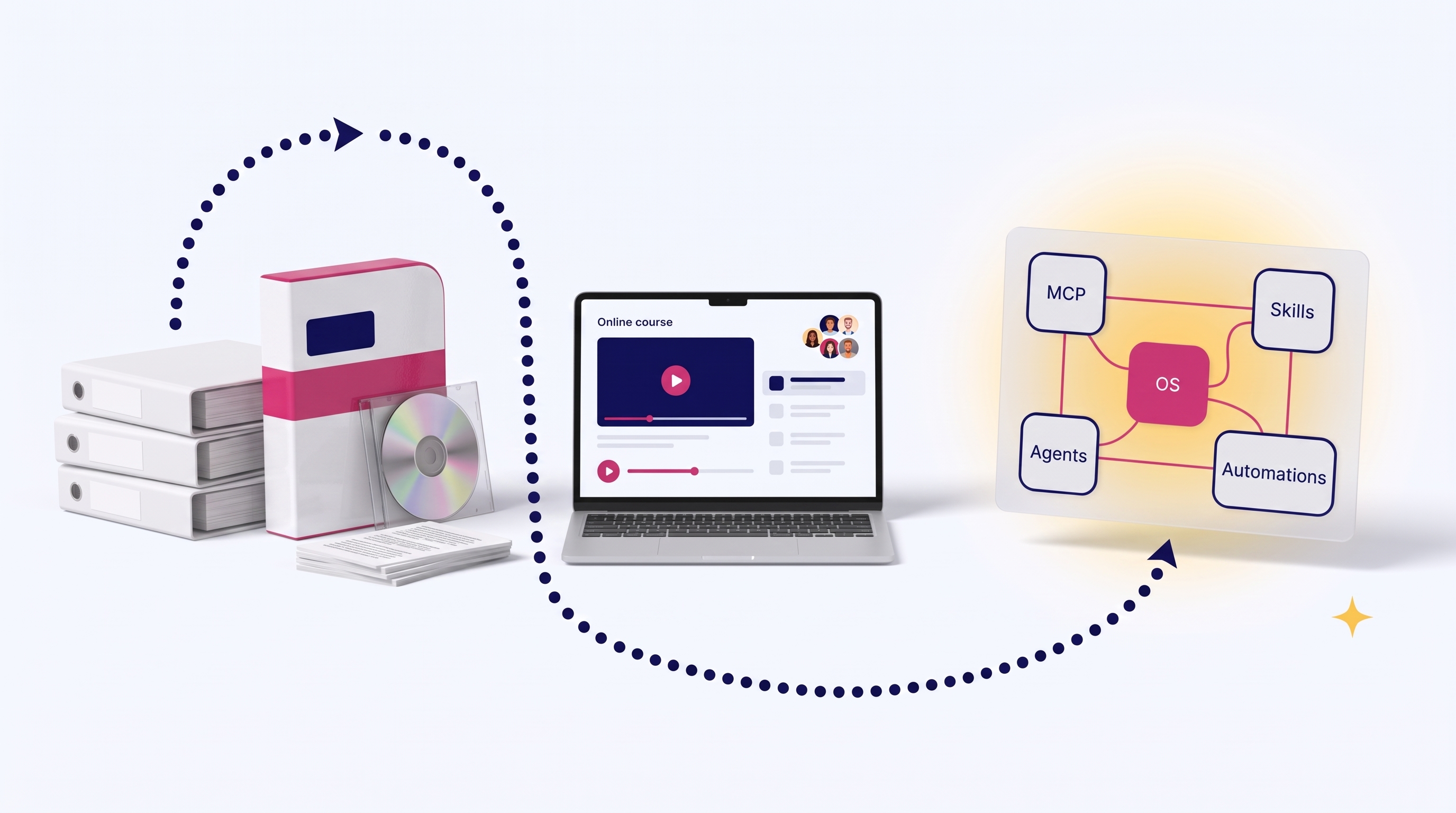
Some of these products are skills, which package instructions and know-how for an AI assistant to use. Some are automations that run when something happens, and others are agents that work through several steps with tools they're allowed to access. MCP can connect an AI assistant to other tools and information.
I'm interested in what all of that lets us do for someone who is stuck. Maybe she needs to research an offer, sort through what she already has, or turn an idea into something she can test. The format matters less to her than whether she can make progress.
From binders and boxed software to online courses to tools that do the work with you. The formats change. What people need from them doesn't.
Of course, building a product doesn't mean people will buy it. You still need to understand who it's for, what problem it solves, how to explain it, and how you'll reach those people. AI didn't make those questions disappear. If anything, it made them easier to skip because you can build the idea so quickly.
Which brings me to a lead magnet I've built five times.
Apparently, I needed to build five quizzes to figure this out
Five. Freaking. Times. Apparently I am tenacious, even when the thing I'm tenacious about isn't quite right.
Each version got better. One had nine profiles, a designed PDF, and results personalized using three fields. The next one was simpler, with four paths. I added conditional logic and email follow-up that changed based on the result. Technically, I was making progress.
And I was having a great time building them. With AI, I could think, “What if the results changed based on this answer?” and actually try it.
What I couldn't seem to build was any enthusiasm for promoting the damn quiz.
[I wrote about all five versions here: LINK TO FIVE QUIZZES ARTICLE.] At the time, I thought the best-built version wasn't carrying the right message. That was true, but I had stopped one layer short. It was also the format I kept trying to make work.
Quizzes can absolutely work. If the result teaches someone something useful and you follow up based on what they told you, great. My follow-up did match their results, but it still felt a little meh. People in the online business world have taken a lot of quizzes. I kept thinking about what I could add to mine when I really needed to ask what I wanted to give them.
When you can build almost anything, it's easy to spend another evening improving something without asking whether you want it in your business.
So I finally asked myself: What would I be excited to put in someone's hands the first time they find me?
I want the free thing to be worth coming for
The answer became The Obvious Offer.
Someone tells the tool about their business and what they already have to work with. It researches a possible asset they could create and sell, then builds a report around that decision. It's for people with some experience, an audience or presence, and an understanding of whom they serve. They may be developing a new offer or changing direction, but they aren't starting from a blank page.
I love working with people at that point. They usually already have so much in their business; they just haven't necessarily seen what it could become.
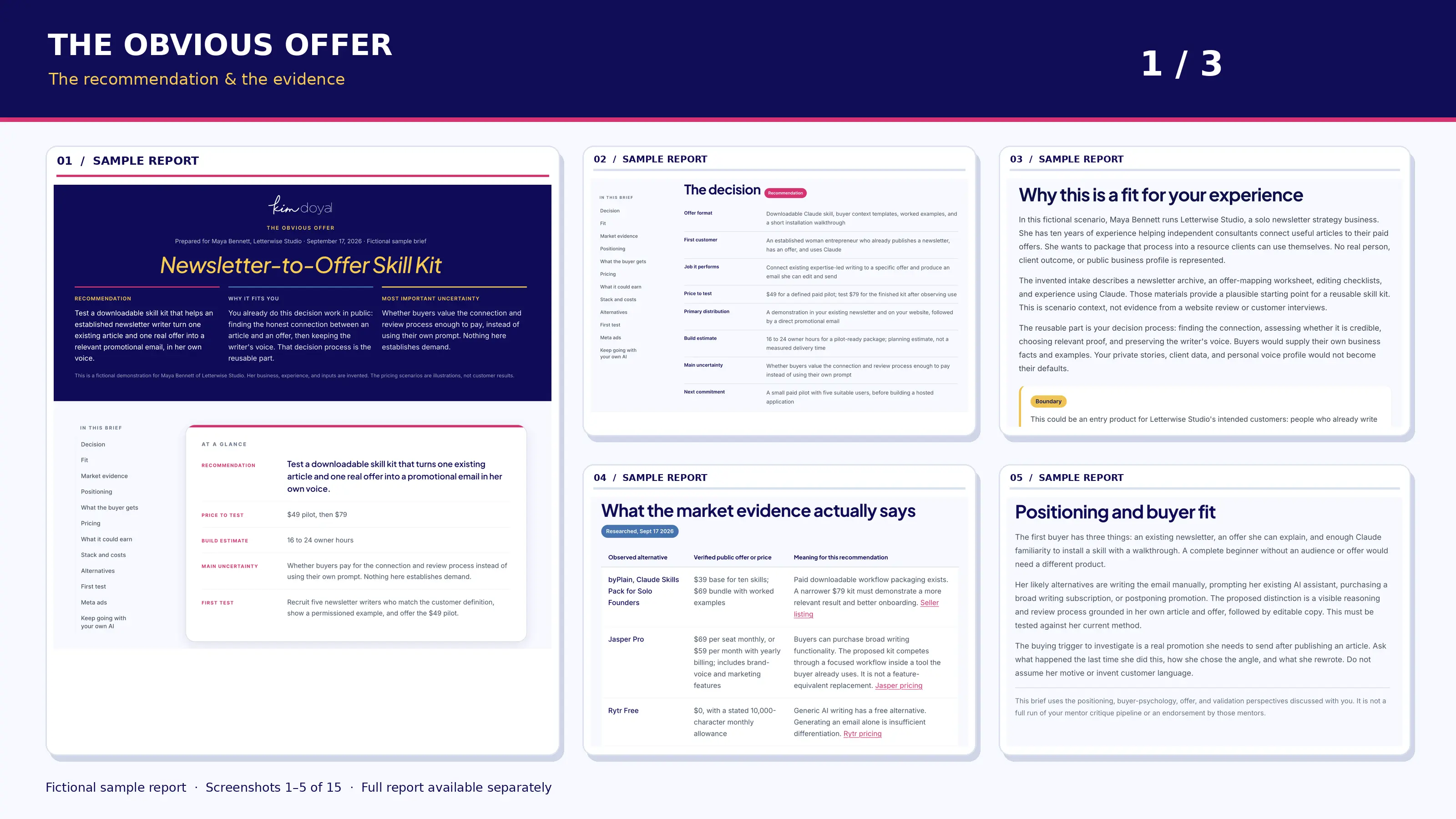
To show you what the tool does, I made a fictional sample report for a newsletter strategist named Maya Bennett. The recommendation is a Newsletter-to-Offer Skill Kit: something that would help an established newsletter writer turn an article and a real offer into a relevant promotional email in her own voice.
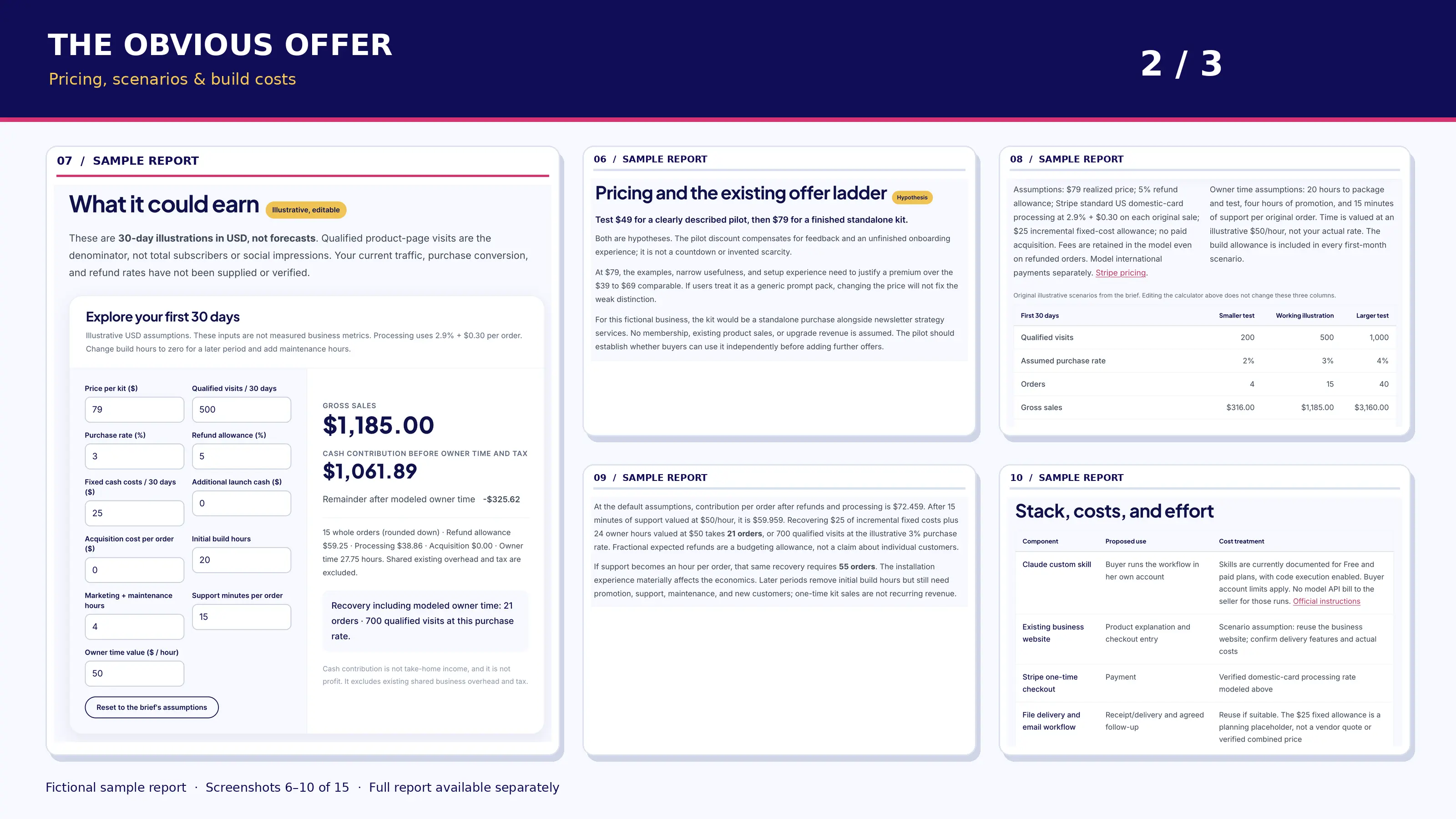
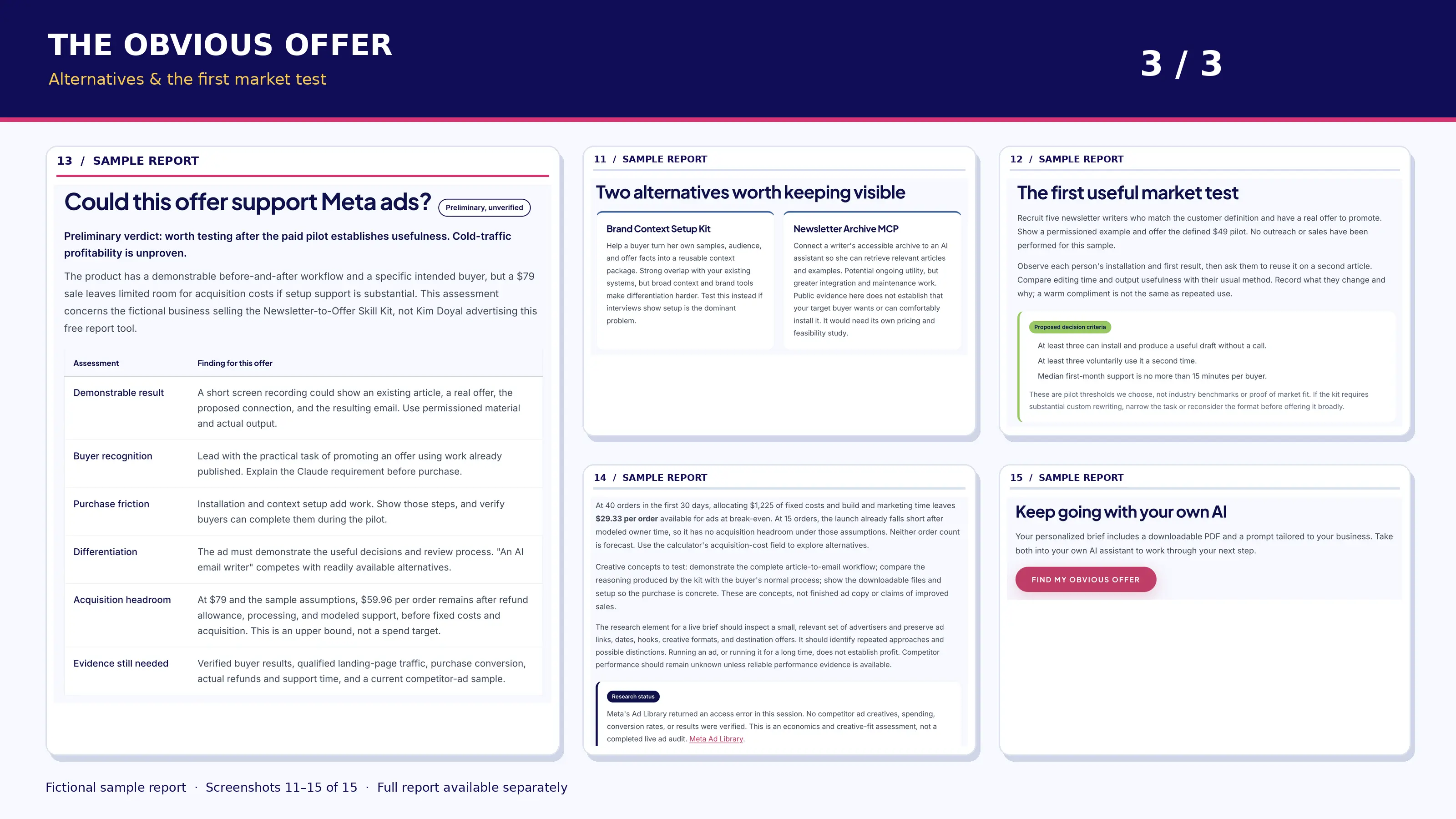
The report doesn't stop at the recommendation. It explains why this fits Maya's experience, looks at public market evidence and alternatives, works through buyer fit and positioning, and sketches what the customer would receive. Then it looks at pricing, the work and tools involved in building it, and several financial scenarios. Those numbers are illustrations, not forecasts or customer results. It finishes with other ideas worth considering and a small paid test that could tell her whether this particular offer deserves more work.
The first five screens of a sample Obvious Offer report: the recommendation, why it fits, and what the market evidence actually says. This one is a fictional example, not a real customer.
What I like most is that it doesn't pretend the research has proven demand. It names the biggest uncertainty: would people actually pay for this process when they could try prompting an AI assistant themselves? That's the kind of question I would want to know before spending weeks polishing a product page.
Screens six through ten: pricing, an editable 30-day earnings calculator, and what the build actually costs in time and tools. Illustrations, not forecasts.
A person could look at their own report and say, “Yes, that's worth testing,” or “Actually, the alternative makes more sense for me.” Either way, they've learned something about their business. They have more to work with than a cute label telling them what type of entrepreneur they are.
The last five screens: two alternative offers worth keeping visible, a five-person first market test, and whether the offer could ever support Meta ads.
[LINK: View the complete fictional sample report in detail.]
Doing that research and producing a report costs me money every time someone uses The Obvious Offer. My current estimate is under a dollar per person, and I'm fine with that.
To be clear, that's the cost of producing the report. I still have to get someone to the tool, follow up, and earn their business. But we spend money on ads, landing pages, email software, and everything around a free offer. I'm happy to spend some of it on what the person actually receives.
By the time they get an email from me, I want them to have experienced how I think and what I can help them do. Yes, there's a follow-up sequence. I'm still running a business. 😂 I just like this as a first introduction a lot more than another download I hope they open.
What happens between step two and step ten?
Remember the box of binders? The guy in the breakout room showed us an exciting destination. The problem came when we got home and needed help with the steps in between.
I've bought plenty of products since then that did a more polished version of the same thing. You're at step two; someone sells you step ten. The missing pieces might be how to write copy, where to find customers, or which part to try first. You don't always know what's missing until you're trying to put the thing to work.
AI lets you ask questions as those gaps appear. That's how I learned to build: “Why do I need this?” “What happens if someone clicks here?” “Is there a simpler way?” Often the answer gave me the next step. Sometimes it gave me three more questions, but at least I knew what to ask.
Human support still matters. I'm coaching a client who's learning to build, and I can see her connecting the dots. With her permission, I have a project for her in Claude, so I can work through ideas and make notes between our calls. From talking with her, I know how she processes information and where she tends to get stuck. AI helps us do more together, while I help her decide what matters right now.
That's the kind of support I want to build into products where it makes sense: a useful next step, available when someone needs it.
[Spark Lab: SPARK LAB LINK] is one way I'm doing that. The tools inside help members work through specific parts of their business at a price that doesn't require a giant leap of faith. They cost me something to run, but the economics still work for a subscription. The idea is that someone can get help with today's problem and then come back when they're ready for the next one.
A staircase is a model, not a set of rules
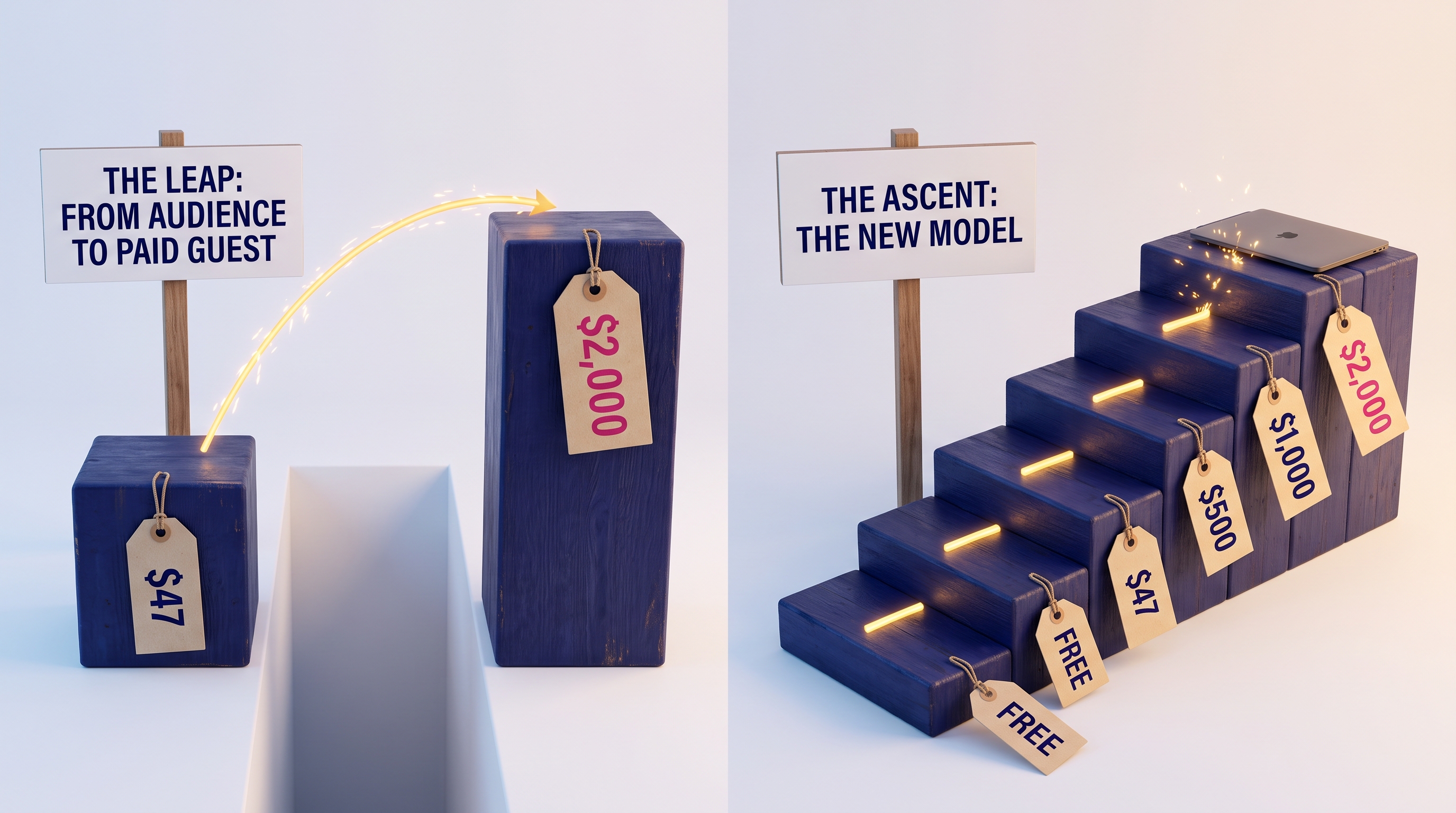
Russell Brunson's offer ladder is one version of an idea you've probably seen: start with a free or accessible offer and give people ways to go deeper as their needs grow. I'm calling the shape in this illustration an ascent model. It makes more sense to me than asking someone to jump straight from following your work to buying a $2,000 offer.
The old model asks someone at $47 to jump straight to $2,000. The new one gives her a step to stand on at every price.
That doesn't mean you need two free offers, six price points, or the exact staircase in the image. You might need three steps. You might sell one very good thing. You know your audience, your capacity, and how you want your life to feel better than any diagram does.
You find out by publishing and testing. And if an offer doesn't sell, look at what actually happened before tossing the whole thing. The offer might be right while the copy, distribution, or follow-up needs work. I've been known to rebuild a quiz five times, so you are welcome to learn from my research on this particular subject. 😂
I want to own what I'm building, too
This is why some of the growth advice I see feels dated to me. The tools have changed, and I don't want to spend the next decade building a business that depends on teaching people to win on one platform.
I've enjoyed publishing on Substack, but I have no interest in becoming a Substack growth person. I spent ten years as The WordPress Chick. I have zero regrets; WordPress gave me a business and introduced me to wonderful people. It also taught me how hard it can be to pivot when everyone associates you with a platform, even when you're still working in the broader world of digital marketing.
I want to help people turn what they know into assets they own, and I want to own the tools I'm building for them.
That's a big part of why I'm building SaySo.
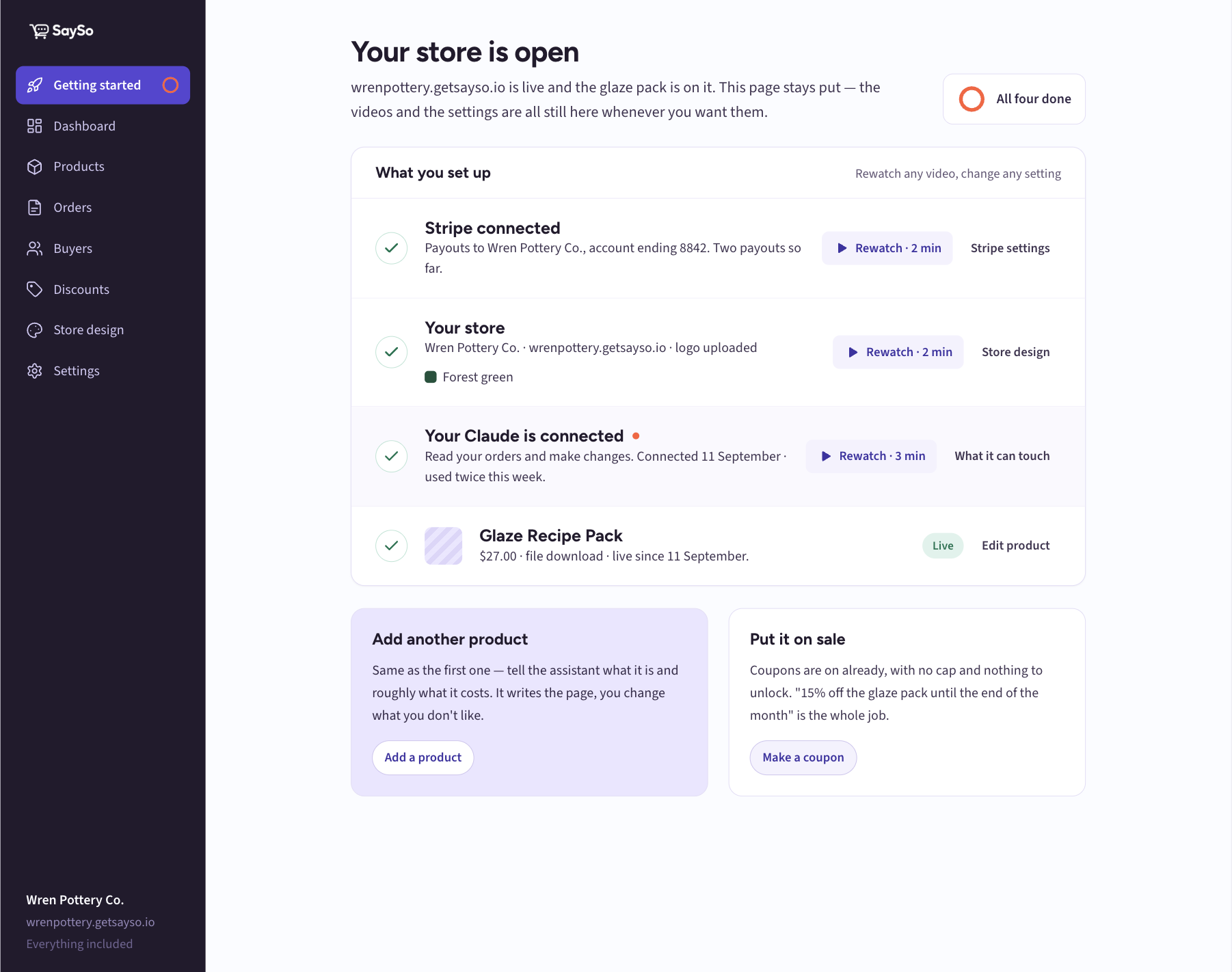
It's a digital storefront I'm designing so people can work with their own Claude or ChatGPT account, instead of managing everything through another dashboard. The aim is simple: you can sell what you've made, use your own Stripe account, and keep control of your business. SaySo won't take a percentage of your sales or lock basic selling features behind an upgrade. Stripe's payment processing fees still apply.
I'm working toward a simple price for individual sellers and a separate agency account for people managing client stores. I'm preparing to bring in beta testers, which is exciting and, if I'm honest, a little nerve-racking. The app is still being built, but it feels like something I want to keep working on. After five quizzes, I didn't want to promote; that's a useful thing to know. 😂
An early look at the SaySo owner dashboard. Everything you set up stays put, and the assistant does the heavy lifting when you add a product or run a sale.
I'm still going to buy books
Probably more than I have time to read, if we're being honest.
Courses, ebooks, and PDFs still have a place. Sometimes I want someone to teach me. Sometimes I want to read their thinking at my own pace. And sometimes I want a tool that helps me do the thing while the problem is sitting in front of me.
What excites me is having more choices about what I can make for the people who come to me for help. I don't have to squeeze every idea into a course because it's the format I know how to create. I can build something that helps a person make a decision, test an offer, or move from step two to step three.
The guy in San Francisco did give us something: he helped me see what might be possible. I just wish the product had helped us once we got home.
That's the bar I'm thinking about now. What can I give someone that is useful when they actually sit down to use it?
If you'd like to see what I mean, [try The Obvious Offer here: OBVIOUS OFFER LINK]. I'd love to hear what it finds in your business, and whether the recommendation is something you'd actually be excited to build.
Kim Doyal
Kim Doyal is a digital marketing strategist and AI builder with 18 years of online business experience. She is the founder of AI Spark Studios and SPARK Lab, and the creator of The Hub — a custom 33-agent AI operating system that runs her entire business. She has also built kimdoyal.com, StackRewards, and multiple AI tools and agents using vibe coding, a natural language approach to building software without a traditional development background.