Why I Waited This Long to Launch an Official Paid Substack Tier
After 18 years online, I finally built a paid product that matches how I want to live.
June 8, 2026|5 min read
Nothing is more powerful than an idea whose time has come."
Victor Hugo
There were a handful of activities I look back on as a kid when I could get lost for hours in what I was doing. It was usually drawing, reading, or just being completely present when hanging out with my friends. Those afternoons when it felt like time stood still... and nothing else mattered.
We weren't thinking about what came next. The only things that brought me out of that bubble were either being called downstairs by my parents or checking the time because I had to be home for something.
I hadn't felt that way about my business in a long time. Years, maybe. And I didn't realize how much I missed it until it came back.
Why Did It Take 18 Years to Find the Right Model?
Because every model I tried required me to perform instead of build... And performing kills the work.
Plus, at this stage of my life, I have zero energy for the performative nature of all of this. Doing good work, sharing it, promoting it, highlighting other people? I'm here for that, but on my own terms.
I've been building & creating online since 2008. That's eighteen years of WordPress sites, email funnels, product launches, affiliate campaigns, content strategies, webinars, summits, and pretty much every iteration of "how to make money on the internet" that this industry has cycled through. I know the playbooks. I've run them, taught them, built them for other people.
And here's the thing I've come to understand about myself, not about the industry, but about me: every time I pushed something into the world just because I needed to make money from it, it choked.
The energy was off.
The words didn't land. I could feel myself performing (pushing) rather than creating, and the people on the other side could feel it, too.
But when something genuinely lit me up, when the thing I was building aligned with how I also wanted to live my life... it worked. Not because of some manifesting magic (though I'm not above my own bit of woo-woo), but because the work itself was better. I showed up differently, and the message was clear. Everything flowed the way those childhood afternoons used to flow.
Remember that Victor Hugo quote I shared above?
A great example of that was when I created and launched "The Content Creators Planner" with my friend, Jodi Hersh. At the time (2018), I tended to use pen & paper (with colored markers, of course) when I wanted to map things out.
I had an idea for a physical content planner with an actual strategy (not just fill-in-the-blank pages) to help creators plan content that supports their business. I reached out to Jodi, a trained Graphic Designer, and asked whether I could hire her or if she wanted to partner with me. She said yes (to partnering).
We had that first call in August of 2018, pre-sold enough in December of 2018 to print the first run, and were shipping planners by March (I drew the pages out, she designed them all with InDesign). We spent hours on Zoom refining things.
We scaled that to almost half a million in sales, as a part-time business for both of us (we both had our own businesses).
Neither of us had had an e-commerce business before, but we had enough experience to make it happen.
That was an idea whose time had come.
I've had other launches (courses, cohorts, digital products, etc.) that did well, but nothing that quite lit me up the same way.
Until AI showed up.
I honestly feel like the last 18 years have prepared me for this moment. I have no idea what that looks like or how it's going to play out, but one thing I do know is that I'm trusting myself and my own process.
What Can 19 Paid Substack Subscribers With Nothing Behind the Wall Teach You?
That trust can't be manufactured, and it's more valuable than any launch strategy.
I've had a paid tier on Substack for a while now. Nineteen people are currently paying me, and there is absolutely nothing gated behind the wall. No exclusive content, no bonus episodes, no "paid subscribers only" posts (although I did test gating a portion of content in two posts). Just the same writing everyone else gets, and nineteen humans who decided they wanted to support what I'm building anyway.
I got a new paid subscriber today...While I was writing this.
It's hardly a sales tactic, and that's something you can't manufacture. It also taught me something I probably should have understood a long time ago: when the trust is already there, you don't have to convince anyone. You just have to build something worthy of it.
So the question became... what would be worthy of it?
What Made Me Finally Choose Tools?
I realized I'd rather build things that work whether I'm in the room or not.
I thought about this for months. I watched what other creators were building for their paid tiers, and there are too many variations of what that looks like to list them all here, but here's a quick sampling:
Private training (pre-recorded or live)
Tools
Access to gated content (prompts, agents, complete guides, and how-tos)
Live workshops, Substack chats
Public threads, shout-outs, links
Tools (MCPs, agents, micro-SaaS)
Some have promises of 'X' amount of 'new things,' and some add to them when it makes sense.
I don't think there's a right or wrong to what a creator includes (or doesn't include) in a paid tier. It just has to be sustainable for the creator and valuable for the subscriber.
For me, I know myself well enough now to trust what I know. I spent years being "on," podcasting every week, answering DMs, hosting webinars, and participating in summits (I hosted one, as well), maintaining the kind of presence the internet tells you is required. And while there were seasons where that worked, I kept coming back to the same realization: I'd rather build & create.
I love people, and I love connecting. I seriously never thought I'd feel the sense of community I feel on Substack online ever again - and I'm so incredibly grateful to have this lovely corner of the web. I just don't want to live on a community platform to run my business. I want to build things that work whether I'm in the room or not.
So that's what I did.
What Are the AI Tools Inside SPARK Lab?
I've been building tools. AI-powered tools designed specifically for solopreneurs who have the experience and the business knowledge but want to actually use AI in ways that go beyond chatting with Claude or ChatGPT (or whatever LLM they prefer).
Research agents that dig into your niche and come back with real intelligence. Content scoring that tells you where your writing lands and what's missing. Visibility audits that show you how you're showing up in search and where the gaps are. Things that used to require a consulting team or a developer... built so you can run them yourself.
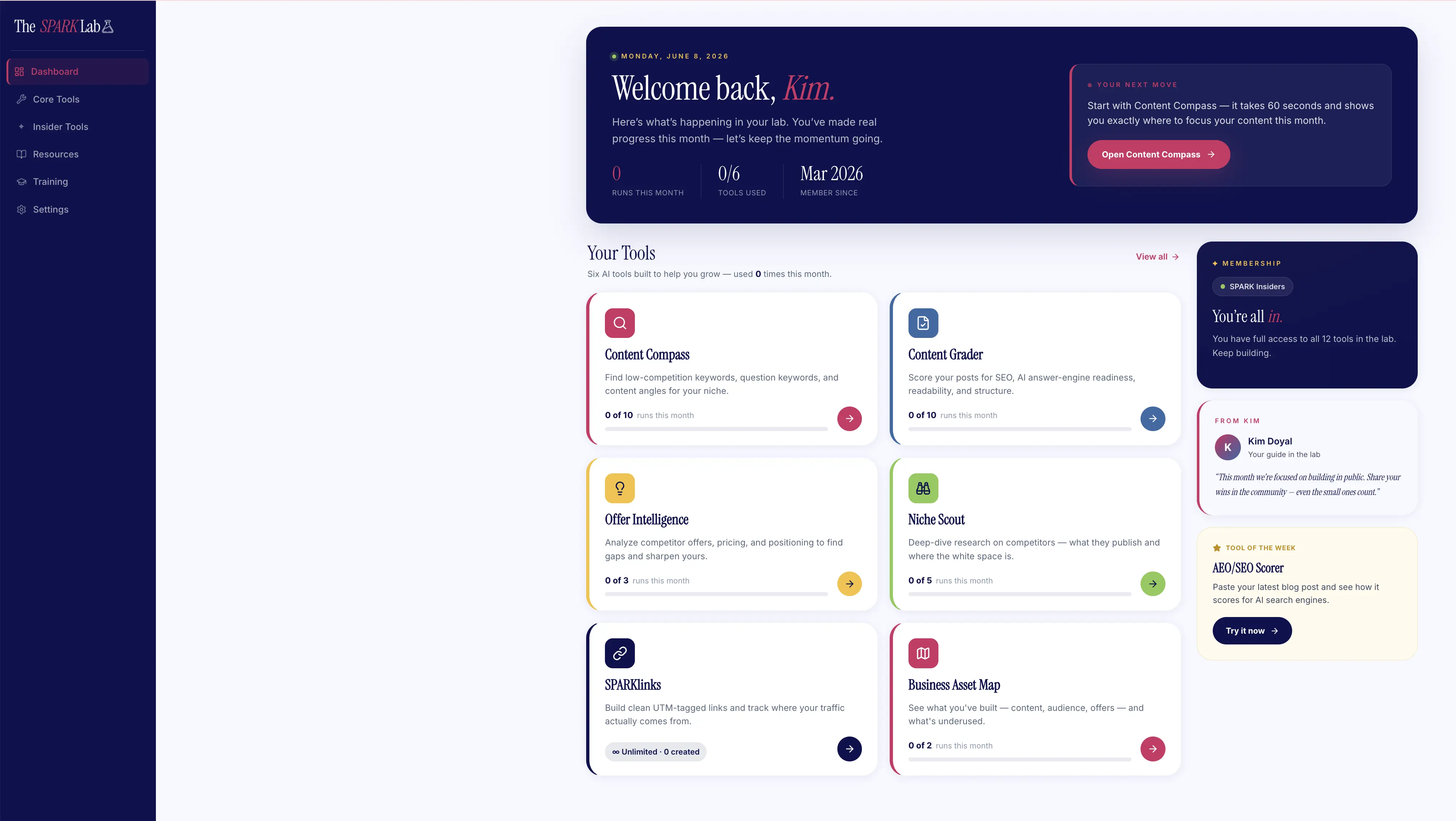
Your paid Substack subscription gives you access to all six core tools. And if you want to go deeper, there's an Insiders tier with six additional tools for visibility audits, positioning, and competitive research. Every single one of them exists because I built it for myself first, realized it was actually useful, and then thought... if this is saving me hours, it'll do the same for you.
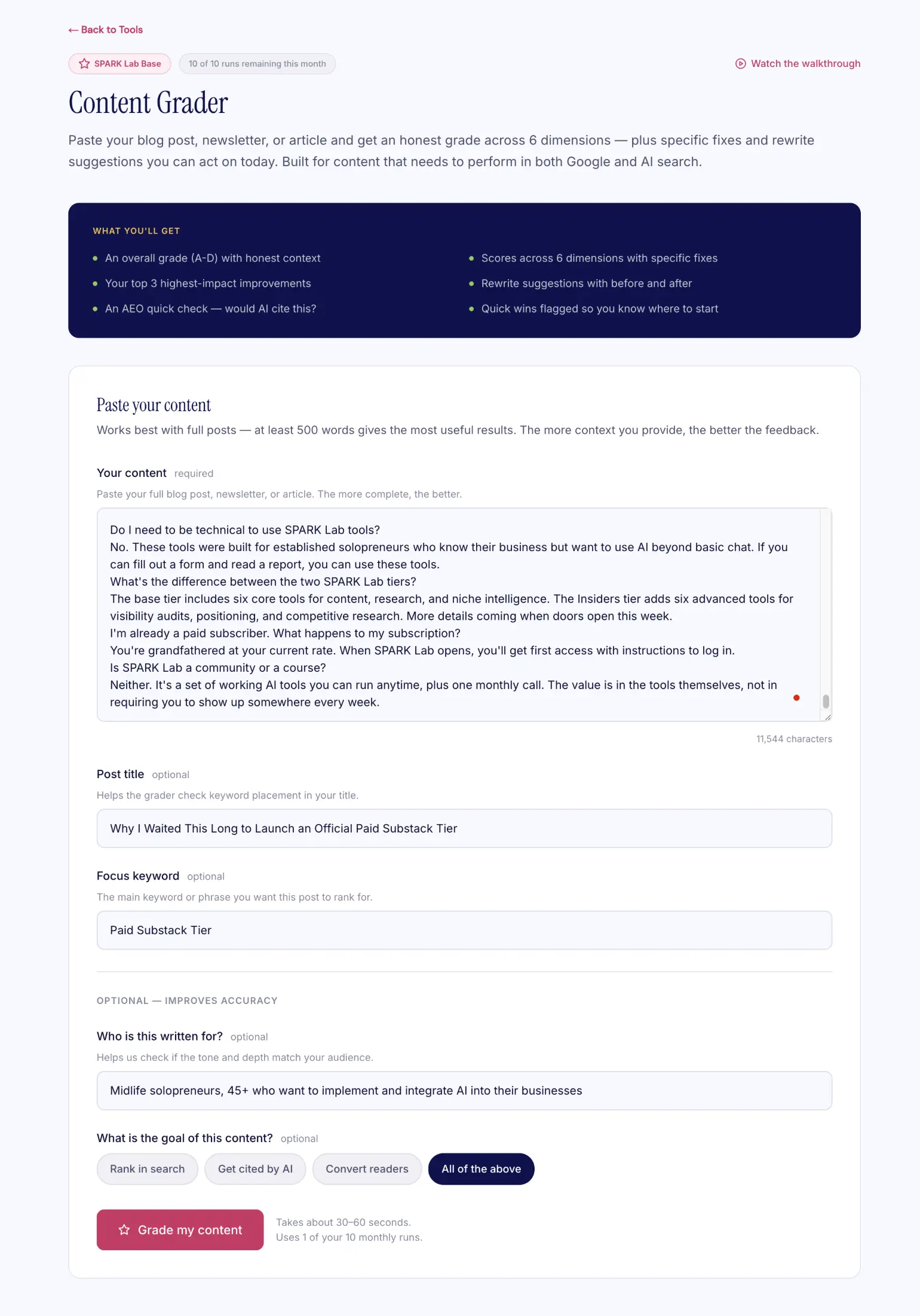
Here's the Content Grader input screen. I put this post in to demonstrate the output:
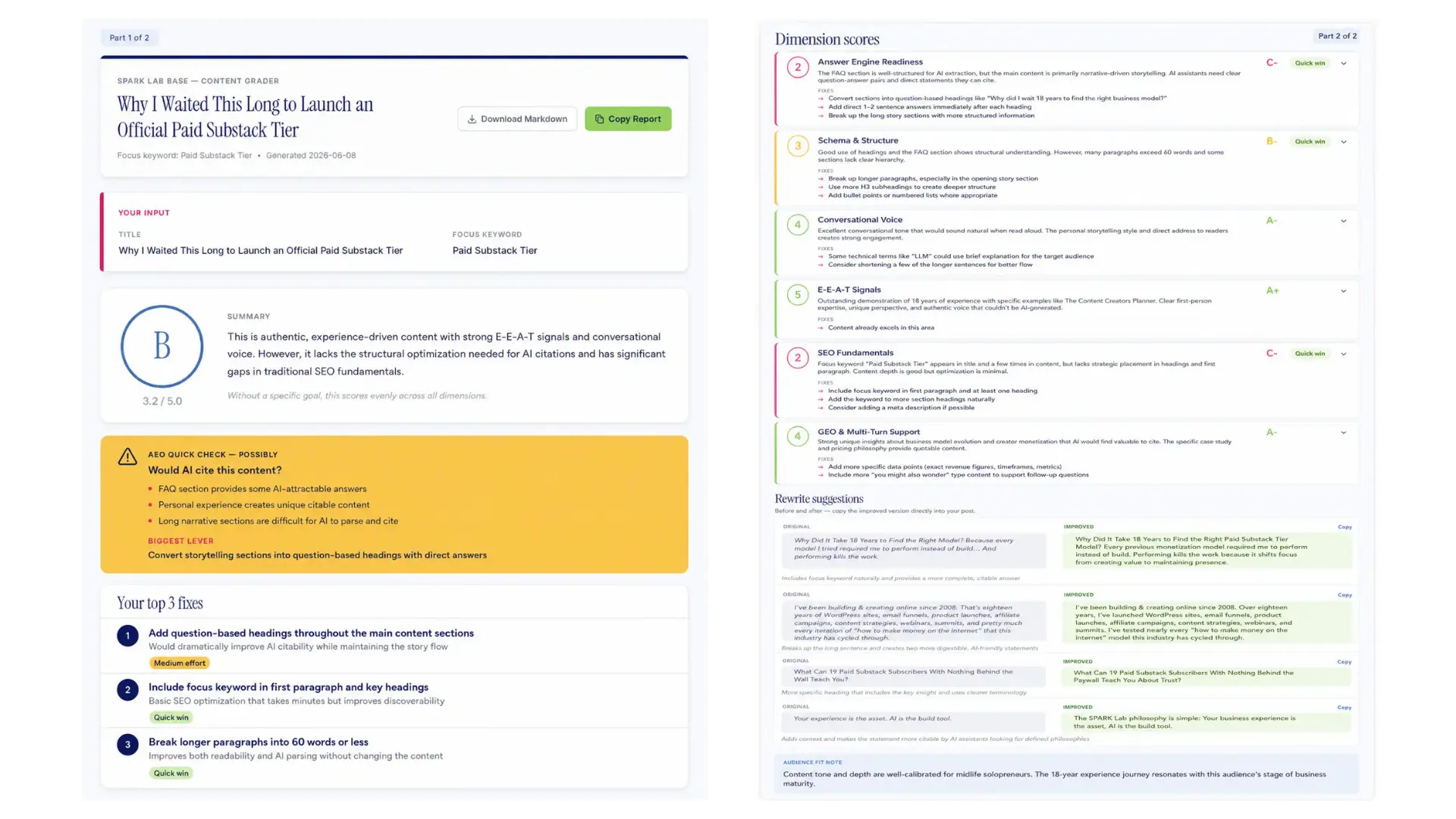
Here's the output from "Grade my content":
This Is SPARK Lab
The model is simple: one monthly call because I genuinely want to know the people in the room, and the tools themselves are available for you to use whenever you need them. The value isn't me being available around the clock. The value is that the tools work whether it's 2 PM or 2 AM, and they don't need me in order to deliver.
Your experience is the asset. AI is the build tool.
That's the whole philosophy. I built the tools. You bring what you know. And the tools do the work that used to eat your entire afternoon.
And I want to be transparent about something: this is the beginning. SPARK Lab may evolve. It may find a different shape over time as I learn what people actually need and how they use the tools. I'm okay with that. I'm not in a rush to have it all figured out before I open the doors, because honestly, that's just another version of the perfectionism that keeps people from shipping anything at all.
What I do know is what I can provide right now, today, and that's twelve tools that work and a genuine willingness to build this alongside the people who show up.
I also want to take you behind the build itself. How the tools were made, what's changing, what I'm experimenting with, what broke, and what I learned from it. Some of that will be pre-recorded walkthroughs, some of it will be live, and all of it will be the kind of raw, real look at the process that I wish more people shared.
Here's the other thing I keep coming back to: I don't think people want another platform to log into where they have to show up and engage.
We're all already managing too many tabs, too many Slack channels, and too many community threads that we feel guilty about not engaging with. What I think people actually want is to show up when it matters, connect for real when they're there, and then go back to their lives and their businesses with something useful in hand. That's what this is designed around.
Kind of like getting lost in something again. Except this time, you come out the other side with actual output.
What Happens This Week
I'm opening doors to SPARK Lab this week.
I'm going to do a live walkthrough where I show you the core tools, what they do, what the output looks like, and how they fit into a real business. That's it. Come see the thing, and decide if it's for you.
If you're already a paid subscriber, you're getting first access. More details on that very soon.
And those nineteen people who have been paying me with nothing behind the wall? They're all getting grandfathered at their current rate. Because that's what trust deserves.
I'll share pricing and all the details when the doors open later this week. For now, I just wanted to tell you why it took me this long, and why I'm actually excited about this in a way I haven't been excited about something in my business in a very long time. The kind of excited where you lose track of time, and it doesn't matter.
I'd love to hear from you. What's the one thing in your business you wish AI could just handle for you? Reply and tell me... it'll make sense why I'm asking in a few days. 😉
Frequently Asked Questions
Do I need to be technical to use SPARK Lab tools?
No. These tools were built for established solopreneurs who know their business but want to use AI beyond basic chat. If you can fill out a form and read a report, you can use these tools.
What's the difference between the two SPARK Lab tiers?
The base tier includes six core tools for content, research, and niche intelligence. The Insiders tier adds six advanced tools for visibility audits, positioning, and competitive research. More details coming when doors open this week.
I'm already a paid subscriber. What happens to my subscription?
You're grandfathered at your current rate. When SPARK Lab opens, you'll get first access with instructions to log in.
Is SPARK Lab a community or a course?
Neither. It's a set of working AI tools you can run anytime, plus one monthly call. The value is in the tools themselves, not in requiring you to show up somewhere every week.
Your obvious offer is hiding in plain sight.
Free. Tell it what you know and who you help, and it'll show you the offer everyone can see but you.
Find Your Obvious Offer →
Kim Doyal
Kim Doyal is a digital marketing strategist and AI builder with 18 years of online business experience. She is the founder of AI Spark Studios and SPARK Lab, and the creator of The Hub — a custom 33-agent AI operating system that runs her entire business. She has also built kimdoyal.com, StackRewards, and multiple AI tools and agents using vibe coding, a natural language approach to building software without a traditional development background.
Keep Reading

AI Building
How to Grow Your Substack Without Living on It... Built for Freedom — Part 01
I read the article on my phone in bed before I even got up, because I was genuinely excited about it. That kind of excitement means something right now. Here's what I started building, and why the how matters as much as the what.
April 26, 2026READ MORE
AI Building
What You Built Works... You Just Don't Want to Open It
I launched SPARK Lab minimum viable and then didn't want to log into it. It wasn't broken, it was flat, and flat is the harder problem because it doesn't tell you where to go. Here's the filter I ran on my own product, and the four prompts so you can run it on yours.
July 27, 2026READ MORE
Vibe Coding
How I Built a Custom AI App in 3 Hours (A Vibe Coding Case Study)
If you've been following my journey into "vibe coding," you know I'm always on the lookout for tools that make bringing ideas to life faster and more intuitive. While I've had success with other platforms, a new tool recently caught my eye and has completely changed the game for me.
August 28, 2025READ MORE