HOME/BLOG/YOUR AI TRAFFIC STRATEGY IS THE MOST UNDERRATED PLAY IN ONLINE BUSINESS RIGHT NOW
AI Building
Your AI Traffic Strategy Is the Most Underrated Play in Online Business Right Now
Six channels, one framework, and the shift most solopreneurs haven't made yet
June 29, 2026|5 min read
QUICK ANSWER
AI can do more than create your content... it can build the system that gets your content seen. In 2026, the traffic landscape has split into six distinct channels, and the one most solopreneurs are still relying on (follower-based social media posts) has a 1-7% reach and is falling. This post maps the six channels that actually work now, with one action you can take in each one this week.
"Use AI to write your blog posts." "Use AI to repurpose your newsletter into 12 social posts." "Use AI to batch a month of content in an afternoon."
None of that is wrong. I use AI for content creation every single day. My entire publishing workflow runs through a content pipeline I built with Claude, and I've talked about that process plenty of times.
But something's been bugging me.
I've been in online marketing for 18 years. I've run Facebook ads back when a $5 daily budget actually reached humans. I've done SEO when keyword density was a real strategy (I know, I know). I've watched every traffic channel evolve, fragment, get more expensive, and then get disrupted by the next thing.
And right now, in the middle of the biggest technological shift most of us will experience in our lifetimes, the AI conversation in our space is almost entirely about one thing: creating more content.
Content was never the problem.
Getting the right people to see it... that's always been the problem. And that problem doesn't go away because you can produce more. It gets more urgent. Because now you've got this incredible content engine running, and if nobody sees the output, you've built a very efficient machine that goes nowhere.
Why Isn't Your Content Getting Seen? The Traffic Split Nobody's Talking About
Because the traffic landscape fractured into two fundamentally different models, and most people are still using the one that's dying.
"Traffic" isn't one thing anymore. It used to be simple: post on social, buy some ads, do your SEO. Three buckets, more or less.
The old model was follower-based. You built an audience on a platform, and when you posted, your audience saw it.
That model is in free fall.
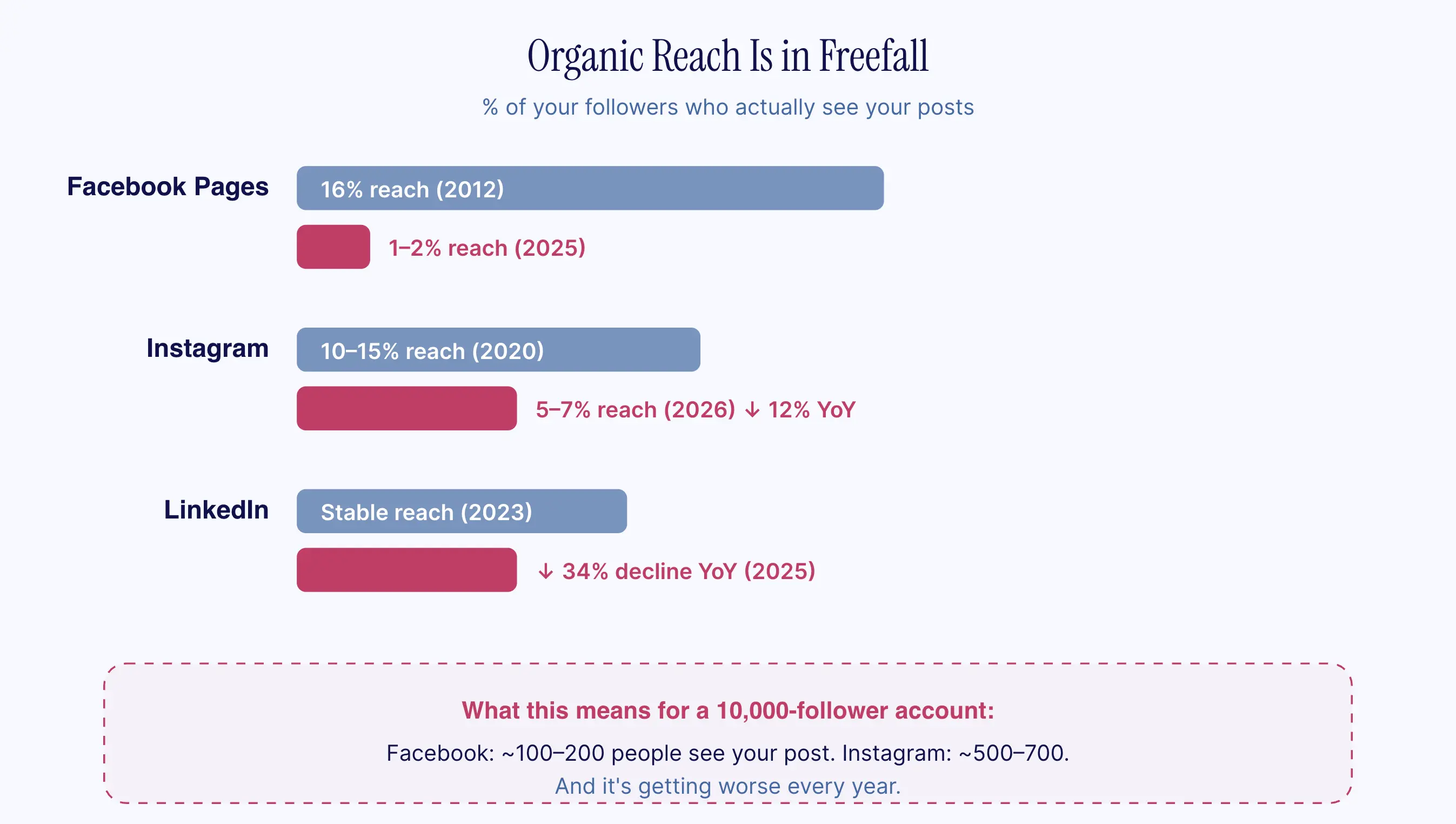
Organic reach across the three major business platforms has been in steady decline for over a decade. The model most solopreneurs are still relying on is the one that's breaking.
If you've been posting on your Facebook page, your Instagram feed, or your LinkedIn and wondering why nobody's engaging... it's not you. The model itself broke. Platforms make their money from advertising. Limiting organic reach is how they push you toward paying for distribution.
But here's the split most people are missing. At the exact same time follower-based reach collapsed, something else happened. The algorithms shifted to interest-based discovery. Meta's recommendation engine now surfaces 50% more Reels from creators who published that day. TikTok's engagement rate climbed 49% year over year. YouTube doesn't care how many subscribers you have... it recommends videos based on what the viewer is interested in, not who they follow.
So the same platforms where your feed posts reach 2% of your followers are simultaneously pushing your Reels, Shorts, and video content to people who've never heard of you... if the content matches their interests.
Two completely different traffic engines, living on the same platforms. And most people are still using the one that's dying.
What Are the Six AI Traffic Strategy Channels That Actually Work in 2026?
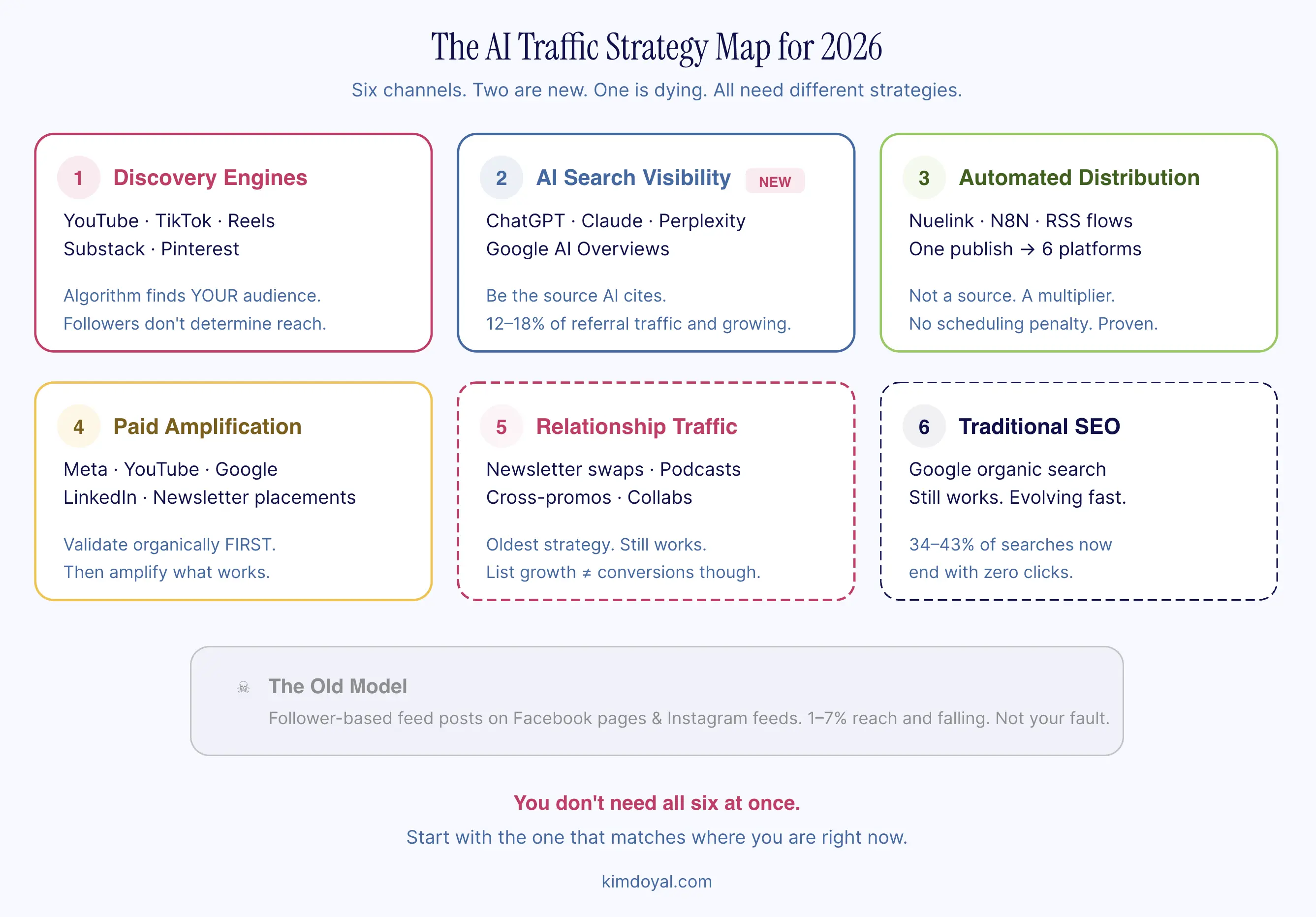
There are six distinct traffic channels in 2026, and they work fundamentally differently from the "organic vs. paid" split most people are still using. The biggest shift is the rise of interest-based discovery engines and AI search visibility... two categories that barely existed three years ago.
I've been mapping this out for weeks, and I think the traffic conversation needs an entirely new framework. Not "organic vs. paid" (that's a 2018 distinction). Something that reflects how people actually find content, products, and businesses now.
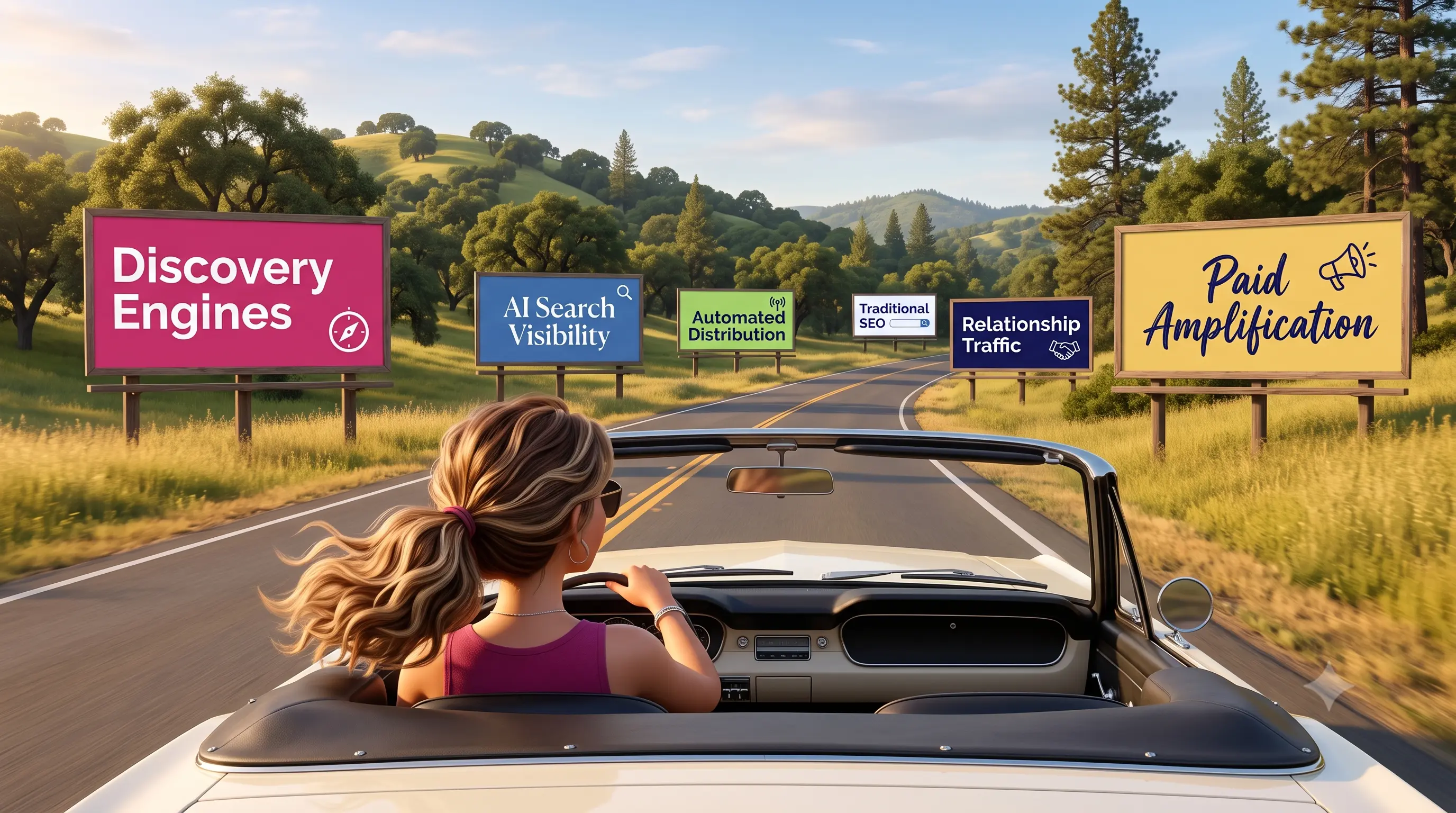
Here are the six categories I'm working with. And for each one, I'll tell you the one thing you can do this week to start... because I don't want you waiting for a series to take your first step.
The "organic vs. paid" split is a 2018 framework. In 2026, traffic breaks into six distinct channels, two of which barely existed three years ago. You don't need all six at once... start with the one that matches where you are right now.
1. Discovery Engines
What they are: Platforms where the algorithm matches your content to interested people, regardless of whether they follow you. YouTube, TikTok, Instagram Reels, Substack (recommendations, Notes, discovery feed), and Pinterest.
This is what Gary Vee meant when he told 10,000 real estate agents that his 55 million followers don't matter. A brand new account can outperform him if the content is better... because the algorithm rewards relevance, not history.
But "make good content" isn't an AI traffic strategy. The question is: good content about what? This is where the traffic conversation connects to something most people skip entirely: research before creation. You need to know what your audience is actually searching for, watching, and engaging with... before you create a single piece of content. AI can tell you this. A simple prompt asking Claude or ChatGPT to analyze what's trending in your niche on YouTube or what questions your audience is asking gives you a map that most people are creating without.
Your one move this week: Go to YouTube and search for the main topic of your business. Look at the top 10 results. - What are the titles? - What questions are being asked in the comments? Now ask Claude or ChatGPT: "Based on these topics, what's missing? What angle isn't being covered?" That gap is your first piece of content.
2. AI Search Visibility
What it is: Being the source that AI cites when someone asks a question. This traffic channel barely existed two years ago. Now it's real, it's growing fast, and almost no solopreneurs are thinking about it.
Here's the shift that changes everything. Google ranks pages. AI cites statements. When someone searches Google, they get a list of links and decide which one to click. When someone asks ChatGPT or Perplexity a question, the AI reads dozens of sources, synthesizes an answer, and attributes specific claims to whichever source said it most clearly. Either you're one of the 3-5 sources it cites, or you're invisible. There's no "page two" in AI search.
The numbers are hard to ignore. AI-powered search engines now account for an estimated 12-18% of total referral traffic, up from 5-8% in late 2024. AI search traffic converts at 14.2% compared to Google's 2.8%... that's a 5x advantage. And AI referral traffic to US retail sites grew 693% year over year. ChatGPT alone processes 2.5 billion prompts daily, and roughly 65% of those qualify as search queries.
So what makes AI choose YOUR content to cite? This is the part most people don't understand yet, and it's surprisingly relevant to how solopreneurs already write. Specific numbers, percentages, and named data points get cited far more than soft claims. "AI Overviews cut click-through rates by 58%" is citable. "AI is changing search a lot" is not. Content that provides clear, citable facts with supporting data is more likely to be cited than content that buries insights in long paragraphs. Answer-first formatting matters too... put the direct answer in the first sentence or two of each section, then expand. The AI extracts the answer. It doesn't hunt for it buried in paragraph four.
Here's why this is actually good news for solopreneurs. About 94% of AI citations come from non-paid, non-brand-owned sources. That means you don't need a massive advertising budget to get cited. You need clear, specific, experience-backed content that says something an AI can extract and attribute. Your real results, your specific frameworks, your original data from running your business... those are citability signals that generic "10 tips" articles can't compete with. The same depth and specificity that make content valuable to your ideal client are exactly what make AI want to cite it.
This doesn't replace traditional SEO. It builds on top of it. Nearly 40% of Google's AI Overviews already rank in the top 10 organic search results. So strong Google rankings still matter as a foundation. But the additional layer, making your content structured so each section is independently extractable and each key fact is independently citable, is what gets you into the AI answer.
Your one move this week: Open ChatGPT or Perplexity and ask it a question your ideal customer would ask... something directly related to what you sell. Are you mentioned? Are your competitors? That's your AI visibility baseline, and now you know where you stand. But don't stop there. Look at what IS being cited. What content got picked? What format is it in? What makes it citable? That's not just a visibility check... it's research. You're looking at exactly what kind of content gets surfaced by AI, which tells you what to create next.
3. Automated Distribution
What it is: The system that takes one piece of content and pushes it across multiple platforms without you logging into any of them.
This isn't a traffic source. It's a traffic multiplier. One blog post, distributed to six platforms through a tool like Nuelink or an N8N automation, reaches people on Bluesky, Threads, LinkedIn, Facebook, Instagram, and YouTube... from a single publish action.
And here's the thing I wish I'd understood years ago: there is no scheduling penalty. I know the old belief was that platforms reward you for being "on" the platform, posting natively, in the moment. Research has consistently debunked this. Posts published through official APIs receive the same algorithmic treatment as posts published manually. Hootsuite tested this directly and found scheduled posts actually earned higher engagement than native posts on the same account. Every major platform- Meta, TikTok, LinkedIn- offers an official API for scheduling. If scheduling hurt reach, those APIs wouldn't exist.
What does matter is consistency. Algorithms weigh posting consistency almost as heavily as engagement signals. An account posting five times a week consistently outperforms one posting excellent content twice a week, sporadically. Automated distribution makes consistency effortless.
And this goes deeper than most people realize. There are actually three levels to automated distribution. The first is scheduling tools... you batch your content, pick your times, and it goes out. Most people stop here, and it works. The second is workflow automation... You set up a trigger so that publishing in one place automatically creates and distributes content to others, no batching required. The third is something most people don't even know exists yet: publishing directly from your AI workspace, where you create the content and push it live without ever leaving the tool you're working in. I'll break down all three levels in the series, including downloadable workflows you can plug straight into your own setup.
Your one move this week: Pick one piece of content you've already published. Turn it into five platform-specific social posts (use AI to help). Schedule them across the next five days using whatever scheduling tool you have access to... even the free Meta Business Suite counts. You just multiplied one piece of content by five without being on any platform.
4. Paid Amplification
What it is: Meta ads, YouTube ads, Google Ads, LinkedIn ads, newsletter paid placements (SparkLoop, Beehiiv Boosts), and now even ChatGPT ads (launched in February 2026).
Here’s my take after successfully running paid traffic, and this might be unpopular: don't pay for traffic to something you haven't validated organically first. Unless you have deep pockets and you're comfortable treating the spend as pure testing budget.
If a piece of content doesn't get engagement organically, paying to push it to more people doesn't fix the message. It burns money faster. Paid amplification should follow organic signal, not replace it. You find what resonates, then you pour fuel on it.
Where AI changes this game is in the research layer. AI agents can analyze what ad creative is already running in your space, what copy angles competitors are using, and what's working... before you spend a single dollar. The testing happens in intelligence gathering, not in your ad budget.
Your one move this week: Go to Meta's Ad Library (it's free, anyone can access it) and search for competitors or businesses in your space. Look at what ads they're running. What hooks are they using? What offers? You just did competitive ad intelligence without spending anything.
5. Relationship-Based Traffic
What it is: Newsletter swaps, Substack cross-promotions and recommendations, podcast guesting, Substack Rewards collaborations, joint ventures.
This is the oldest traffic strategy on the list, and it still works. But I want to be honest about something: list growth and conversions are two different things. A Substack recommendation can bring hundreds of new subscribers. That's real. But do those subscribers become buyers? That depends entirely on what they see when they arrive, what you're offering, and whether they're the right fit for what you sell. Getting subscribers is one problem. Getting the right subscribers who actually buy is a different one.
AI helps here too. You can use AI to research potential collaboration partners, analyze audience overlap, and even draft outreach. But the relationship itself is still human. Nobody wants a cold DM that reads like it was written by AI.
Your one move this week: Identify three newsletters or creators in an adjacent space (not competitors, but serving a related audience). Subscribe to them. Engage with their content. This is the groundwork for a swap or collaboration later... and it starts with a genuine relationship, not a pitch.
6. Traditional SEO
What it is: Google organic search. Still alive, still sending traffic, but the landscape has fundamentally changed.
Zero-click searches now account for 34% of Google searches without an AI Overview, and that jumps to 43% when an AI Overview appears. Google's own AI is answering people's questions before they click through to your content. This doesn't mean SEO is dead. It means the KIND of content that earns clicks has changed. Google is rewarding depth, expertise, and original perspectives... not keyword-stuffed articles that say the same thing as everyone else.
For solopreneurs, this is actually an opportunity. Your real experience, your specific expertise, your original frameworks... those are harder for AI to replicate than generic "10 tips for X" articles. The bar for SEO content has gone up, which means people who actually have something to say are better positioned than those who were just playing the keyword game.
Your one move this week: Search Google for your primary topic. Do you see an AI Overview at the top? Read it. What sources does it cite? What does it say? That AI Overview is your new competition for click-throughs... and understanding what it says helps you create content that goes deeper than the summary.
Why Do Solopreneurs Have a Traffic Advantage Right Now?
Because AI traffic tools are better suited to one person who can move fast than to a 47-person marketing department that needs six approvals to change a headline.
Big companies already have traffic teams. Media buyers, SEO specialists, analytics people, social media managers. They're using AI too, but they're layering it on top of existing infrastructure and existing headcount.
We don't have that. We ARE the traffic team. That's an advantage right now.
You can spin up a research agent, analyze your competitive landscape, build a distribution system, and start testing... all in the same week (maybe even in a day). A corporate team is still scheduling the meeting to discuss the proposal.
The window for this is real, and I don't think it's permanent. Right now the tools are accessible, the costs are low, and the playbook hasn't been written yet. Which means the solopreneurs who build a real AI traffic strategy... not just a content strategy... are going to have a serious head start.
What Does Building an AI Traffic Engine Actually Look Like?
It starts with research and intelligence... using AI to understand where your audience is and what they're looking for before you create or spend anything.
I'm working through all six of these channels in my own business right now. Building the research agents, testing the ad creative workflows, deploying the automated distribution systems, and tracking what actually moves the needle.
Over the next few weeks, I'm going to walk through the entire implementation. Layer by layer. What I'm running, what's working, what's not, and what I'm learning along the way.
The first layer is Research and Recon.
Before you create anything or spend any money, AI can conduct competitive analysis, identify content gaps in your space, audit your search presence, surface which ads your competitors are running, and show you where your audience is already spending their time. Inside SPARK Lab, I built tools for exactly this... Niche Scout, SEO Keyword Research, Search Presence Audit, and Visibility & Authority Audit all feed this research layer. But even without those tools, a well-structured prompt in Claude or ChatGPT can get you 80% of the way there. That's where we'll start.
If you want to follow along, subscribe. And if you want access to the AI-powered research and visibility tools I'm building for solopreneurs who think about their business this way, check out SPARK Lab.
In the meantime, pick one of the six channels above. Do the "one move" for that channel. Just one.
You don't need to figure out all six this week. You just need to start.
Isn't organic social media dead?
Follower-based organic reach is dying... Facebook pages reach 1-2% of followers, Instagram around 5-7%, and LinkedIn dropped 34% year over year. But interest-based discovery on the same platforms is growing. Instagram Reels, YouTube Shorts, TikTok, and Substack's discovery feed all match content to interested people regardless of follower count. Organic social isn't dead. It's split in two, and the half most people are using is the half that's declining.
Do I need to use all six traffic channels?
No. Start with the one channel that matches where you are right now. If you're already creating content consistently, automated distribution *(channel 3)* gives you the most leverage with the least effort... one publish action, six platforms. If you want to understand where your audience is before creating anything new, start with the research layer in discovery engines *(channel 1)* or run the AI search visibility check *(channel 2)*. The whole point of the framework is that each channel works independently. You add more as you're ready, not all at once.
Does scheduling content instead of posting natively hurt my reach?
No. This is one of the most persistent myths in social media. Research from Hootsuite, Buffer, and Agorapulse consistently shows no algorithmic penalty for scheduled posts. In Hootsuite's controlled test, scheduled posts actually earned higher engagement than native posts on the same account. Every major platform offers an official scheduling API... they wouldn't build it if it hurt reach. Focus on native engagement, not posting.
What's AI search visibility and do I need to worry about it?
AI search visibility means being cited when someone asks ChatGPT, Claude, Perplexity, or Google AI Overviews a question related to your expertise. AI referral traffic now accounts for 12-18% of total referral traffic and converts at 14.2% compared to Google's 2.8%. It's the newest traffic channel on the map, and most solopreneurs aren't thinking about it yet, which means there's still room to establish presence early.
I don't have a budget for ads. Does any of this work without paid traffic?
Four of the six channels require zero ad spend: discovery engines, AI search visibility, automated distribution, and relationship-based traffic. Paid amplification is channel 4 specifically because it should come after you've validated what works organically. The research layer is also free. You need time and consistency, not a budget.
Your obvious offer is hiding in plain sight.
Free. Tell it what you know and who you help, and it'll show you the offer everyone can see but you.
Kim Doyal is a digital marketing strategist and AI builder with 18 years of online business experience. She is the founder of AI Spark Studios and SPARK Lab, and the creator of The Hub — a custom 33-agent AI operating system that runs her entire business. She has also built kimdoyal.com, StackRewards, and multiple AI tools and agents using vibe coding, a natural language approach to building software without a traditional development background.