HOME/BLOG/SEARCH CHANGED FAST. HERE ARE THREE AI TRAFFIC TOOLS BUILT FOR WHAT'S NEXT.
Content Strategy
Search Changed Fast. Here Are Three AI Traffic Tools Built for What's Next.
The click economy is collapsing. Your experience is exactly what the new landscape rewards.
August 16, 2026|5 min read
QUICK ANSWER
AI traffic tools are small, focused AI agents that each do one specific piece of the traffic work you keep meaning to get to... checking whether AI engines recommend you, grading your existing content for discoverability, and finding the places your people already gather. There are three of them in SPARK Lab: Content Grader, AI Visibility Audit, and Traffic Finder. The point isn't three more dashboards to babysit. It's leverage... getting more traffic from what you've already made, and pointing you to the handful of moves that actually matter.
Everything about how people find you online has changed in the last two years, and it's changing fast... and it's continuing to change at a pace we haven't seen before. But before your stomach drops, let me be clear about where this is going, because this is not a doom post. The ground shifted under all of us, the best practices you already know still hold, and the thing that actually changed is how we do the work, not whether it's worth doing. Stay with me to the end of this section, because the reframe there is why I built the tools I'm about to show you.
Here's the shift in one line: the click is disappearing, and being the source AI trusts is taking its place.
What actually changed about search and traffic in 2026?
The short version is that a search used to end in a click, and now, more often than not, it doesn't. When I published the first post in this series at the end of June, I put zero-click searches at about a third. A few weeks later, the cleaner cross-device data from SparkToro puts it much higher... fewer than one in three Google searches now sends a visitor to the open web at all. Pew found that when Google shows one of its AI summaries, people click through to a regular result 8% of the time instead of 15%. And those summaries aren't a rare event anymore... they now show up on close to half of all searches, up from roughly a third a year ago. Same direction I pointed at in Post 1, just moving faster than even I expected. If you've watched your own traffic slide over the past year even though you're doing everything you've always done right, this is why. It almost certainly isn't you.
Then there's the part almost nobody in our corner of the internet is talking about. More than half of all web traffic is no longer human. 🤯 The 2026 Thales report clocked automated traffic at 53% of everything moving across the internet last year, and for the first time it named AI agents as their own category, sitting right alongside the good bots and the bad ones. The web you're publishing into is increasingly read first by machines.
I know how that lands. A friend saw a version of this and left a comment on one of my posts that stuck with me. It was, more or less: if the bots are the ones reading now, what's even the point of writing?
I understand the feeling completely. And here's the reframe that pulled me right out of it.
If AI is the one reading, what's the point of creating content?
Because the AI isn't the audience. The AI is the filter.
When a machine reads your content first, that isn't the end of the line; it's the gate. It reads everything, decides what's clear and credible and actually answers the question, and then it hands the human who asked a short list of sources worth their time. Being read by the machine is how you get to the human on the other side. You're not writing for the bot. You're writing so the bot lets you through.
And when it does, the person who lands on your work is worth more than the ten who used to click around from a page of blue links. The data on this is not subtle. Brands that get cited in AI answers earn about 35% more organic clicks than brands that don't, according to Seer Interactive. Ahrefs found that AI search made up half a percent of their traffic but drove more than 12% of their signups. Adobe watched AI referrals convert 31% better over the holidays, with revenue per visit up 254% year over year. The visitors are still a small slice, low single digits of most sites' traffic for now... but they arrive already researched, already half-decided, and they are the fastest-growing source on the web right now.
So no, the point didn't disappear. It moved.
The work now is making sure the filter can read you clearly, that it trusts you enough to cite you, and that when someone does come looking, you turn up in the places that feed it. And here's the reassuring part: that's not new work. It's the work you were already doing, pointed one layer differently. Clear writing, real expertise, actually answering the question someone asked... all of it matters more now, not less, because it's precisely what the filter is built to reward.
That's why I keep saying your experience is the asset. The filter can't be charmed by someone who doesn't actually know the thing... it rewards the years you've already put in, the judgment you've earned, the problem you understand better than any model does. AI is just the tool that finally makes all of it legible.
In Post 1, I mapped the six traffic channels that actually work in 2026. Here's what I built to run three of them without it eating my life.
Three AI traffic tools, each pointed at part of that map. The Content Grader takes the content you've already published and makes it findable and citable... your traditional SEO and AI search visibility channels doing real work instead of sitting in a framework. The AI Visibility Audit is your AI search visibility channel made literal, telling you whether the machines recommend you yet. And Traffic Finder is your discovery engine and relationship channels pointed outward, to find where your people already gather. Two of the three have been quietly living in SPARK Lab for months. Traffic Finder is the one that just went live. I'll walk you through them in the order you'd actually use them: fix what you have, find out where you stand, then go get discovered.
How do I get more traffic from content I already published?
You run it through the Content Grader.
This is the purest expression of "more from what you already made." You paste in a blog post, a newsletter, an article... something already written and published... and it tells you why it isn't getting found and exactly what to change.
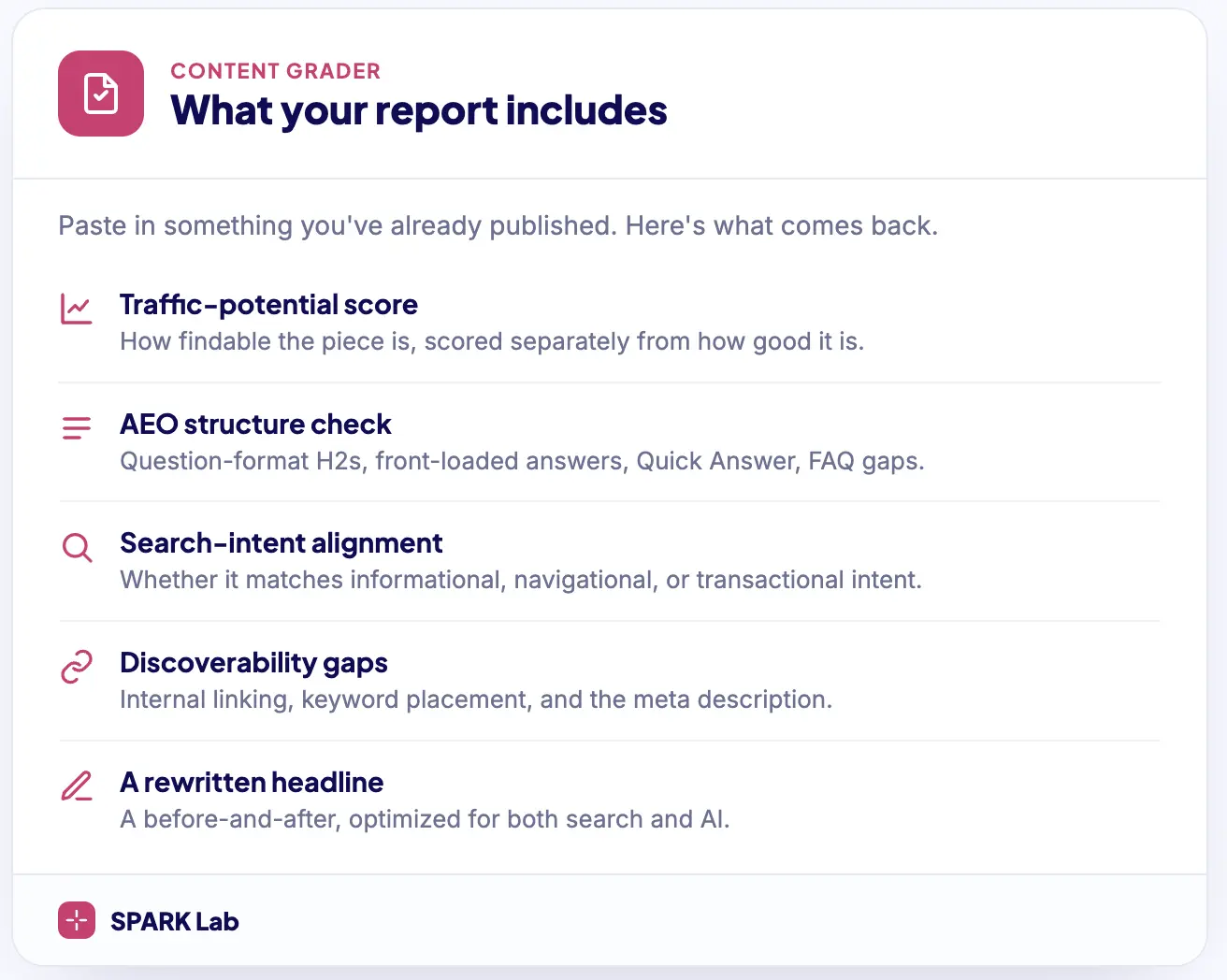
Here's what it actually returns:
A traffic-potential score that's separate from content quality. Your writing can be genuinely good and still be invisible, and those are two different problems. This scores the second one.
An AEO structure check(that's Answer Engine Optimization... whether AI search engines can actually extract and use your content). It looks at whether your H2s (H2 is a heading tag if you're unfamiliar with the term. The subheading above this section is an H2, the post title is an H1) are phrased as real questions, whether your answers are front-loaded, whether there's a clean Quick Answer an AI can lift, where the FAQ opportunities are.
Search-intent alignment, so you know whether the piece matches what someone is actually looking for when they search... informational, navigational, or transactional.
The discoverability gaps nobody enjoys auditing by hand: internal linking, keyword placement, the meta description you probably left blank.
And the part I like most... a rewritten, search- and AI-optimized headline, plus a before-and-after of the handful of changes that would move the needle most.
The Content Grader takes something you've already published and shows you why it isn't getting found, down to a rewritten headline.
This tool goes first because it asks nothing new of you. You already did the hard part. You wrote the thing. This just makes the thing findable, which is the least glamorous and highest-leverage traffic work there is.
Does AI actually recommend me... and what do I do about it?
That's the AI Visibility Audit, and it answers a question I don't think enough established business owners have thought to ask yet.
We spent a decade optimizing for "does Google rank me." The question underneath everything is different now. When someone opens ChatGPT, Perplexity, or Google's AI Overviews and asks, "who's good at X" or "what should I use for Y"... does your name come up? Or does the AI confidently recommend five other people while you sit there invisible, having done great work for years?
A lot of us have never checked.
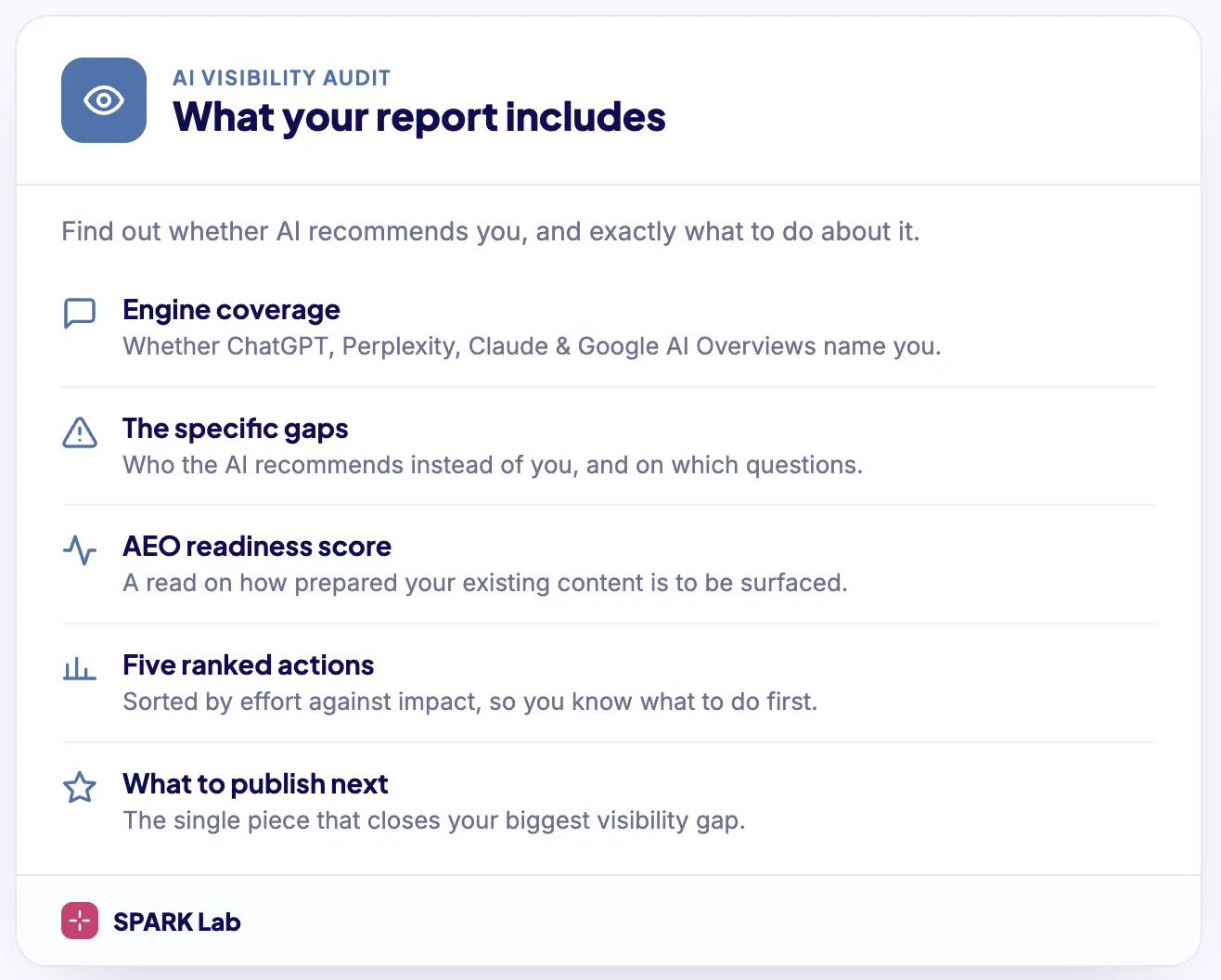
You give it your business name, your URL, and the three-to-five topics you actually want to be known for. It comes back with:
Whether ChatGPT, Perplexity, Claude, and Google's AI Overviews mention or recommend you in your space at all.
The specific gaps, framed the way they actually hurt: "when someone asks this question, here's who the AI recommends instead of you." That sentence is uncomfortable to read and exactly the point.
An AEO readiness score for your existing content, if you hand it a URL.
Five actions ranked by effort against impact, so you're not staring at a wall of equally-weighted suggestions.
And a single "what to publish next" pick... the one piece of content that would close your biggest visibility gap. Not a content calendar. One move.
The AI Visibility Audit tells you whether ChatGPT, Perplexity, Claude, and Google's AI actually recommend you, and the one thing to publish next.
This tool pairs naturally with the Content Grader. One tells you whether AI recommends you at all; the other tells you how to fix a specific piece so it pulls its weight. A checkup on your presence, and a scalpel on one post.
Where are my people, and where should I actually show up?
This is Traffic Finder. This is the one I just built, and as of today it's live in SPARK Lab.
Everything so far has been about getting more out of what you already have... your content, your existing presence. Traffic Finder is the tool that looks outward. It answers the question that stops a lot of established people cold: okay, I know I need traffic from somewhere other than the algorithm gods... but where, specifically, without spending my life pitching into the void?
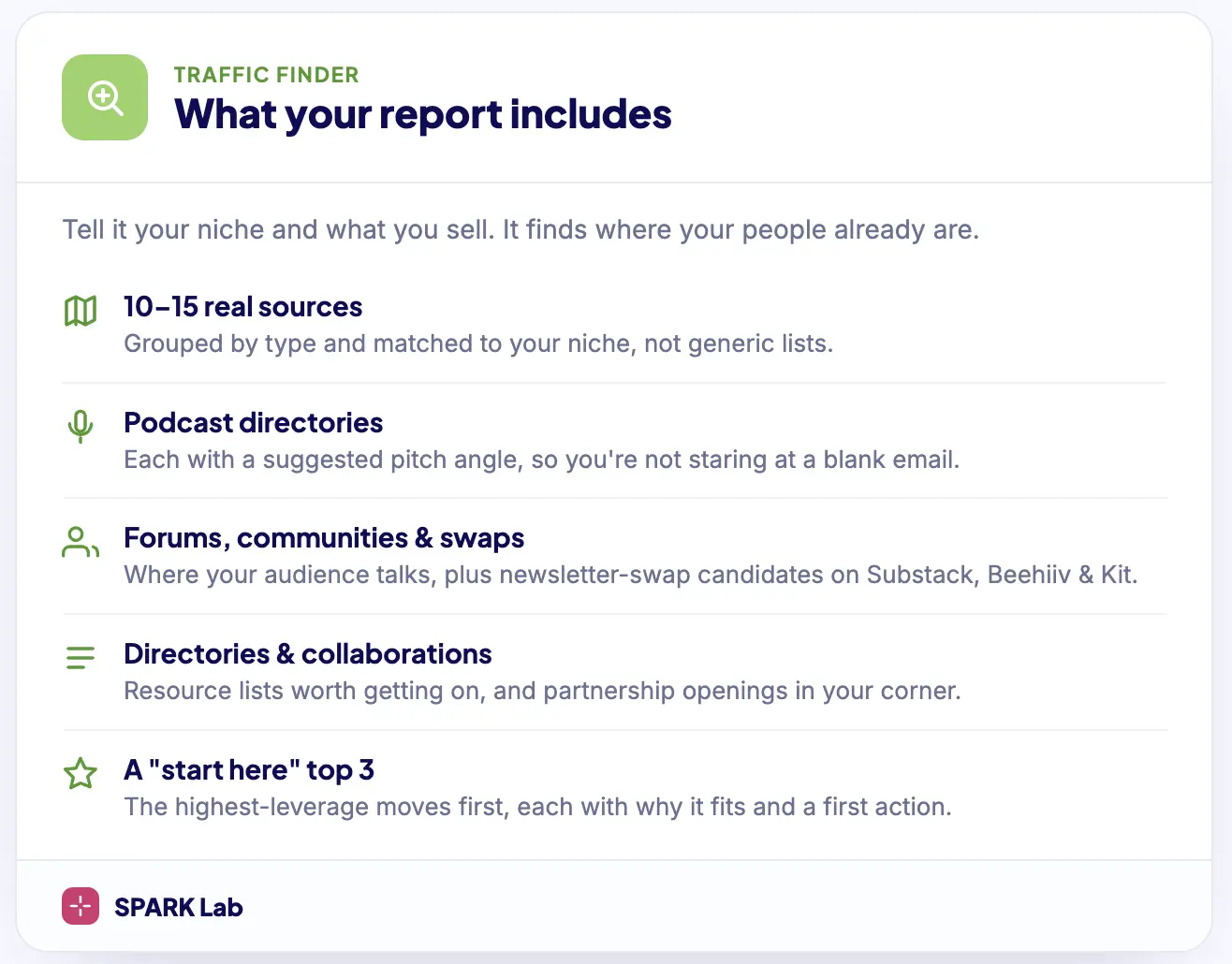
You tell it your niche, your business type, the platforms you're already on, and what you sell. It runs live research (built on Tavily, Apify, and Firecrawl, with Claude reasoning over the results... the same research stack powering the rest of my tools, no new plumbing) and comes back with 10 to 15 real places your people already gather, grouped by type:
Podcast directories, each with a suggested pitch angle so you're not staring at a blank email.
Niche forums and communities where your audience is already talking.
Newsletter swap candidates across Substack, Beehiiv, and Kit... the cross-promotion moves that actually grow lists right now.
Industry directories and resource lists worth getting on.
Collaboration opportunities in your specific corner of the world.
And for each source: why it fits you, how much effort it'll take, and the suggested first action. Plus a "start here" top three so you know which of the fifteen to touch first.
Traffic Finder finds 10 to 15 real places your people already gather, grouped by type, with a "start here" top three so you know where to begin.
Now, I'll be honest about the risk with this one, because it's the whole reason the next post exists. Traffic Finder is the tool most likely to turn into homework. A list of fifteen places to pitch is not leverage if you still have to sit down and write fifteen pitches. That's just a prettier to-do list.
So it doesn't stop at the list.
Why three AI traffic tools instead of one big one?
Because the traffic problem isn't one problem, and pretending it is has never once helped anyone.
Getting found is a different job than getting recommended, which is a different job than getting discovered somewhere new. One giant "traffic tool" that tried to do all three would do all three badly. The scarce thing here was never the features. It's the sequence... knowing that you sharpen what you have before you chase what you don't, that you find out if AI already recommends you before you go pitch strangers, that you fix the content you published before you publish more.
Three focused tools in a deliberate order will beat one bloated dashboard every time. That's not a SPARK Lab opinion. That's 18 years of watching people drown in tools they use 40% of the time.
And the piece that ties Traffic Finder back to "leverage, not homework"... the part that turns a list of fifteen sources into actual outreach without eating your week... that's the layer I'm dogfooding right now. It drafts the personalized pitch for each source it finds (the podcast angle, the swap proposal, the guest-post note), tracks what you've sent and who's replied, and hands you ready-to-go drafts. Nothing sends on its own... the relationship part stays yours. But the research, the writing, the personalization? Delegated.
That's next week's post, because I want to run it against my own business first and show you exactly what comes back, not describe it in the abstract. (Watch me, remember. Not "trust me.")
Where these live
All three tools are inside SPARK Lab, the $15-a-month membership where I keep the growing set of build-and-intel tools I use to run my own business. I'm not going to pitch you hard on it here, because that's not what this post is for... this post is me showing you what I built and how I think about the traffic problem. If the tools are useful to you, they're right there. If you'd rather build your own versions, even better, and I'll keep showing my work either way.
There's a fuller breakdown of how to put these to work coming at the end of the series, once I've run all three against my own business and have the real numbers to show you.
Don't put all your traffic in one basket
If there's one habit I'd protect you from, it's building your whole business on a single traffic source you don't control. Focus on one, absolutely... you can't be everywhere, and trying to be on six channels at once is its own kind of failure. But focusing on one and relying on one are different things. Relying on one means betting the whole business on rules you didn't write and can't see changing.
And they change fast. Just this month, Anthropic started weaving an invisible watermark into the text its Claude models generate to comply with a European transparency law. It's genuinely unknown whether search engines or AI answer engines will ever treat a provenance signal like that as a ranking or citation factor... they may never. But that's exactly the point. A rule written by regulators on another continent, one that few of us were even tracking, reshaped part of the landscape overnight, and the second-order effects will take months to understand. You can't plan around that. What you can do is make sure no single channel can take you down with it.
Which, honestly, is the quiet argument underneath these three tools. Get found, get recommended, get discovered... that isn't just a sequence; it's three different doors into your business, so that when one of them narrows (and one always eventually narrows), the others are already open. Focus your energy and diversify your dependence. Those two only sound contradictory until the ground moves under the channel you loved.
What's next
In the next traffic post, I point all three tools at my own business and show you the actual output. The real Traffic Finder results, the real visibility gaps it surfaces about me, the content the grader tells me to fix... and the outreach drafting layer running live, turning that list of sources into pitches I can actually send.
Less "here's what I built." More "here's what happened when I used it." That's the fun part, and it's the part I can't fake, which is exactly why it gets its own post.
If you're building your own traffic tools alongside this series, I'd love to hear what you're making... reply and tell me which of the three jobs (get found, get recommended, get discovered) you keep putting off. My guess is I already know, because it's the same one I put off the longest. 😉
Frequently Asked Questions
What is an AI traffic tool?
An AI traffic tool is a small, focused AI agent that automates one specific part of growing your traffic... checking whether AI engines recommend you, scoring existing content for discoverability, or finding new places your audience gathers. The goal is leverage: getting more traffic from what you already have rather than producing more content.
Do I need to know how to code to use these?
No. All three tools run inside SPARK Lab as web tools... you fill in a short form and get a visual report back. The building happens on my end. If you want to build your own versions, that's the whole point of the "Watch Me Build" approach, and I share how.
What's the difference between the Content Grader and the AI Visibility Audit?
The Content Grader looks at a single piece of content you've already written and tells you how to make it more findable. The AI Visibility Audit looks at your whole business and tells you whether AI engines recommend you in your space, plus what to publish next to close the biggest gap. One is a scalpel on one post. The other is a checkup on your
What does Traffic Finder actually find?
It returns 10 to 15 real places your specific audience already gathers... podcast directories, niche communities, newsletter swap candidates, industry directories, and collaboration opportunities... each with why it fits you, the effort involved, and a suggested first move, plus a "start here" top three.
Is this just SEO with a new name?
No. Traditional SEO optimizes for ranking in Google's blue links. This optimizes for a world where a growing share of searches never produce a click, and where AI engines answer the question directly. AEO (Answer Engine Optimization) is about being the answer, not the tenth link. These tools work the AEO problem alongside the traditional one.
Where can I get the tools?
All three live in SPARK Lab at $15/month. A fuller walkthrough of how to use them together comes at the end of this series.
Sources
The research behind this post, if you want to go deeper:
Kim Doyal is a digital marketing strategist and AI builder with 18 years of online business experience. She is the founder of AI Spark Studios and SPARK Lab, and the creator of The Hub — a custom 33-agent AI operating system that runs her entire business. She has also built kimdoyal.com, StackRewards, and multiple AI tools and agents using vibe coding, a natural language approach to building software without a traditional development background.