HOME/BLOG/I DELETED 428 SUBSCRIBERS THIS WEEKEND. HERE'S WHAT MY LIST TOLD ME WHEN I LOOKED DEEPER
Business Growth
I Deleted 428 Subscribers This Weekend. Here's What My List Told Me When I Looked Deeper
This is the follow-up to "What Substack Doesn't Tell You About Your Subscribers." I went and got more data, it's not pretty.
April 5, 2026|5 min read
In March, I wrote a piece called "What Substack Doesn't Tell You About Your Subscribers (And Why That's Not an Accident)." It was about the gaps in Substack's analytics, the quality problem with its recommendation engine, and the incentive structures that keep creators in the dark about who's actually reading their work.
That article got 3,394 views, 268 hearts, 119 comments, and 33 restacks. It clearly struck a nerve.
It also drove 32 new subscribers.
Zero paid.
Which, honestly, is kind of the perfect encapsulation of what I'm about to talk about. The article performed beautifully by every engagement metric Substack cares about. And it produced exactly zero revenue (let me be clear, that wasn't the point of the article, but it supports what I'm saying here). The conversation about subscriber quality reached a lot of people... who didn't buy anything.
Before I go any further, I want to say something clearly: Substack is one of the nicest places on the internet right now. I mean that. The quality of conversations, the writers I've connected with, the community that exists here... It's genuinely rare. I'm not leaving, and I don't want you to leave.
But nice doesn't pay the bills. And this article is about the difference between a place you enjoy being and a platform you can build a business on.
How many subscribers did I actually need to remove?
428.
That's how many subscribers I deleted this weekend after syncing my data in a tool called Subflow AI (more on that later).
Over the weekend, I was pulling in subscriber data and running signals I hadn't been able to see through Substack's native analytics, and I found myself staring at a number I wasn't ready for.
These weren't people who subscribed two weeks ago and haven't opened anything yet (I'm patient, I get it, life is busy). These were people who had been sitting on my list for months, some of them years, who had never engaged with a single thing I've sent.
And when I looked at where they came from?
A massive chunk was imports. My old list from the Kim Doyal/WordPress Chick days.
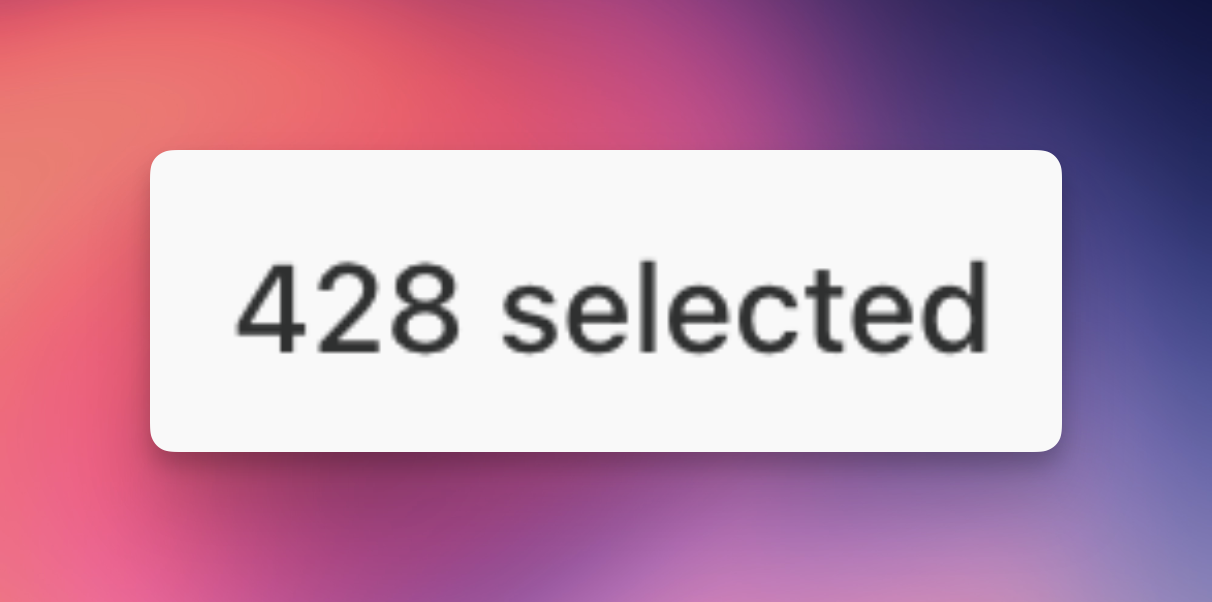
428 selected. Net growth went negative. Never felt better about my list.
Here's the thing... when I imported that list into Substack, I was still writing about content strategy, email marketing, and online business. It's not like I imported a list of gardening enthusiasts and started writing about tech. The topics overlapped. So I assumed people would naturally self-select. Those who resonated with the new direction would stick around, and those who didn't would unsubscribe.
That's not what happened.
What happened is they just... stayed. Technically subscribed, never opening anything, never engaging, quietly sitting on my list and counting toward a number that looked like growth but wasn't. They didn't unsubscribe, but they also didn't read. And I let it go on way too long because the subscriber count felt good.
They're not bad subscribers. They're just not aligned with where I am now, what I'm building, or who I'm building it for. And keeping them on the list wasn't serving either of us. (And honestly? I probably have another 400 to go. This was round one.)
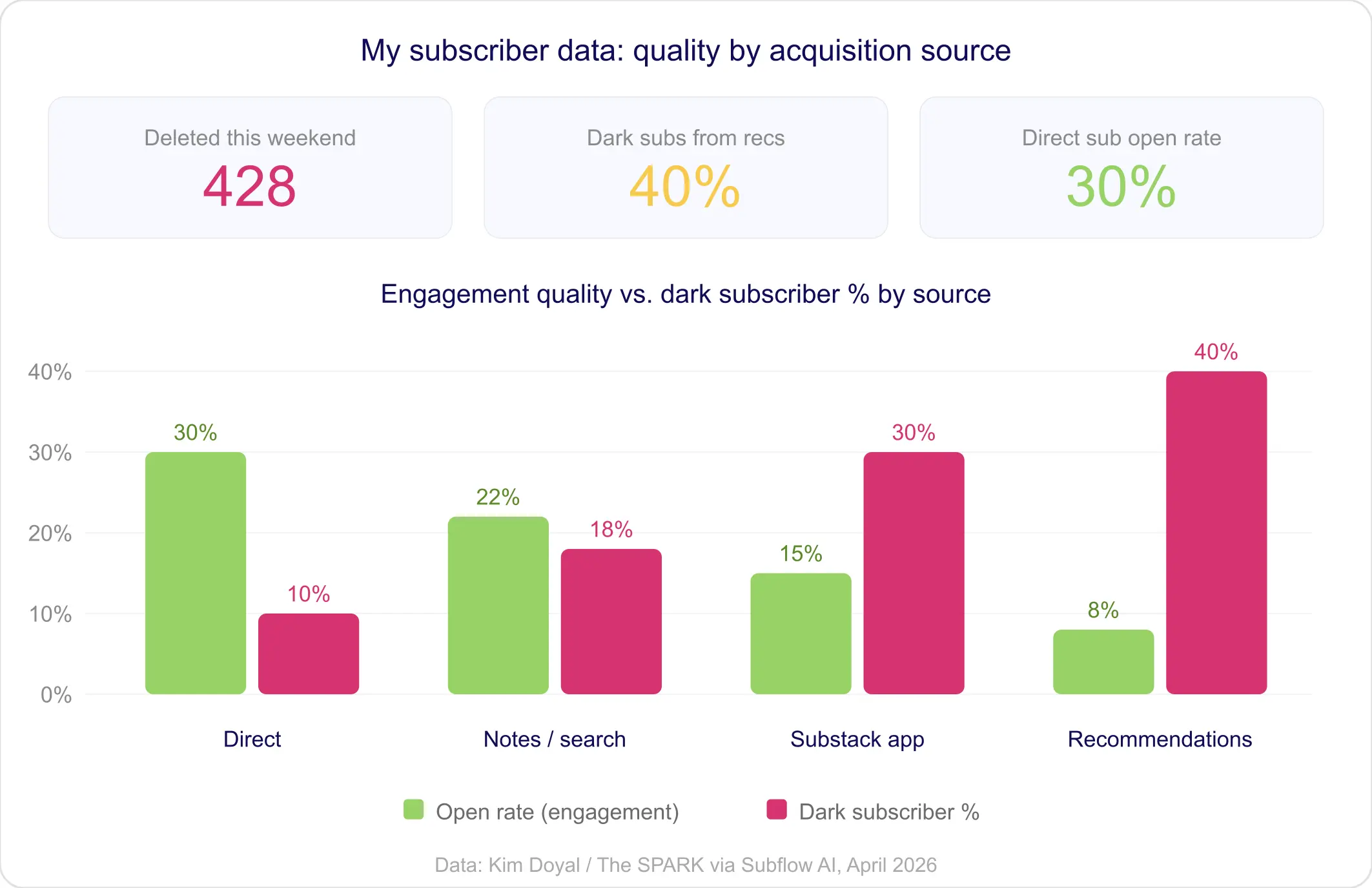
For my list, 40% of my non-engaging subscribers came directly from Substack's recommendation engine. That's the single largest source of dead weight on my list.
The stat that changed everything. 40% of my non-engaging subscribers came from one source.
Not from Notes, not from someone genuinely linking my work in a post, not from search. From the checkout screen that pops up after someone subscribes to another writer, where they're shown a wall of publications to also subscribe to with a single click.
I discussed this in my first article, using the wine-tasting analogy. Someone has a great experience at a winery, they're heading to the car, and ten other wineries are shoving glasses at them on the way to the parking lot. They grab a sip to be polite. They don't remember the wine. They don't know the winery's name. They're definitely not coming back.
That's what 40% of my dark list was made of.
Drive-by sips.
The pattern is hard to miss. As you move from direct subscribers to recommendations, engagement drops and dark subscribers climb.
Is Substack app growth actually real growth?
Subflow showed me that the Substack app drives 59% of my new subscribers, but those subscribers have the lowest engagement rates across every acquisition channel. High volume, low quality.
That sounds great on the dashboard, right? Growth! Momentum! The platform is working!
Except... when you cross-reference that against engagement, the picture falls apart.
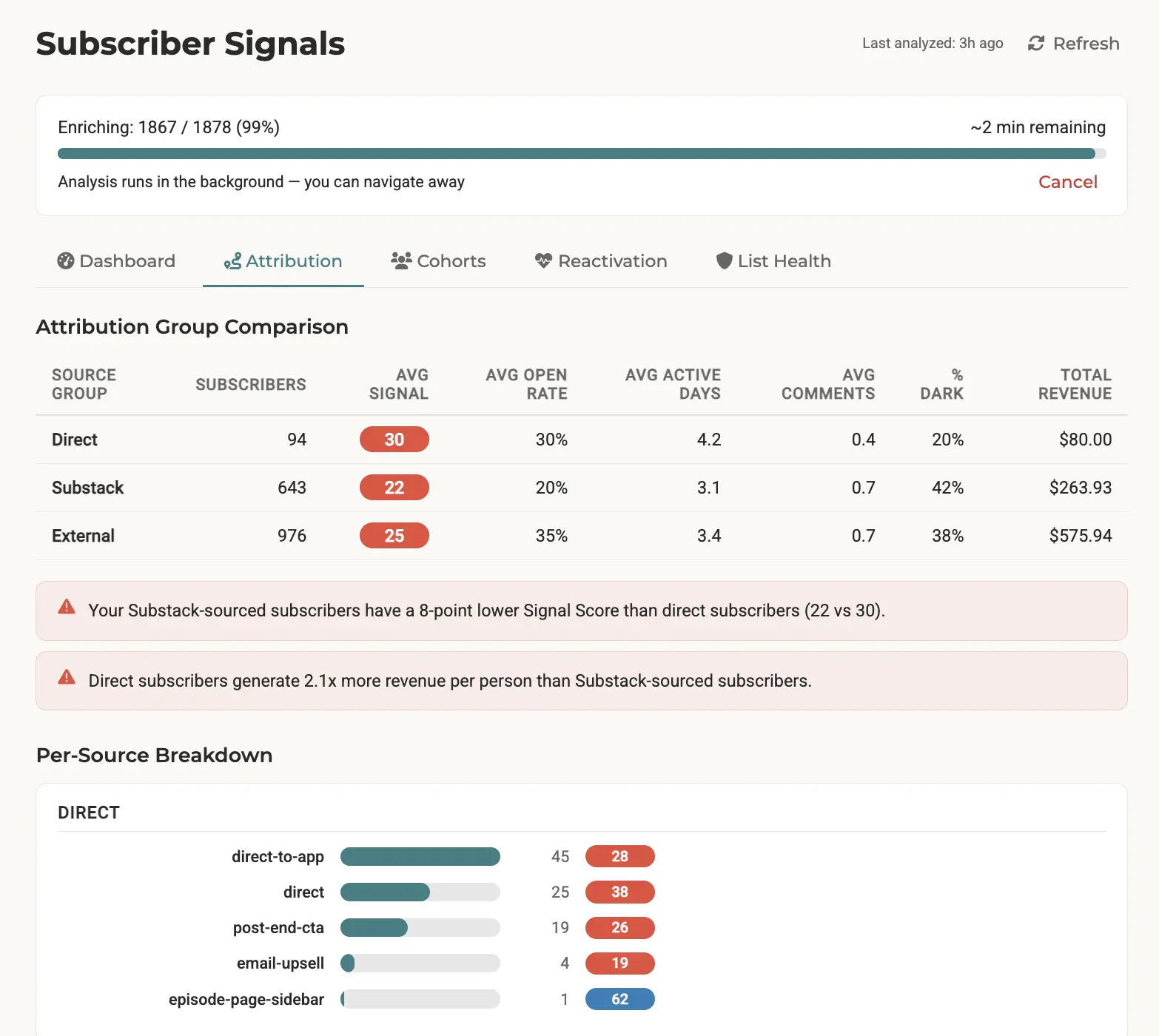
Direct subscribers, the people who found me on purpose, typed in a URL, or clicked a link from my website, have an average open rate of 30%.
Substack recommendation subscribers? The lowest average open rate across every acquisition source. And the highest percentage of dark subscribers in my entire list.
So the channel Substack celebrates the most, the recommendation engine, the app-driven growth, and the "network effects," is consistently sending me the lowest quality subscribers.
And here's something most creators don't realize about the Substack app: there's a difference between someone "following" you and someone "subscribing." App followers are not portable. You don't have their email address. You have no way to contact them outside the Substack interface. When you think you "own" your audience on Substack, you own your email subscribers. The app followers? Substack owns that relationship, not you.
What does subscriber quality actually mean for your email list?
A quality subscriber is someone aligned with your ideal customer profile... someone who has the problem you solve and is in a position to eventually say "yes, I want more of this" with their wallet. It's about alignment, not about judging people.
I want to be really specific about this, because "quality" can sound like you're sorting people into worthy and unworthy categories. I'm not saying recommendation subscribers are somehow lesser humans. I'm definitely not saying anyone is spammy or worthless.
What I'm saying is that most growth mechanisms on Substack (the recommendation engine, the checkout screen, the in-app suggestions) are optimized to grow your number, not to find your people. The platform can't distinguish between "this person is genuinely interested in AI for solopreneurs" and "this person clicked a button because clicking was easy." Both count as one subscriber.
Your job is to figure out which is which. And Substack gives you almost no tools to do that.
And here's the part that most creators don't want to hear: you are better off with 1,000 subscribers who are high-intent, highly engaged, and aligned with what you sell than 7,500 who showed up through a viral post or a recommendation checkout screen.
That smaller, aligned list will out-earn the bigger one every single time. Because those 1,000 people are reading your emails, clicking your links, replying to your questions, and raising their hands when you make an offer. The 7,500 are a number. And numbers don't pay your bills.
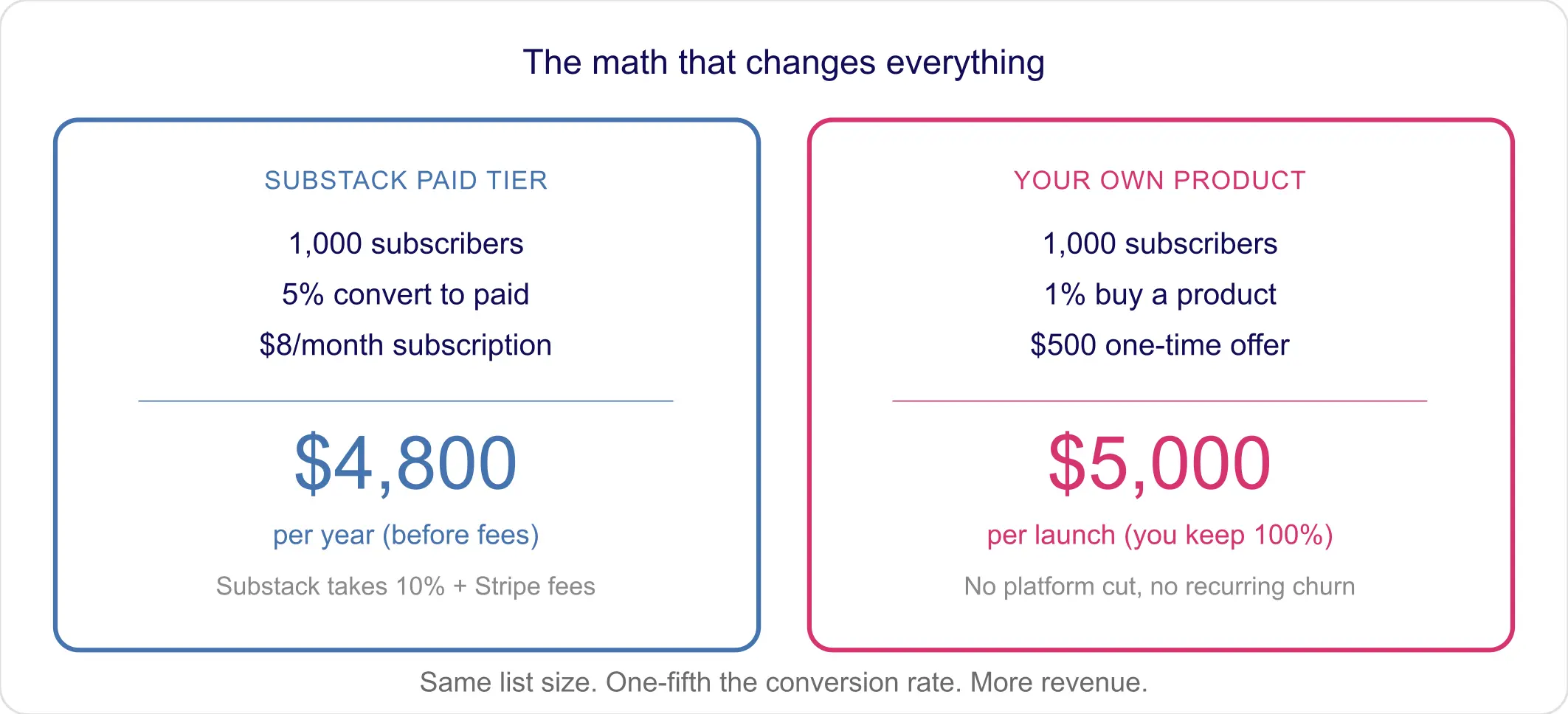
I'd rather have a 1% conversion rate on a $500 product than a 5% conversion rate on an $8/month newsletter subscription. The math is simple:
Same list size.
One-fifth of the conversion rate.
More revenue. And you keep all of it.
What does the actual free-to-paid conversion data show?
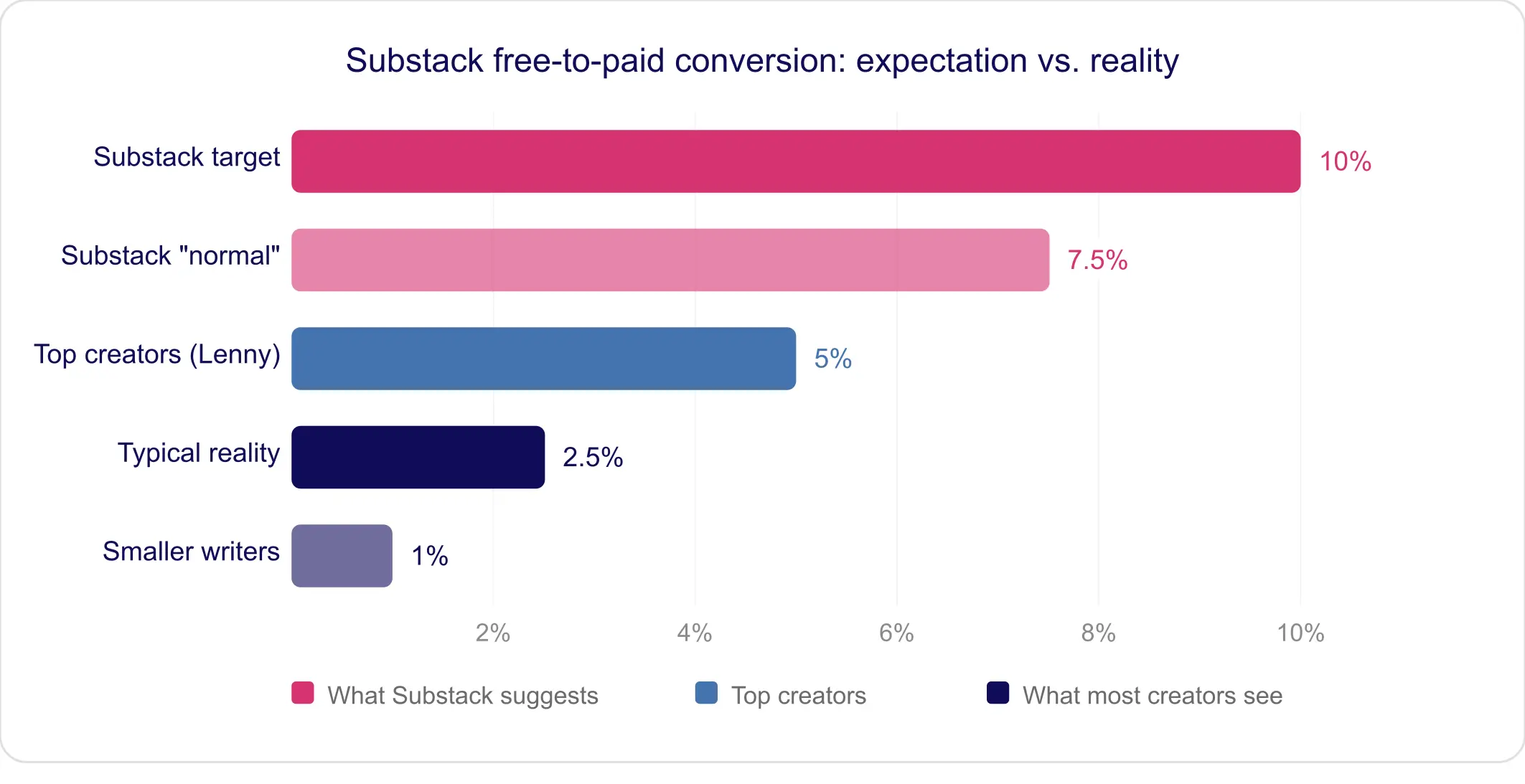
Substack suggests that 5-10% of free subscribers should convert to paid, with 10% as the target. The real numbers tell a very different story.
Across multiple independent analyses and creator reports from 2025 and 2026, the typical free-to-paid conversion rate sits at 2-3%. Even Lenny Rachitsky, arguably the most successful business newsletter on Substack with over a million subscribers, was converting at about 5%, which Substack's own documentation considers underperforming. Most mid-tier and smaller writers report rates closer to 1-3%.
The average across the 50,000 publishers earning money on Substack? Roughly 80 paid subscribers per earning creator. Eighty.
Substack suggests 5-10% free-to-paid conversion. Most creators are seeing 1-3%. Even Lenny Rachitsky converts at about 5%.
And here's where the math gets really honest.
One creator, Wes Pearce of Escape the Cubicle, makes $5,000 a month with ZERO paid subscribers. His entire revenue comes from digital products promoted through his free newsletter. The newsletter is his distribution channel, not his business model. That's the Substack version that actually works for most business builders.
Are you building an audience or an echo chamber?
If most of your Substack engagement comes from other writers in your niche, you may be building visibility without building a customer base. Peer engagement and customer engagement are not the same thing.
Here's the part that stings a little, and I'm including myself in this because I've done it too.
If you spend most of your time on Substack engaging with other writers in your space, recommending their publications, restacking their posts, commenting on their Notes, showing up in their DMs... you're building visibility. And that feels productive. It feels like a community and genuinely feels like growth.
And for some people, it is growth. There are absolutely real customers on Substack. I'm not saying the platform is nothing but writers talking to writers. Depending on your niche and your price point, you may find incredible buyers who found you through Notes, recommendations, or restacks.
But you need to be honest about whether that's actually happening for you, or whether you're spending your energy building relationships with peers who love your work but will never need what you sell.
I learned this lesson the hard way back in the WordPress Chick days. I was well known in the WordPress community. I had a podcast, I went to WordCamps, and I had sponsorships from hosting companies. I was connected and visible, and it absolutely felt like I was building something real.
But the people I was spending most of my time with? They weren't the ones who needed my services or my products. They were peers. Colleagues. Friends, absolutely (and I'm grateful for those friendships to this day). But they already knew how to do what I was teaching. They were never going to be my customers.
The same dynamic plays out on Substack, and it can be even harder to spot because the platform's structure rewards peer-to-peer engagement. The algorithm literally favors creators who treat Substack as their primary social network. Writers who post daily Notes, engage in comment threads, and recommend other publications within the interface get more visibility. Writers who build their audience on LinkedIn or YouTube and only use Substack for email delivery? The algorithm has very little data to work with, so it effectively withholds distribution.
That's not a bug. That's the system working as designed. And the subscribers you gain through that peer-to-peer activity are disproportionately people who do the same thing you do, not people who need what you offer.
What are you actually using Substack for?
This is the question I think most creators skip over, and it's the one that matters more than anything else in this article.
There are really only two answers.
Option one: Substack is your writing home. Paid subscriptions are your business model. You're building a media company, and the $5 or $10 or $15 a month from subscribers is how you earn your living. If that's you, lean in. Play the recommendation game, optimize for the algorithm, grow the list, convert free to paid. That's a legitimate business, and some people are doing it really well.
Option two: You're building something beyond subscriptions. You have workshops, consulting, digital products, services, and offers at higher price points. Your business isn't the newsletter... the newsletter is a marketing channel that feeds the business. If that's you, then your subscriber count matters about as much as your Instagram follower count. It's directional at best. It is not the thing.
Most creators I know are somewhere between options one and two, but they're acting like they're in option one. They're optimizing for subscriber growth when they should be optimizing for subscriber quality. They're celebrating big numbers when they should be asking whether those numbers translate to revenue.
I know this because I've been doing it myself.
My Substack doesn't exactly scream "here's what I sell." I have client work. I'm getting really clear on offers and how they connect to my content. And that's partly why this conversation matters so much to me... because if your Substack doesn't have a clear path from "subscriber" to "customer," then all the growth in the world is just a number on a dashboard someone else controls.
Pick one and build accordingly.
Why you can't rely on a single traffic source (even a good one)
Here's the part that goes beyond Substack, and I think it's the conversation the creator space needs to have right now.
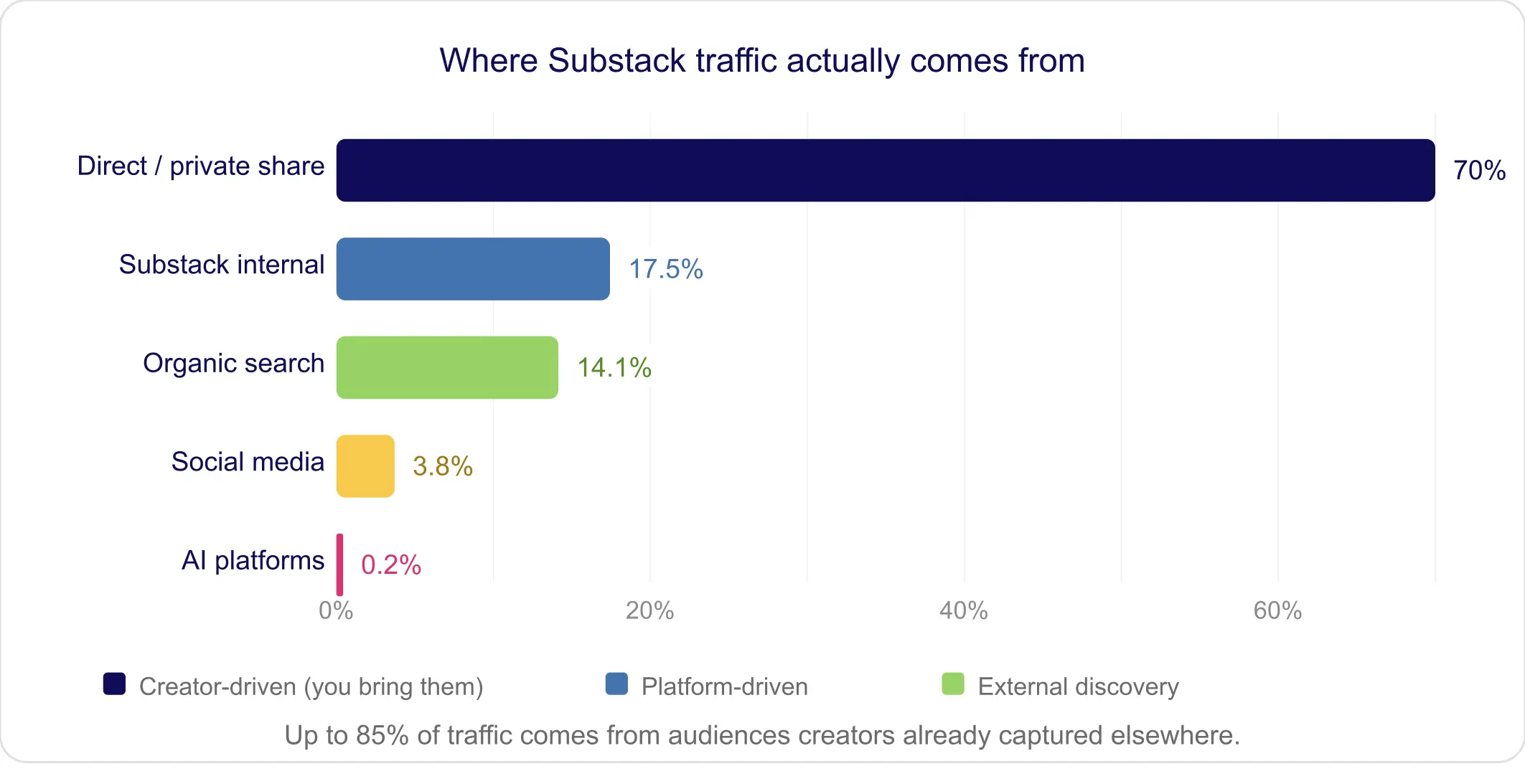
Most of Substack's traffic (up to 85% by some analyses) comes from audiences creators already captured elsewhere. "Direct" traffic, which includes bookmarks, messaging app shares, and email links with stripped referrers, accounts for the vast majority of visits. Substack's internal discovery (Notes, feed, recommendations) drives a much smaller slice than most people assume.
Up to 85% of Substack traffic comes from audiences creators already captured elsewhere. The platform is a destination, not a discovery engine.
In other words: Substack is primarily a destination for audiences you already have, not a discovery engine that finds new people for you. The platform itself says that 50% of reads now come from the feed (not email), and they claim 320 million "discoveries" through Notes and recommendations. But they don't define what a "discovery" means, they don't give a timeframe, and that number is a marketing metric, not an operational one.
The entire landscape of how people discover content is shifting. GEO (generative engine optimization) is already reshaping which content gets surfaced and where. Social platforms are throttling organic reach (shocking… said no one ever;we’ve watched this movie before). And the creator economy is more crowded than it has ever been, with more people writing about how to be a creator than there are people who need those creators' services. (I realize the irony of writing that in a post about Substack strategy, and I'm okay with it.)
Here's what's real: the information that used to differentiate you as a creator is now at everyone's fingertips. AI can produce a decent first draft of almost any how-to content in seconds.
So how do you stand out?
How do you actually get in front of the people who need what you specifically offer?
You don't do it by going all in on one platform and hoping the algorithm stays kind.
I also don't believe in "be everywhere."
That's a recipe for burnout and mediocrity. But I do believe you need more than one source of traffic, more than one way to be discovered, and more than one relationship with your audience that doesn't have a platform sitting between you and them.
Something interesting showed up in my Subflow data, by the way: search is starting to work. Real traffic from Google. And even more surprising? ChatGPT showed up as a referral source. I don't fully know what to make of that yet, but the fact that AI-driven discovery is already visible in the data matters.
The way people find content is changing right now, in real time. The creators who are only visible through one platform's algorithm are going to feel that shift first.
What tool did I use for this subscriber audit?
Subflow AI, built by Dheeraj Sharma of Gen AI Unplugged. It's a Chrome extension that syncs with your Substack data and surfaces what Substack doesn't... acquisition source quality, dark subscriber analysis, engagement patterns by source, and signals about who's actually paying attention versus who's just a number on your dashboard.
Before I deleted 428 subscribers. This is the data Substack doesn't show you. Direct subscribers generate 2.1x more revenue per person than Substack-sourced subscribers.
I mentioned StackContacts by Finn Tropy in my first article, and that tool is still solid if it's a fit for how you work. For me, Subflow's UI just clicks better with how my brain processes this kind of data. Different tools for different people.
(Full disclosure: I'm an affiliate for Subflow. But I wouldn't be writing about it if the data hadn't genuinely changed the way I think about my list. The 428 deletions happened because of what this tool showed me.)
What am I actually doing about all of this?
I don't want this to be one of those posts where someone identifies a problem and then just leaves you sitting with it. Here's what I'm doing, specifically, because of what this data showed me.
I'm cleaning the list aggressively. 428 down, probably 400 more to go. This isn't a one-time purge. I'm going to keep running signals through Subflow and keep removing subscribers who aren't aligned with what I'm building.
I'm emailing everyone who's left. Not a passive "hope they notice" thing. I'm sending a direct message to every remaining subscriber letting them know they're on my list, what I'm building, what to expect, and an easy way to unsubscribe if this isn't for them. I want the people who stay to have actively chosen to stay.
I'm adding paid traffic. This is the part that might surprise some Substack creators, because the platform's whole appeal is supposed to be organic growth. But organic growth from a recommendation engine that sends me 40% of my dark subscribers isn't the kind of growth I want. Paid traffic lets me target the exact people who match my ideal customer profile, put the right message in front of them, and bring them into a system where I can actually track what happens next.
I'm building infrastructure I own. Bento for email marketing and behavioral tagging. N8N for automation. SparkLinks (a UTM builder I built, because of course I did) for tracking what's working. My website for content that lives somewhere Google can find it and AI engines can cite it. None of this replaces Substack. All of it makes Substack more useful because I'm not depending on it for things it was never designed to do.
What should you do about the quality of your Substack subscribers?
Start by understanding what your list actually looks like, then decide whether you're building a subscription media business or a business that uses Substack as one channel among several. Those two paths require completely different strategies.
You don't need to delete 428 subscribers this week (though you might need to eventually).
But you do need to look. Really look. Not at the number on your Substack dashboard, but at who those people actually are and whether there's real alignment between what they need and what you're building.
Are you growing an audience or growing an echo chamber? There are real customers on Substack, absolutely. But if most of your engagement comes from peers in your niche, your subscriber growth might feel meaningful even as your revenue stays flat. It's worth knowing the difference.
Do you know where your subscribers actually came from? Not the Substack bucket ("referral," "network," "app"), but the real source. The intent behind the subscription. Someone who found you through a Note you wrote is a fundamentally different subscriber than someone who clicked your name on a checkout screen.
Have you decided what Substack is for in your business? If it's your whole business, build accordingly. If it's a marketing channel, stop treating the subscriber count like a revenue metric and start building the infrastructure that actually connects discovery to dollars.
Are you willing to let go of numbers that don't serve you? I deleted 428 subscribers this weekend. My net growth went negative. And I have never felt clearer about my list. Because the people who are left are people who chose to be here, people who are aligned with what I'm building, and that's the only number that actually matters.
Frequently asked questions about Substack list cleaning:
How often should you clean your Substack subscriber list?
There's no universal schedule, but I'd recommend running a subscriber quality check at least quarterly. If you've imported lists from previous platforms (like I did from my WordPress Chick days), do an audit immediately. And any time you notice your open rates declining while your subscriber count is climbing, that's a signal worth investigating.
Can you actually delete subscribers on Substack?
You can remove subscribers through Substack's subscriber management page. But the larger issue is that Substack doesn't give you the data to know who to remove. That's why tools like Subflow AI matter... they surface the engagement signals Substack doesn't show you so you can make informed decisions instead of guessing. You can sort by ‘Activity’ and filter to ‘None’ if you want to start there (and seriously, what kind of data is a star rating? 5 stars tells you they’re highly engaged, but with what specifically? 🙄).
What's a realistic free-to-paid conversion rate on Substack?
Substack suggests 5-10%, with 10% as the goal. Real-world data from multiple independent analyses shows 2-3% is typical. Even top-performing business newsletters like Lenny's Newsletter convert at about 5%. The average across 50,000 earning publishers is roughly 80 paid subscribers per creator. If you're building a business beyond subscriptions, the conversion rate to your own products matters more than the conversion to a paid tier.
Should I stop using Substack's recommendation feature?
Not necessarily. The recommendation engine does drive real subscriptions, and some of them will be genuinely interested readers. The problem isn't that the feature exists... it's that Substack treats every recommendation-sourced subscriber the same as someone who actively sought you out, and gives you no tools to tell the difference. Use the feature, but don't mistake those numbers for high-intent growth.
Is it worth paying for email marketing alongside Substack?
If you're building a business beyond paid subscriptions, yes. Substack is a discovery engine with a great community. Email marketing platforms (like Bento, which I use) are business tools that let you segment, automate, and understand who your people actually are. They solve different problems, and trying to make Substack do both is where most creators get stuck.
My open rates are going to shift after this purge. My engagement metrics are going to look different. I’m going to keep running signals through Subflow and keep cleaning as more misaligned subscribers surface (because there are more, I know there are).
And I’m going to keep building infrastructure that I own, alongside Substack, so that when the platform shifts (and it will shift, because companies with $190 million in venture funding and a $1.1 billion valuation always shift), I know exactly who my people are and I can reach them no matter what.
Substack is one of the nicest places on the internet. I genuinely believe that- and I adore the wonderful new friendships and connections I’ve made and continue to make. It’s also a company with investors, and companies with investors serve their investors. Those two things coexist, and understanding both is how you build something that lasts, regardless of what the platform does next.
Platforms do what serves platforms. That was true when I wrote the first article. It’s even more true now that I’ve seen the data.
I’ve been doing this for a long time. This isn’t the first list I’ve purged, and it won’t be the last. Does it feel great watching your subscriber count drop? Not particularly. Am I fine with it? Completely.
But I also didn’t rush into this. And I wouldn’t tell you to either.
If there’s one thing I’d leave you with, it’s this: before you delete anyone, before you add a new tool, before you change anything about how you’re using Substack... just look. Really look. Not at the number on the dashboard, but at what that number actually represents for you and your business.
Get clear on what Substack is for in your world. Get clear on where you’re trying to go. Get honest about whether the metrics you’re paying attention to are the ones that actually matter for that destination, or whether they’re just the ones the platform puts in front of you because they look good.
There’s no rush here. The subscribers aren’t going anywhere (that’s kind of the whole point of this article, right? 😉). But the clarity you get from pausing and asking these questions will change how you build from here.
Stop counting heads, start counting the right ones.
Sources
Platform data and third-party analysis referenced in this article were gathered through a combination of my own research agents (built with Perplexity and FireCrawl) and the following published sources:
Subscriber data from my own publication via Subflow
Kim Doyal
Kim Doyal is a digital marketing strategist and AI builder with 18 years of online business experience. She is the founder of AI Spark Studios and SPARK Lab, and the creator of The Hub — a custom 33-agent AI operating system that runs her entire business. She has also built kimdoyal.com, StackRewards, and multiple AI tools and agents using vibe coding, a natural language approach to building software without a traditional development background.