HOME/BLOG/EVERYONE'S BUILDING WITH AI... THIS ANCIENT FRAMEWORK TELLS YOU WHAT TO BUILD
Mindset
Everyone's Building with AI... This Ancient Framework Tells You What to Build
The AI space is moving at light speed. Ikigai is the reason I'm not chasing it
May 7, 2026|5 min read
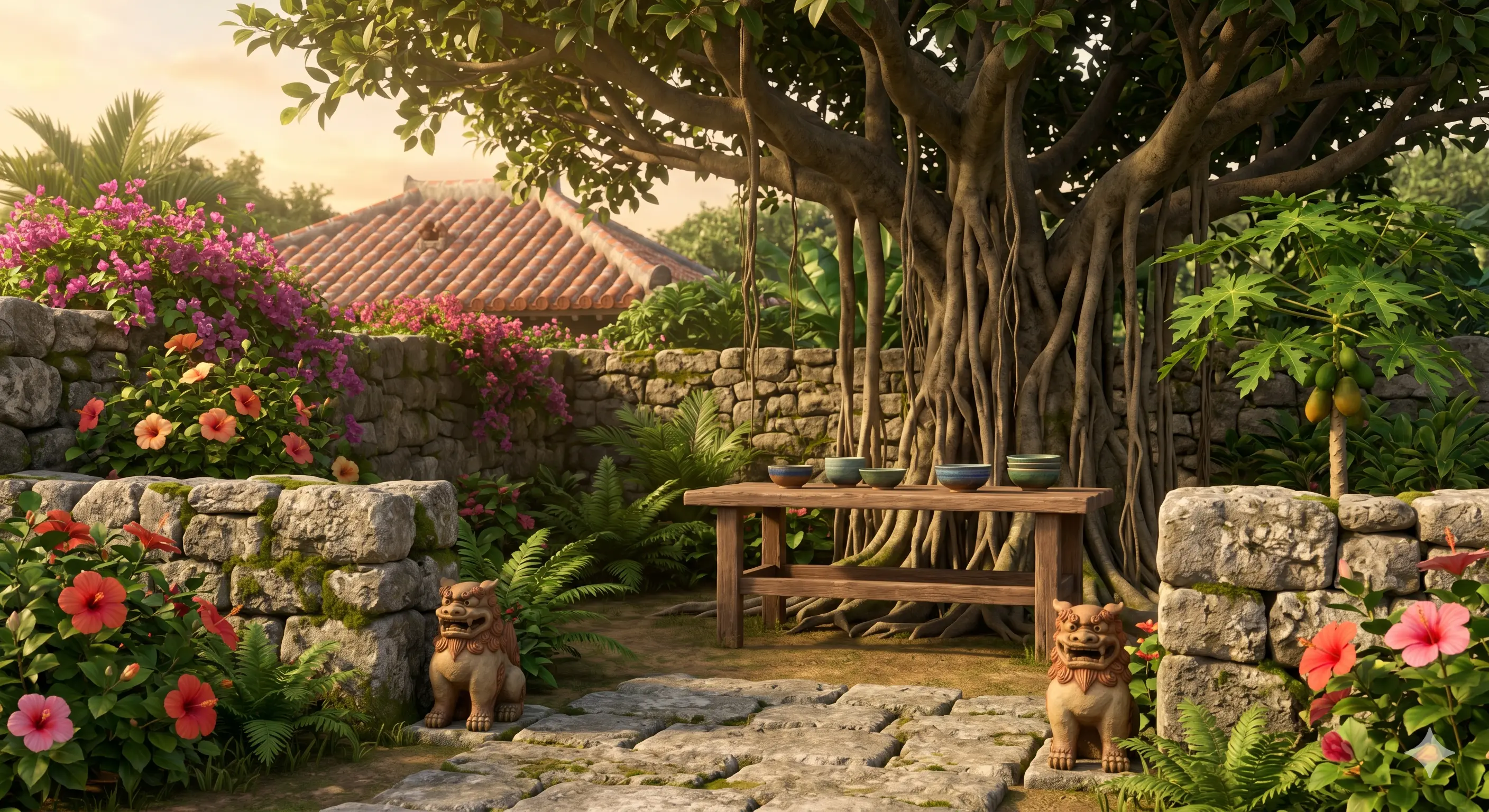
On the island of Okinawa, in a village called Ogimi, there are more people over 100 years old per capita than almost anywhere on Earth. Researchers have been studying them for decades, expecting to find a dietary secret or a fitness routine they could package as a bestseller.
What they found instead was purpose. And that same question of purpose is what separates the people who know what to build with AI from the ones drowning in tools they'll never use.
Every person they interviewed could name their Ikigai... their reason for getting up in the morning. One woman in her late 90s spent hours every day carving traditional Japanese masks. A man in his 80s fished daily; a 101-year-old textile artisan named Toshiko was still weaving the same fabric she'd been making for most of her life... a craft so valued she was designated a Living National Treasure.
None of them were filling out 'morning routine productivity pages.' None of them were optimizing for productivity. They were just... living inside their purpose, every single day. In the garden, at the loom, on the water.
The word Ikigai itself dates back to Japan's Heian period, around 800 AD. "Iki" means life. "Gai" comes from "kai," which means shell. Shells were the most valuable currency of the era. So your Ikigai, literally translated, is what makes your life valuable. Not your income, or your output. Your life.
I was listening to a creator recently who'd used this concept as the foundation for her entire brand, and it stopped me. Not because it was new to me... I'd heard the term before, seen the diagrams, skimmed past it the way you skim past something that feels too self-helpy to be useful. But the way she framed it made me realize I'd been circling something for months without having the language for it.
And I think you might be circling it too.
In Okinawa's village of Ogimi, centenarians don't retire. They garden, weave, carve, and fish... every day, for decades. Their secret isn't a diet. It's purpose.
Is AI Really the Opportunity of a Lifetime?
Yes, but only if you know what to build with it. Having the opportunity in front of you doesn't mean much without a filter for deciding what actually matters.
My friend Jason talks about a moment during college when he wanted to head to Silicon Valley and ride the dot-com wave (he's a New Yorker). At his Mom's suggestion, he didn't go. His life turned out great, and he'd be the first to tell you he has no regrets. But he'll also tell you that what's happening right now with AI feels like that same kind of inflection point. The kind that comes around maybe twice in a lifetime if you're paying attention.
And he's right. This is the opportunity of a lifetime.
But what I haven't heard said enough is this: having the opportunity sitting right in front of you doesn't mean much if you have no idea what to do with it.
And right now, a whole lot of smart, capable people are building at a pace that would've been unimaginable two years ago. New tools, new workflows, new agents, new MCPs, new automations... the output is staggering, and a lot of it is genuinely impressive.
I want to be really clear about something. I'm not criticizing the people who are shipping fast. Many of them are people I respect and learn from. And honestly, the ones who are implementing are the ones who are learning the most. That's just how it works... You learn by doing, not by watching.
But as someone consuming all of this?
I can't always see the forest for the trees.
I can't always find the connective tissue between the fifteenth workflow someone shared this week and the question that actually matters to me as a business owner, which is... "How does this move the needle for my business? Where does this fit into a foundation I can actually build on?"
It reminds me of the online course era circa 2018, when every "expert" had a program with 30 modules and 82 lessons, and you lost access after six months (all for $4997, but today, only $1997). The information was there, but more often than not, the transformation wasn't.
And more information doesn't necessarily mean better (so many course creators stacked so much content into a single course... it was a little ridiculous).
And what I'm watching now sometimes feels like the AI version of that same pattern... output for output's sake. Not because the builders lack purpose (they clearly do), but because, for the person on the receiving end, it can feel like drinking from a firehose without a cup. 😳
If you've felt that, you're not wrong. And no, moving faster is not the answer.
The pressure isn't always explicit.
It's the drip, drip, drip of 'ten tools you need right now' and 'this changes everything' and the constant stream of new, new, new. Eventually, the subtext becomes impossible to ignore: if you're not keeping pace, you're already behind.
But behind what? And headed where?
The Ancient Way of Life That Changes Everything About How You Build
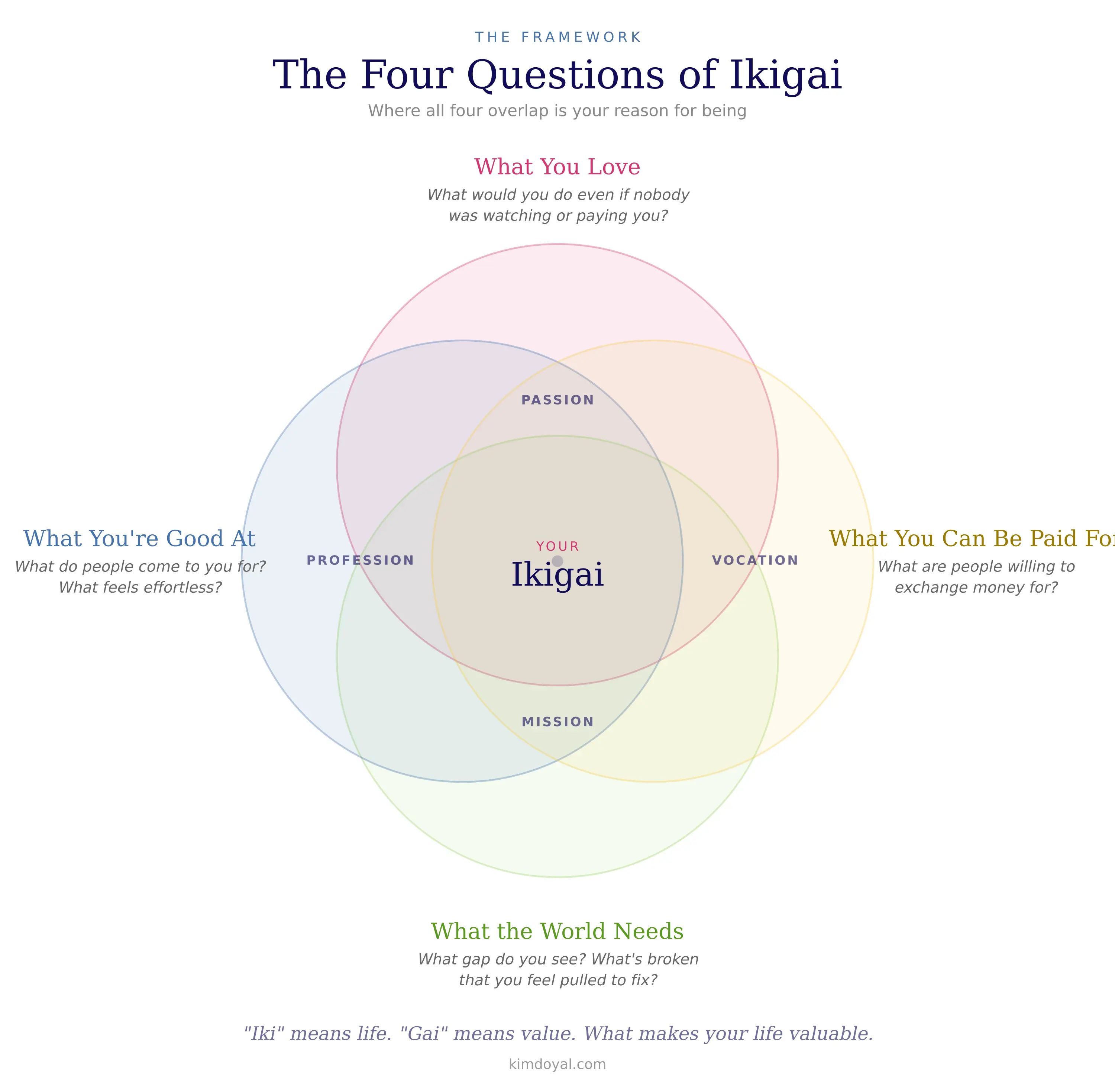
Many people have heard the term Ikigai. You've almost certainly seen the Venn diagram... four overlapping circles, a sweet spot in the center, floating around Pinterest and LinkedIn like it's been around forever. I'd seen it too. Filed it under "I love this, I should read a book about it," and moved on.
Then I actually looked into where that diagram came from, and it changed how I thought about the whole concept.
Here's what you might not know: that Venn diagram isn't Japanese.
Not even close.
In 2014, a British blogger named Marc Winn watched a TED Talk by Dan Buettner about the Blue Zones and Okinawan longevity. Buettner mentioned Ikigai in passing as a reason the Okinawans lived so long. Winn was intrigued, and he found an existing "Purpose Venn Diagram" that a Spanish author named Andrés Zuzunaga had created a couple of years earlier... four circles about passion, mission, vocation, and profession. Winn swapped the word "purpose" for "ikigai," published a blog post, and walked away. The whole thing took him about 45 minutes.
That blog post went viral.
Tens of millions of people saw it. Then two Spanish authors, Héctor García and Francesc Miralles, included Winn's diagram in their bestselling book Ikigai: The Japanese Secret to a Long and Happy Life, and it became the dominant global understanding of Ikigai.
A British blogger, a Spanish diagram, and two Spanish authors. Not a single Japanese person in the chain. 🙄
The actual Japanese concept of Ikigai is simpler and, I think, more beautiful than any framework.
For Japanese people, Ikigai doesn't have to involve your career. It doesn't require you to be good at something, and it has nothing to do with making money. Your ikigai can be your morning tea, your garden, your grandchildren, the walk to work or a hobby you're mediocre at but love showing up for.
Japanese neuroscientist Ken Mogi describes it as simply "a reason to get up in the morning," and says it can be found in the smallest moments... a cup of coffee, a compliment, the morning air.
That's the version the Okinawan centenarians are living. Toshiko, the 101-year-old weaver from the opening of this post, isn't at her loom because she found the intersection of passion and profit. She's weaving because she's been weaving her whole life, and the fabric is part of who she is.
So why am I using the Western framework at all?
Because I think there's something genuinely useful in those four questions, even if they weren't born in Japan. Not as a replacement for the deeper, lived version of Ikigai... but as a filter. A strategic filter for people like us, navigating a massive technological shift while trying to build businesses that actually align with who we are and what we care about.
When I sat with these four questions... not as a worksheet, but as a real conversation... something clicked that I hadn't been able to articulate before.
What do you love?
What are you good at?
What does the world need?
What can you be paid for?
Where all four overlap is your Ikigai.
Your reason for being.
"Iki" means life. "Gai" means value. Your Ikigai is what makes your life valuable.
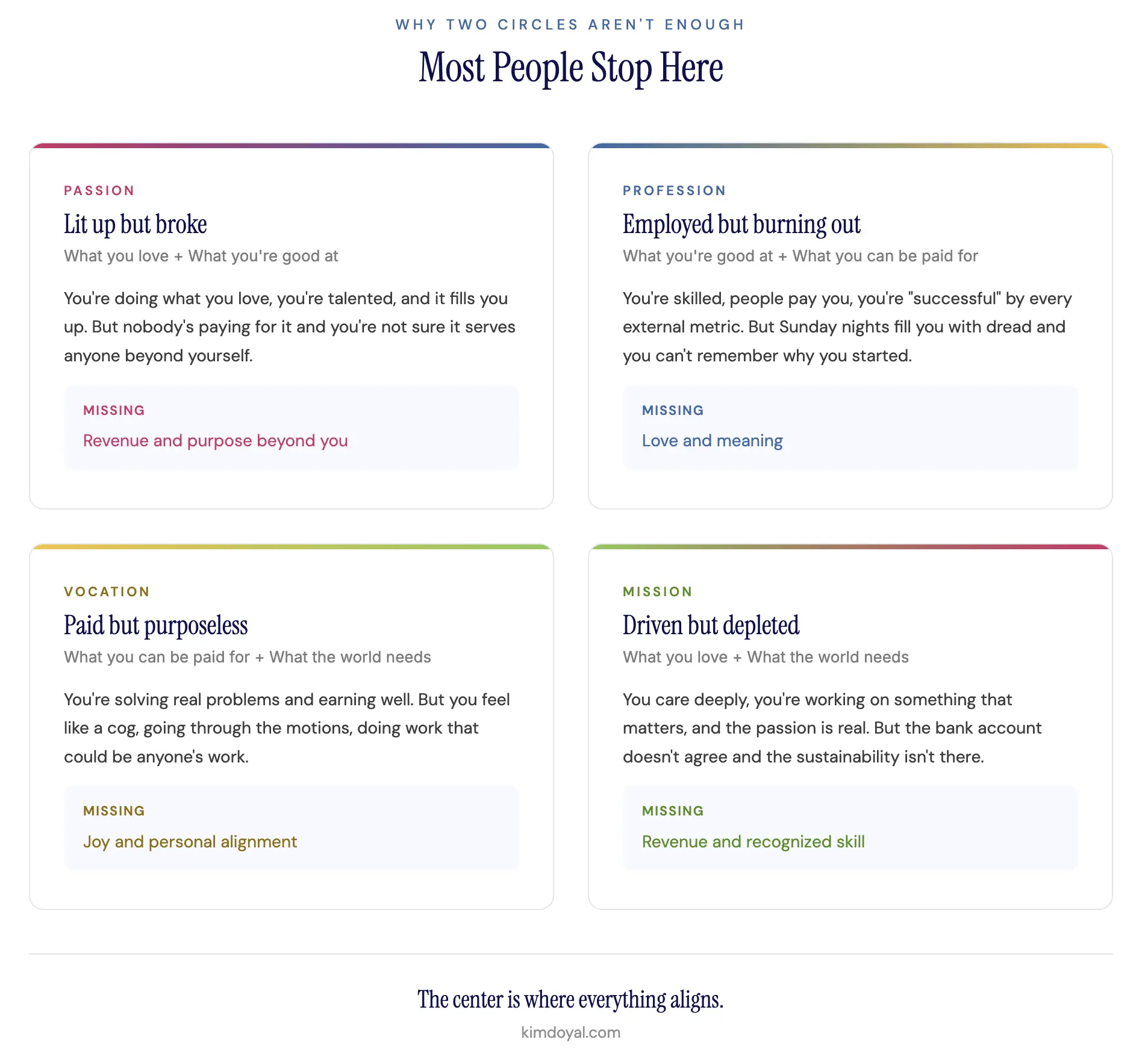
Most people stop at two circles. "I love it, and I'm good at it" is passion, which is beautiful, but passion without purpose or revenue is a hobby (which we all need as well). "I'm good at it, and people will pay me" is a profession, but a profession without love or meaning eventually burns you out.
We've all been there.
Two circles might feel like progress. The center is where everything actually aligns.
The center is where everything aligns. And what makes this particularly powerful right now, in this particular moment, is the third question.
What does the world need?
What Does the World Actually Need from You?
This is the Ikigai question that changes everything. The first two circles are about you. This one forces you to look outward, and at midlife especially, that shift in lens is where the real clarity comes from.
I spent 10 years in the book industry, and at the ripe old age of 22, I discovered "self-help." What followed were years of consuming personal & business development (primarily male authors because there weren't many female authors), inner work, therapy after losing my husband, journaling... all of it. And I'm genuinely grateful for that season. But I'm also at a point in my life where I'm done treating myself like a project that needs fixing.
So when most frameworks ask "what are you good at?" and "what do you love?"... I can answer those in my sleep, and I own it. I'm a creator who builds things and makes complex ideas make sense for people, and I've known that about myself for a long time.
But "What does the world need?"
That question stopped me cold.
Because it's not a self-help question... It's an outward-facing question. And I think that, especially in midlife, the lens naturally starts to shift. Your priorities change. The world doesn't look like what you thought it would at this age. You look around and see broken systems, you see things that are objectively harder for your kids than they were for you at that age, and you start thinking less about personal optimization and more about what you can actually contribute.
That was the catalyst for me wanting to sit with this for real.
And when I did, the first thing that came to mind wasn't "more AI tutorials."
It was feminine energy.
Not in some abstract, woo-woo sense... in a deeply practical, economic one. Women are community-builders by nature. We tend to lift as we climb. We're resilient in ways that don't always get acknowledged or compensated. And yet, too many of us end up on the short end of the stick when it comes to income equity, retirement, and generational wealth.
As a Gen Xer, I know too many women my age who are staring down retirement, wondering if they'll ever get there. And the reason isn't a lack of intelligence or work ethic. It's structural.
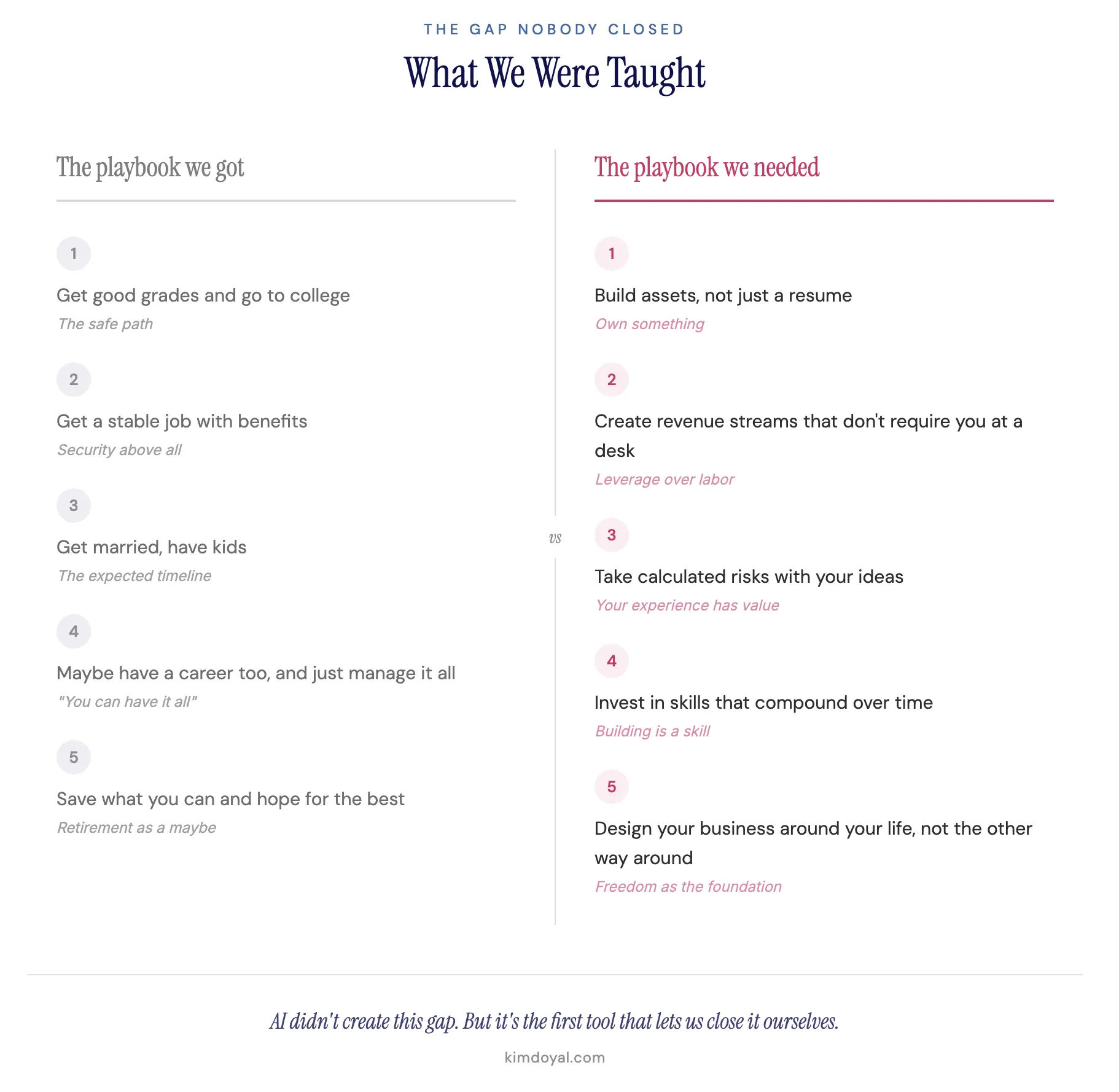
We were taught to get married, have kids, have a career too, and just... manage it all. Nobody pulled us aside and said, "Build assets, take a risk. Create something that generates revenue, whether you're at your desk or not. Own the thing instead of just earning from it."
AI didn't create this gap. But it's the first tool that lets us close it ourselves.
AI changes that equation in a way nothing else has. You don't need venture capital. You don't need a computer science degree. You don't need anyone's permission. You need your experience, your brain, and a build tool that actually listens to you.
That's what I mean when I say your experience is the asset, and AI is the build tool. It's not a tagline. It's the thesis.
Do You Need a Huge Audience to Build with AI?
No. You can build real assets and real revenue streams without tens of thousands of followers. A well-built tool that solves a real problem doesn't need a viral post to find users.
And before anyone starts spiraling into "great, so now I need to build an audience and jump back on the social media hamster wheel so I can be an influencer"... no. You really don't.
Most of the people on my list aren't writing about AI.
They're using it to grow their actual businesses. Coaching practices, agencies, creative work, consulting, e-commerce... real businesses that serve real people. They don't want to be AI influencers any more than they want to get back on the social media hamster wheel they spent years trying to get off of.
There is a very real, very earned social media exhaustion happening right now. People are tired of performing for algorithms. Tired of the content treadmill. Tired of the idea that visibility equals viability.
The incredible thing about what AI makes possible is that you can build genuine assets, real tools, real revenue streams, without needing tens of thousands of followers. A well-built app that solves a real problem doesn't need a viral post to find users. A membership with genuine value doesn't need a 47-step funnel.
And this is where your values and integrity become your compass.
If you love creating (and I do... it's the thing that lights me up more than almost anything), you don't have to hand that work over to AI. That's not what any of this is about. Use AI to build the infrastructure, the systems, the stuff that drains your energy.
Keep the creative work for yourself.
Keep the things that make you feel alive.
For those of us who started businesses because we wanted freedom, AI is the first tool I've encountered that actually delivers on that promise.
Not "passive income"... I've written about why that's mostly a myth when you have integrity and actually care about the people you serve. Real leverage and real freedom. Built on real work that aligns with who you actually are.
My Ikigai
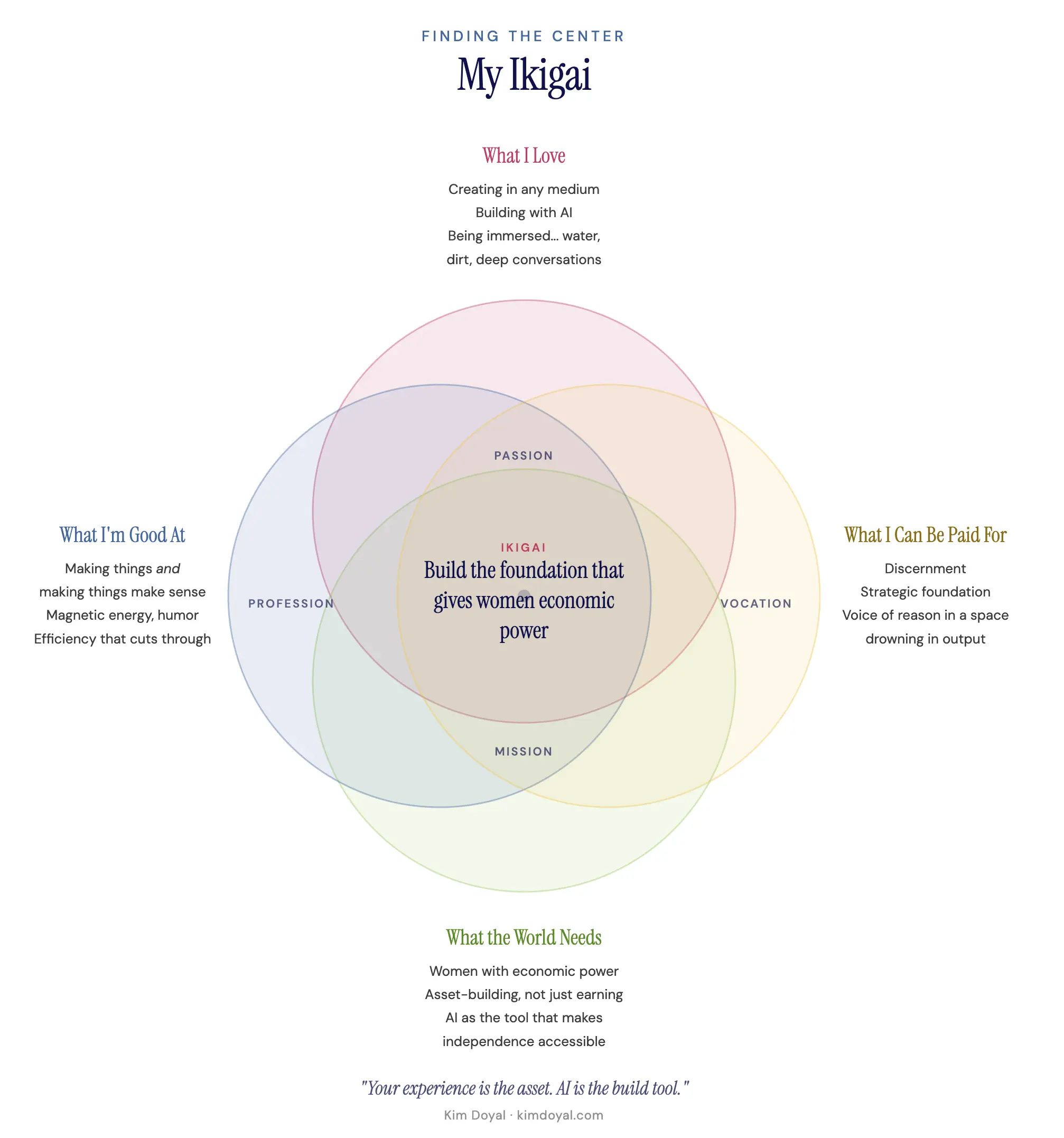
I ran myself through this exercise this week, as a conversation, not a worksheet. I wanted to share it because I think seeing someone else's process makes it easier to do your own.
What I love: Creating... in any medium. Painting, building apps, writing, gardening, deep conversations that go somewhere real. The through-line isn't "tech" or "business." It's the act of bringing something into existence where there wasn't something before. I need to be IN the thing, not observing it. Hands in the dirt, body in the water, brain in the build.
What I'm good at: Making things, and also making things make sense. Real-world analogies that click for people. An energy that draws people in (I've been told this my whole life) and enough humor to keep them there long enough to actually learn something. And I'm efficient... not in a "hustle" way, but in a "strip away everything that doesn't serve the thing" way.
What the world needs: Women with economic power. Asset-building, not just earning. AI is the tool that finally makes independence accessible to people who were never given the playbook, and the ripple effect that happens when women have money, choice, and community.
What I can be paid for: Discernment. The ability to look at this entire AI landscape moving at light speed and say, "This is the foundation. Build this first. The rest is probably noise for you right now." Strategic thinking from someone who's actually building every day, not just theorizing about it.
My Ikigai: I build the foundation that gives women economic power and makes them believe they can build it, too.
Your experience is the asset. AI is the build tool.
Your Turn
You don't need to figure this out in an afternoon. Those Okinawan centenarians didn't sit down with a framework... they just lived inside their purpose until it became indistinguishable from their daily life. The woman carving masks wasn't optimizing for meaning. She just carved masks.
But for those of us navigating a massive technological shift while also trying to build a business and a life that actually feels like ours... having language for it helps. Having a filter helps. Having something that keeps you from chasing every shiny new tool and instead asks, "Does this serve the center?" is worth its weight in gold. (Or shells, if we're being historically accurate.)
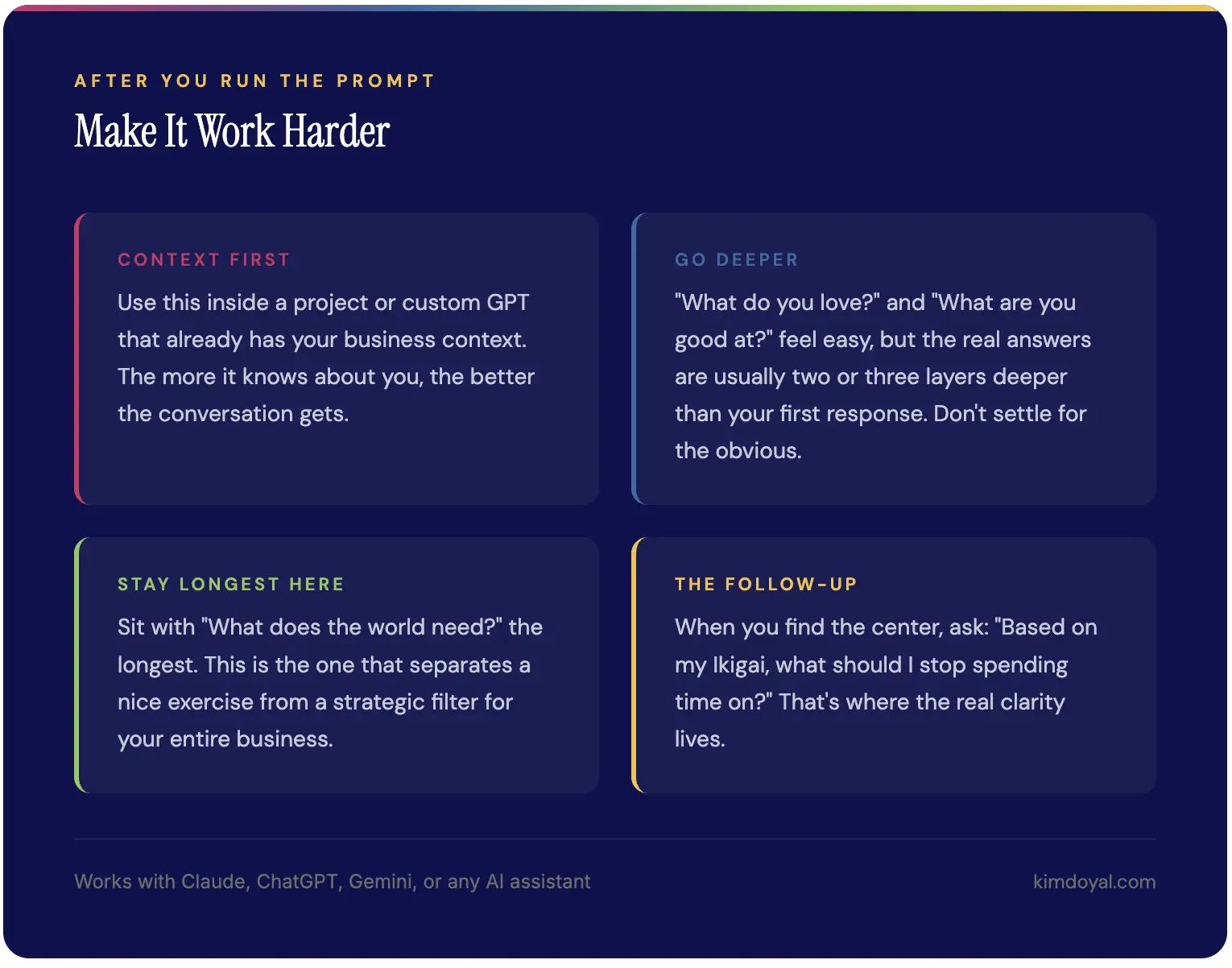
So here's what I'd suggest: Open a conversation with whatever AI you use... Claude, ChatGPT, Gemini, whatever you're comfortable with. But do it inside a project or a custom GPT that already has your business context. The more it knows about you, the better this works.
And use this prompt:
I want to find my Ikigai using the Japanese framework of four intersecting questions. Walk me through each one as a conversation, one at a time. Don't move to the next question until I've fully answered the current one. Start with 'What do you love?' and go deep... I don't want surface-level answers. After all four, help me find the center where they overlap, and tell me what that means for my business... what I should build, who I should serve, and what I can confidently ignore.
The follow-up question is where the real clarity lives.
The answers might surprise you. Mine surprised me.
And if the center of your Ikigai points you toward building something... I'll be here showing you how.
I'm launching SPARK Lab on May 18th, where I put everything I've built into your hands. If you want to see what that looks like, keep an eye on your inbox.
What are the four circles of Ikigai?
The Ikigai framework maps four questions: what you love, what you're good at, what the world needs, and what you can be paid for. Where all four overlap is your Ikigai... your reason for being. The Venn diagram version was actually created in 2014 by a British blogger, not in Japan.
How is Ikigai different from just finding your passion?
Passion is only two of the four circles... what you love and what you're good at. Without the other two (what the world needs and what you can be paid for), passion stays a hobby. Ikigai adds purpose and sustainability to the equation.
Can I use Ikigai to decide what to build with AI?
Yes, and that's exactly how I used it. Instead of chasing every new tool and workflow, I used the four questions as a strategic filter. The center told me what to build, who to serve, and what to ignore.
Do I need to be technical to build with AI?
No. AI is the first build tool that doesn't require a CS degree, venture capital, or anyone's permission. If you have experience, a brain, and a real problem to solve, you can build something that generates value.
Your obvious offer is hiding in plain sight.
Free. Tell it what you know and who you help, and it'll show you the offer everyone can see but you.
Kim Doyal is a digital marketing strategist and AI builder with 18 years of online business experience. She is the founder of AI Spark Studios and SPARK Lab, and the creator of The Hub — a custom 33-agent AI operating system that runs her entire business. She has also built kimdoyal.com, StackRewards, and multiple AI tools and agents using vibe coding, a natural language approach to building software without a traditional development background.