TABLE OF CONTENTS
What exactly is an automation, and why does it matter?What's an AI agent, and how is it different from automation?The dishwasher and the power switchThe part that makes this genuinely extraordinaryWhat does the difference between agents and automations look like in a real business?Example 1: Your email follow-upExample 2: Your morning briefExample 3: Your content pipelineOne agent, a small team, or an orchestra — it's a spectrumSo... do you actually need agents right now?You already have the most important thingHOME/BLOG/AI AGENTS VS. AUTOMATIONS: WHAT THEY ACTUALLY ARE (AND WHY THE DIFFERENCE MATTERS FOR YOUR BUSINESS)
AI BuildingAI Agents vs. Automations: What They Actually Are (And Why the Difference Matters for Your Business)
What they are, how they're different, and where one or two could quietly change your week
March 27, 2026|5 min read

QUICK ANSWER
An automation follows a fixed rule: if this happens, do that. An AI agent reads context, makes decisions, and adapts based on what's actually in front of it. Automations are reliable and consistent. Agents are flexible and responsive. Both have a place in your business — knowing which to use and when is where the real leverage lives.
There's a lot you can't control right now. The news, the economy, that low-grade hum of uncertainty that seems to be the backdrop of everything these days. But your business? That's yours. And if there's something you can do inside it to get a few hours back, to take one stack of tasks off your plate, to feel like you have a little more breathing room... that's worth paying attention to.
Here's what I want to talk about: AI agents for solopreneurs who need their business to work harder without working more hours themselves. Not the hype version, not the "robots are taking over" version (we'll leave that to the breathless LinkedIn posts), but the real, practical version that actually matters for someone running a business solo.
Because here's the thing about being a solopreneur: you didn't get into this to do all of it. You got into it to do the thing you're actually good at, the thing that lights you up, the reason you started in the first place. And somewhere along the way, you also became your own marketing department, your own admin, your own content team, your own systems person... because there was simply no other option. Hiring meant managing, and managing meant more of your time gone, so you just kept doing everything yourself and called it freedom.
Agents are starting to change that math. Not because they replace people you'd want to hire, but because they finally fill the roles that were always empty. The ones you were doing badly, in stolen hours, on the weekends, quietly resenting the whole time.
But before we get there, we need to clear something up: "agent" and "automation" get thrown around as if they mean the same thing, and they really don't. Understanding the difference is what takes you from casually using AI to actually building a business that works a little harder for you without you being in every corner of it. Let's start from the beginning.
What exactly is an automation, and why does it matter?
An automation is a fixed rule that runs without you. You define when it triggers and what it does — then it handles itself, the same way every time, without making any decisions.
DEFINITION
An automation is a rule. If this happens, do that.
You define the trigger (the "if this"). You define the action (the "do that"). From that point forward, it runs on its own, every time, exactly as you set it up.
That's the whole concept. Genuinely. And once you see it that way, you'll start recognizing automations everywhere in tools you're probably already using.
Think of an automation like a recipe card that runs the kitchen for you. The recipe doesn't improvise. It doesn't decide to add more garlic because it seemed like a good idea today, or skip a step because it's in a hurry. It follows the instructions exactly as written, every single time, and that's actually the point. Predictability is the entire value. You set it once, and it handles itself.
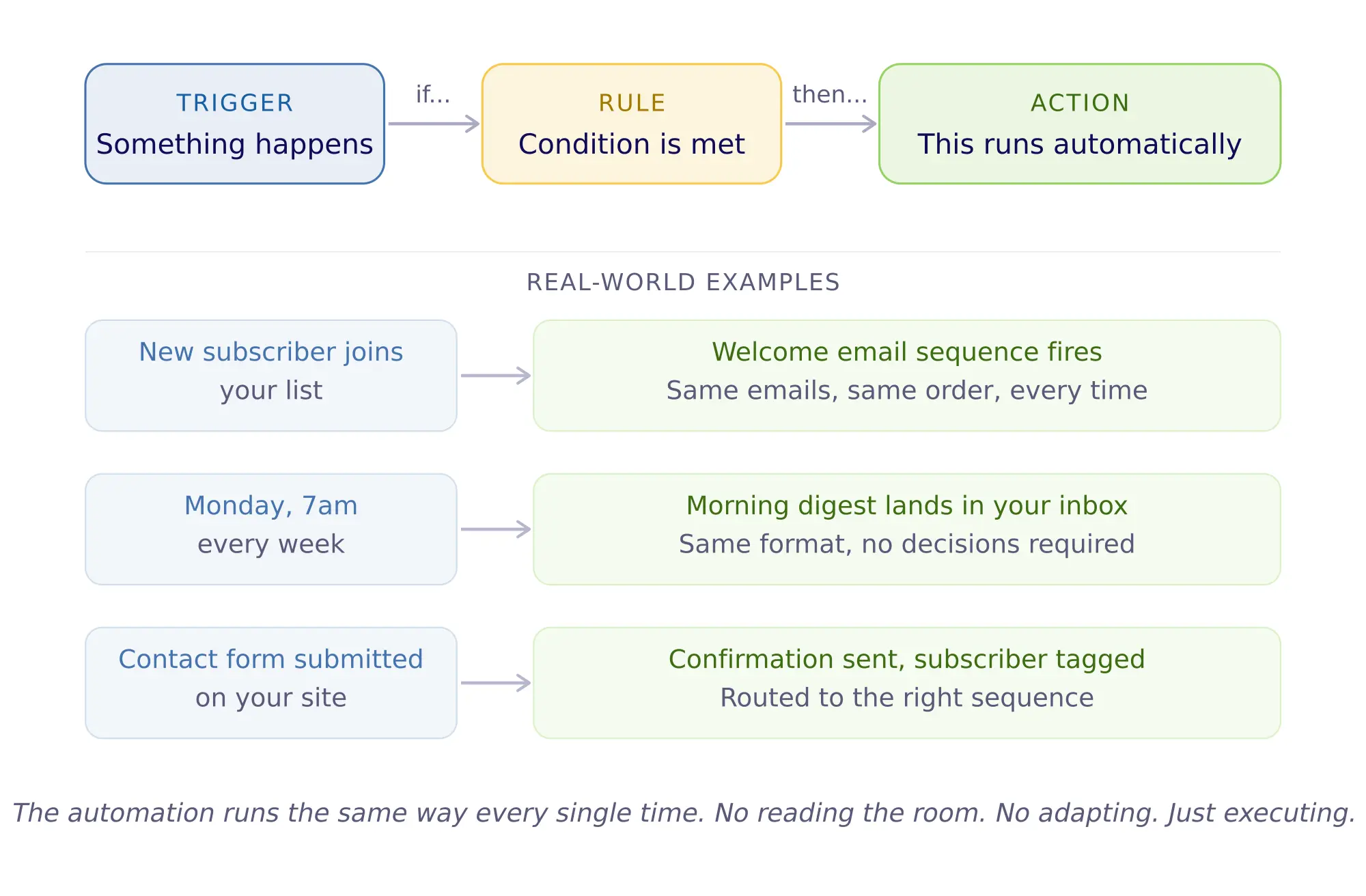
You've probably already got automations running in your business, even if you didn't call them that. An email sequence that goes out on a schedule. A Zap that posts your new blog content somewhere automatically. A form that tags a subscriber and moves them into a specific list based on what they opted in for. All of that is automation... rules running without you in the loop.
And they are genuinely useful. Don't let anyone convince you that automations are the "lesser" version of something. For predictable, repeatable tasks, they're exactly the right tool. They're reliable, they're consistent, and once you build them, they just run.
But they have a ceiling, and it's worth knowing where that ceiling is.
Automations are only as smart as the rules you write for them. They can't read context. They don't know that this subscriber clicked three links about content strategy and might need different information than the one who downloaded your pricing guide. They can't decide. They can't adapt. They execute the instructions you gave them, and that's where they stop.
That's exactly where agents begin.
What's an AI agent, and how is it different from automation?
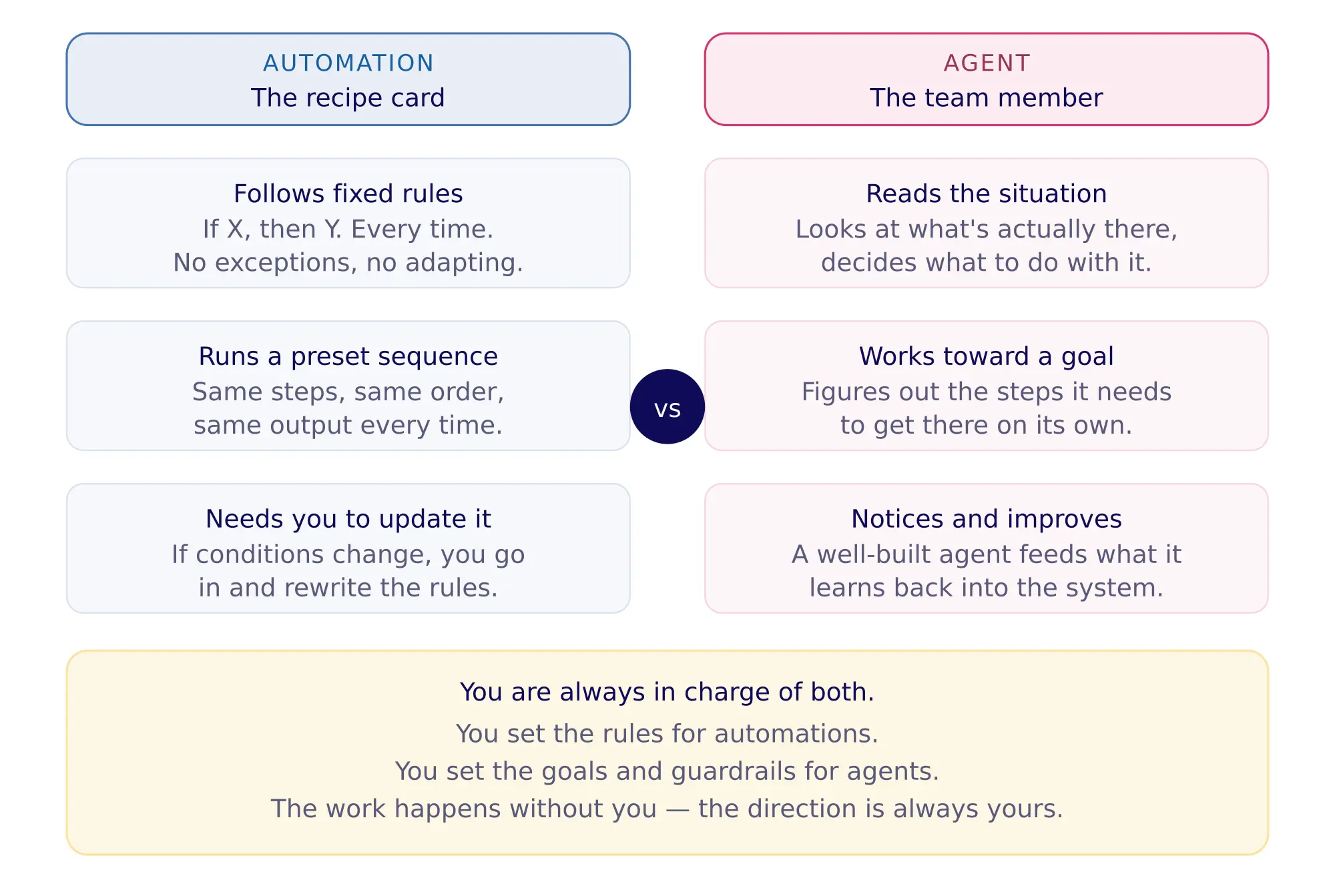
An AI agent reads the situation, makes a decision, and takes action — without a fixed script telling it exactly what to do. Where an automation executes a rule you wrote in advance, an agent figures out what needs to happen based on what's actually in front of it.
DEFINITION
An agent is an AI that can read context, make decisions, and take action — on its own, without a fixed script.
Where an automation follows rules you wrote in advance, an agent figures out what needs to happen based on what's in front of it. It reads the situation. It decides. It acts.
Here's the analogy that finally made this click for me: think about the difference between a recipe card and a team member.
An automation is the recipe card. It tells the kitchen exactly what to do, and the kitchen does it, every time, exactly as written. That's useful. That's reliable. But a recipe card can't look at the situation and decide something needs to change. It can't notice that the oven is running hot today, or that this particular client needs a slightly different approach. It just follows the steps.
An agent is the team member who knows the recipe... and can also improvise when something shifts. They read the room. They make a call. They hand you back something finished without needing you to direct every single step.
And here's the part that matters most for you as a solopreneur: that team member works while you're not in the room. You don't have to manage them moment-to-moment. You give them the context, the goal, and the guardrails, and they handle it. You stay in charge of the direction. They handle the execution.
The dishwasher and the power switch
Here's another way to think about it, one that makes the orchestration piece click.
A dishwasher is an automation. You load it, you set it, it runs the cycle. It doesn't decide to be more gentle with the wine glasses or skip a rinse because it's running low on time. It does the cycle. Every time.
Now imagine you have an agent running inside that process, checking in on the cycle, noticing when something didn't come out clean, deciding to run it again. That agent is doing something the dishwasher can't: reading the result and making a call.
But here's the part people miss: you control the power. The agent runs because you gave it the context and the go-ahead. Pull the plug, and the work stops. This isn't AI doing whatever it wants in your business -- it's AI doing exactly what you've set it up to do, working inside boundaries you define, stopping when you say stop. You are always the one in charge. The agents just handle the execution so you don't have to be in every room at once.
The part that makes this genuinely extraordinary
Here's where it gets interesting, and honestly, a little mind-bending if you let it.
Let me show you what this looks like in my actual business, because I have this running right now and it's the clearest example I know.
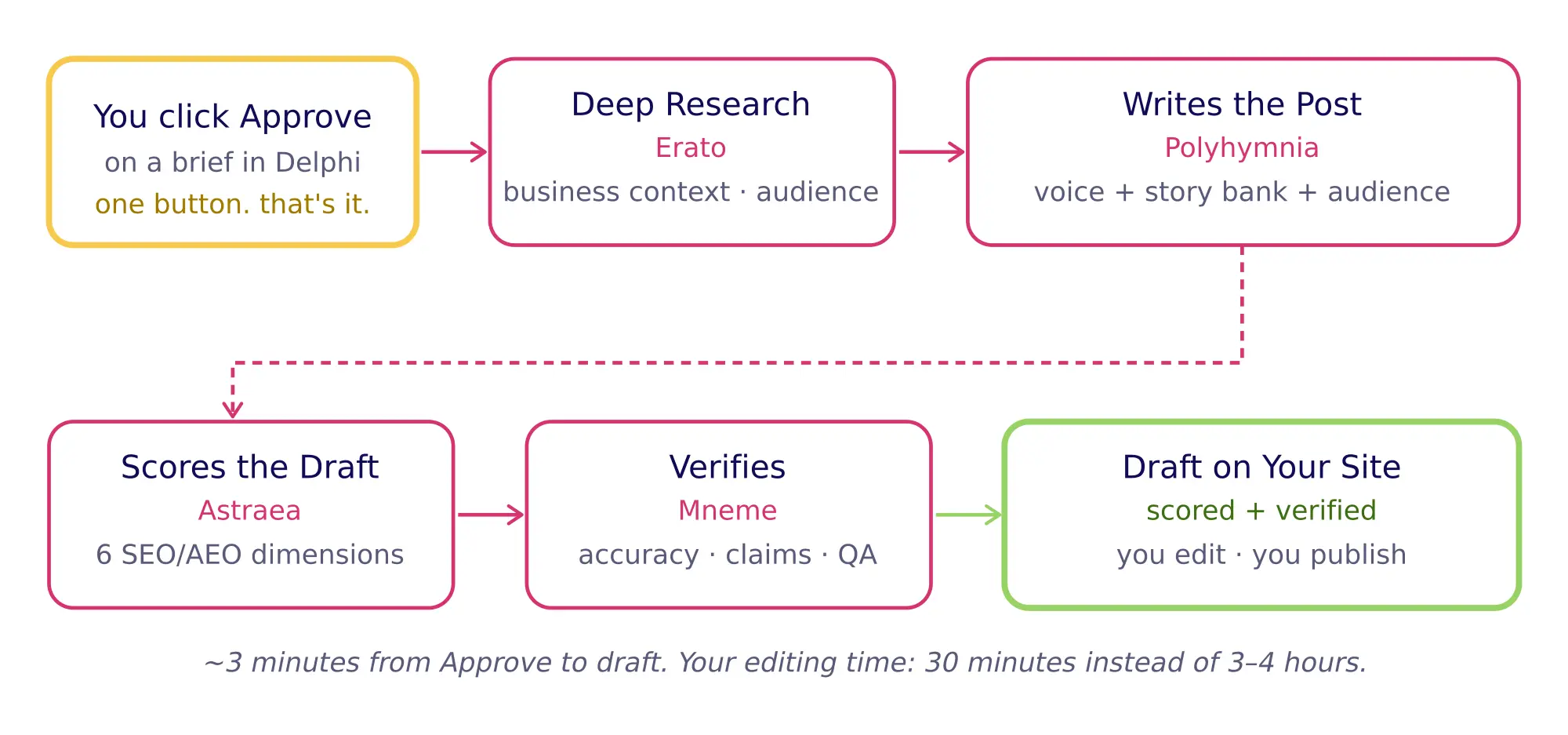
I write content regularly. Blog posts, mostly -- research-heavy, voice-specific, SEO-conscious posts that used to take me three to four hours each. Now I have four agents who handle the heavy lifting in sequence, like a relay team. Here's the handoff:
A content brief sits in my approval queue. When I'm ready, I review it and click one button: Approve. That's my input. That's me staying in charge of the direction. And then this happens, automatically, without me in any of it:
Erato goes first. She does deep research on the topic -- pulling context, angles, what's already out there, what's missing. She hands her research notes to the next agent.
Polyhymnia picks up those notes and writes the full post. Not a generic AI blog post -- she works from my voice guide, my audience profiles, my story bank. She knows who I'm writing for and how I sound. She hands the draft to the next agent.
Astraea scores the draft across six SEO and AEO dimensions. She flags what's strong, what could be sharper, what's missing for search visibility. Her score goes into the next handoff.
Mneme runs quality assurance. She's checking for outdated information, anything that might be incorrect, anything that doesn't hold up. She does a final verification pass and closes the relay.
The whole thing takes about three minutes. When it's done, a scored, verified draft appears on my website -- not published, just waiting for me. I go in, add my stories, adjust anything that needs my voice more specifically, format the images, make it mine. That part takes maybe thirty minutes instead of three to four hours.
But here's the part that's genuinely extraordinary. Each time I go in and edit that draft -- the language I change, the stories I add, the formatting choices I make -- the system can observe those patterns over time. Not automatically, and not by magic. It's built intentionally, so that future runs get sharper based on what I actually do with the output. It's not learning the way a human learns. But it's noticing. And a system that notices is a very different thing from a system that just executes and forgets.
That's the shift from using AI to building with AI. And it's the difference between a tool and a team.
What does the difference between agents and automations look like in a real business?
The same task handled by an automation runs identically every time. Handled by an agent, it adapts based on what's actually happening. Here are three side-by-side examples from work solopreneurs do every day.
Example 1: Your email follow-up
Someone downloads your free guide. What happens next?
With an automation, you've set up a sequence. Email one goes out immediately with the download link. Email two goes out three days later with a related tip. Email five is the soft pitch. Every single person who downloads that guide gets those exact emails, in that exact order, regardless of what they do between emails. The person who clicked every link gets the same email five as the person who never opened email two. The automation doesn't know the difference. It can't.
With an agent, the follow-up is actually responsive. The agent reads what that subscriber did -- which links they clicked, which topics they engaged with, how long they've been on your list -- and writes the next email based on those signals. The person who's been clicking everything about content strategy gets something different from the person who only engaged with the pricing content. Not because you wrote every variation manually, but because the agent read the room and responded to what was actually there.
Same goal. Completely different experience for the person on the other end.
Example 2: Your morning brief
Lots of people have some version of a morning news digest running. An automation version of this is straightforward: it pulls from a fixed RSS feed or a set list of sources, formats the content the same way every day, and drops it in your inbox at 7am. Reliable, consistent, exactly what you told it to do.
A research agent does something different. It scans across sources, reads the actual content, decides what's relevant to you specifically -- your industry, your audience, what you've been paying attention to lately -- and surfaces the signal from the noise. It's not just pulling content. It's making editorial judgments about what you actually need to see today. Some days that's three items. Some days it's twelve. It depends on what's out there, not on a rule you wrote six months ago.
Example 3: Your content pipeline
You just read this one. The brief in the queue, the Approve button, four agents running in relay -- Erato researching, Polyhymnia writing, Astraea scoring, Mneme verifying -- and a draft on your website three minutes later. That's not a sequence of automations following fixed rules. That's a team of agents reading context, making decisions at each step, and handing the work forward.
The difference isn't just efficiency. It's the quality of what comes out the other end.
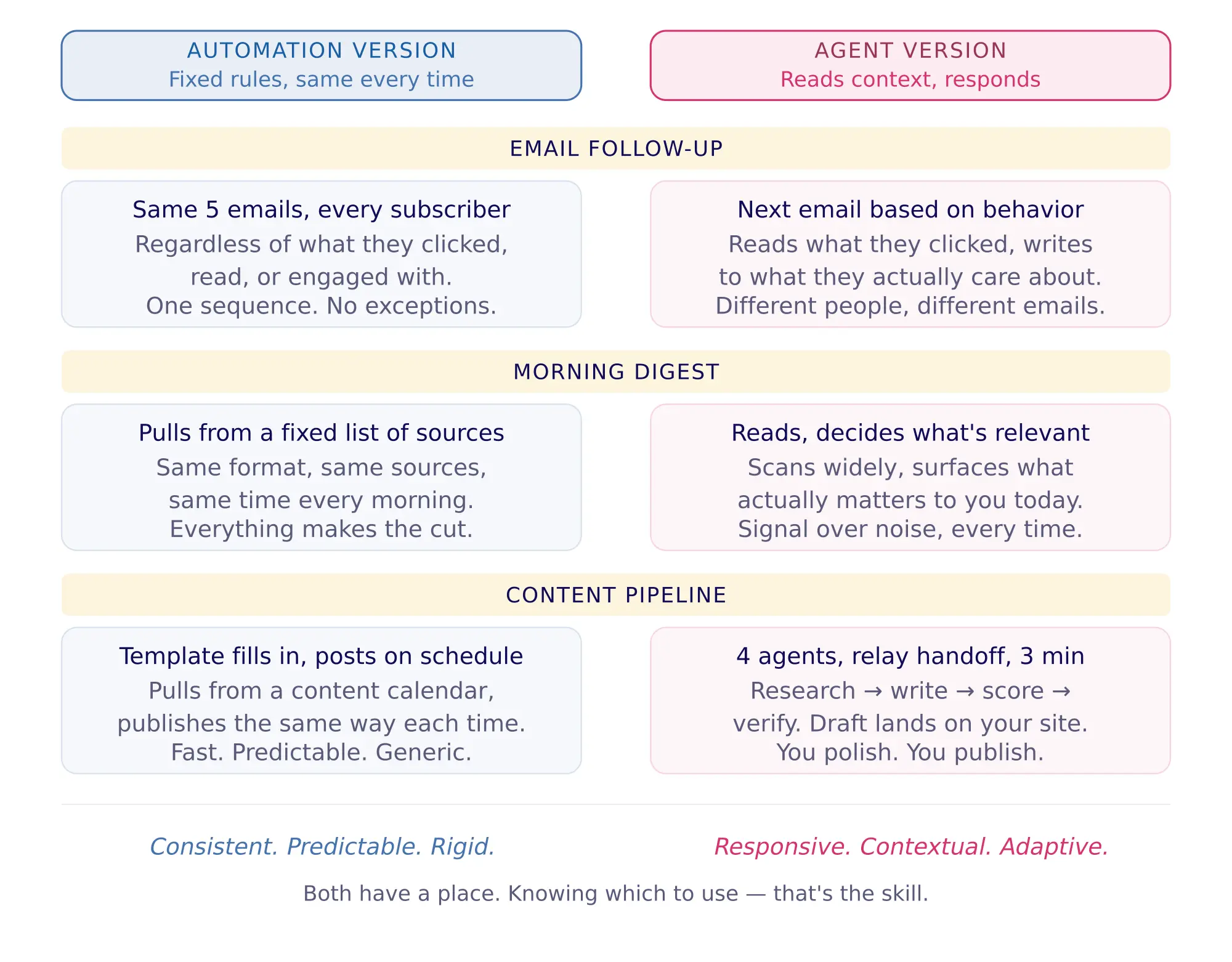
Neither of those columns is better than the other in every situation. That's the thing people miss when they get excited about agents. There are tasks in your business where the automation is exactly right -- where you want consistency, where you don't want variation, where the rule is the point. And there are tasks where you've been tolerating a rigid rule when what you actually needed was something that could think.
Learning to tell the difference is where the real leverage lives.
One agent, a small team, or an orchestra — it's a spectrum
Here's something that trips people up: agents aren't all-or-nothing. You don't have to build thirty-three of them to get value. You can start with one, doing one job, and that alone can change how your week feels.
Think of it like building a team. You don't hire an entire department on day one. You hire for the most painful gap first. You see how it goes. You add the next role when you're ready.
Agents work the same way.
One agent might be a research assistant who scans your industry every morning and surfaces what's worth your attention. That's it. That's the whole thing. And for a lot of people, that alone is a few hours back per week.
A small team of agents starts to create leverage. One agent does the research, another uses that research to draft your content, and a third distributes it. Now you've got a relay—a handoff chain where each agent builds on what the previous one produced. The output is better because no single agent is working in isolation.
An orchestrated system is what happens when you keep building intentionally. Multiple teams of agents, each with a specialty, coordinated by an orchestrator that routes work to the right place. This is where the solopreneur starts operating with the infrastructure of a much larger organization... without the overhead of actually running one.
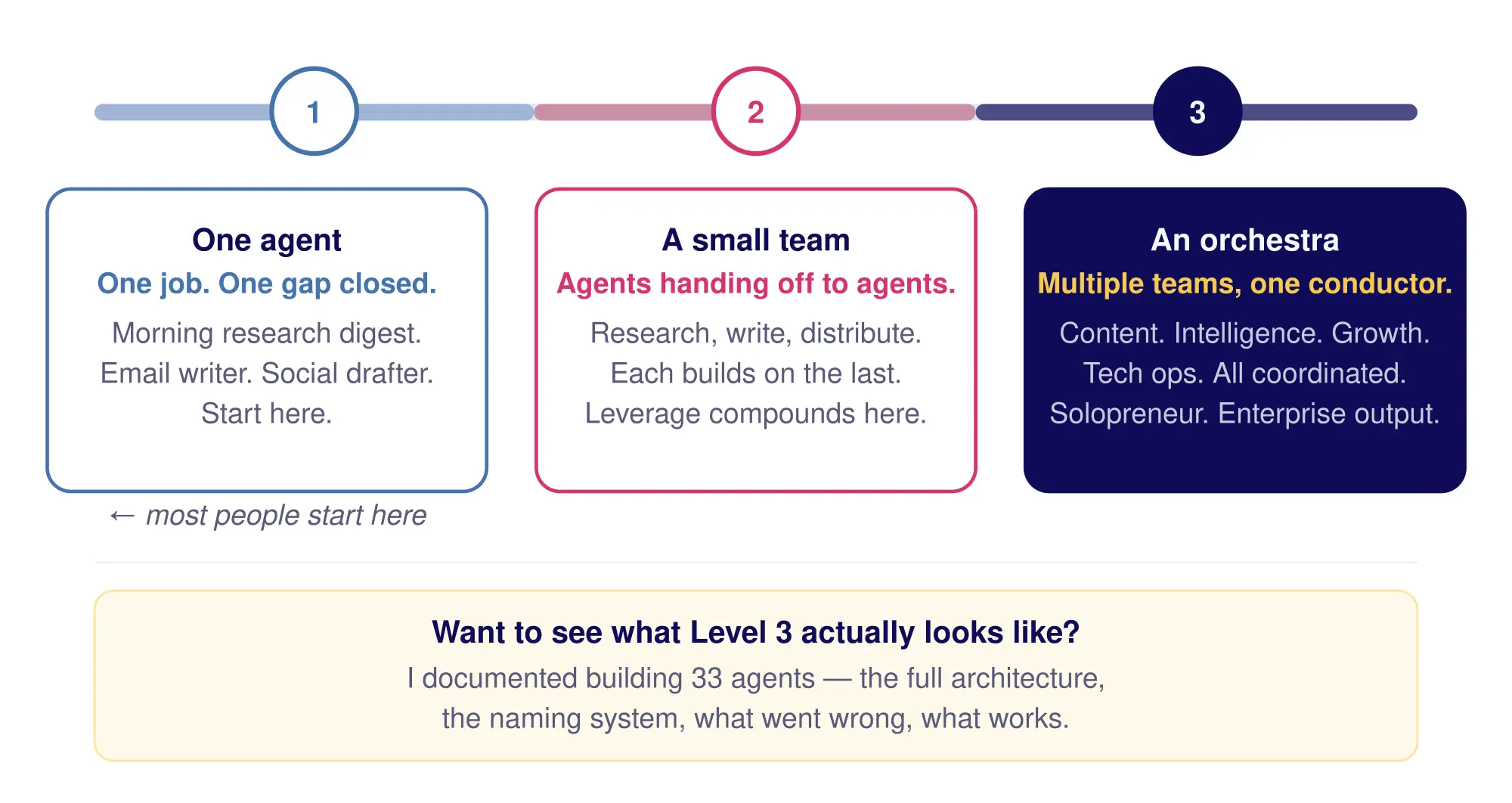
I'll be honest with you: I have thirty-three of them right now, organized into five divisions, coordinated by an orchestrator who routes work across all of them. I documented the whole build, decision by decision, in real time. If you're curious what Level 3 actually looks like in a solopreneur business, that post is the deep dive.
But start at Level 1. One gap, one agent, one week of seeing what it actually feels like to have that job handled. That experience will tell you more than any blog post, including this one.
So... do you actually need agents right now?
Maybe. And maybe not yet. Both of those answers are completely fine.
Here's the gut check I'd run before you do anything else.
Think about a task you do regularly in your business. Something that takes meaningful time, that you do often enough to feel the weight of it. Now ask yourself one question: does this task require someone to read a situation and make a judgment call -- or does it just need to happen the same way every time?
If it just needs to happen the same way every time, an automation is your tool. Build the rule. Let it run. Don't overcomplicate it.
If it requires reading context, adapting to what's actually there, making a decision based on something that's different every time it comes up -- that's where an agent earns its place.
Most solopreneurs I talk to have a mix of both in their business and haven't distinguished between them yet. They're either automating things that should have judgment (and wondering why the output feels generic), or they're manually doing things that could easily be automated (and wondering why they're so tired). Getting clear on which is which is, honestly, the most useful thing you can do before you touch any new tool.
You don't need to build anything today. You just need to start noticing which pile your tasks fall into.
Quick answers to the things people ask most after reading about agents for the first time.
How much do AI agents actually cost?
It depends on how you build them. If you're using an all-in-one platform like n8n or Make, you're typically paying a monthly platform fee ($20–$50/month for basic use). If you're building with the Claude API directly, you pay per use -- a single agent run costs cents, not dollars. The pipeline I described in this post, four agents running in sequence, costs me less than $1 per complete blog post draft. The real cost is build time, not ongoing fees.
What if I'm not technical? Can I still use agents?
Yes. The tools have gotten accessible enough that if you can describe a problem clearly, you can direct an AI to build a solution for it. This is what I mean by "vibe coding" -- you don't write the code, you direct the build. That said, there is a learning curve to understanding how agents are structured and what they need to work well. Start with one simple agent, get comfortable with how it behaves, then build from there.
What's the difference between an AI agent and ChatGPT?
ChatGPT (and Claude, and other chat tools) are AI models you interact with manually. You ask, it responds. An agent is a layer built on top of those models that gives the AI a specific job, a context window of relevant information, and the ability to take actions -- like writing to a database, searching the web, or handing off to another agent. Think of ChatGPT as the engine. An agent is the car built around it.
Where do I start if I want to build my first agent?
Pick the most painful, repetitive task in your business right now -- something you do regularly that requires more thinking than a simple automation can handle. That's your first agent. Keep the scope small: one input, one decision, one output. Get it working. Then expand. The biggest mistake people make is trying to build a complete system before they've built a single working piece.
You already have the most important thing
Remember the opening? The low-grade hum of uncertainty, the sense that everything outside your business is a little out of your control right now? That's still true. I'm not going to pretend a blog post about AI agents fixes that.
But your business is yours. And the way you build it -- what you spend your time on, what you hand off, what you protect for yourself -- that's entirely up to you. Agents are just one more tool for making sure more of your hours go toward the thing you actually showed up to do.
You're not behind on this. You're not too late, too non-technical, too small, or too busy to figure it out. The people who are going to use AI well in the next few years aren't the ones who understood it first. They're the ones who stayed curious long enough to try something small.
Start there. One agent. One job. See what it feels like.
And if you want more of this -- plain-language, no-hype, here's-what-I'm-actually-building content -- come find me on Substack. I write there regularly, documenting the whole thing in real time: what works, what breaks, what I'm building next.

Kim Doyal
Kim Doyal is a digital marketing strategist and AI builder with 18 years of online business experience. She is the founder of AI Spark Studios and SPARK Lab, and the creator of The Hub — a custom 33-agent AI operating system that runs her entire business. She has also built kimdoyal.com, StackRewards, and multiple AI tools and agents using vibe coding, a natural language approach to building software without a traditional development background.
Keep Reading

AI Building
How to Grow Your Substack Without Living on It... Built for Freedom — Part 01
I read the article on my phone in bed before I even got up, because I was genuinely excited about it. That kind of excitement means something right now. Here's what I started building, and why the how matters as much as the what.
April 26, 2026READ MORE

AI Building
What You Built Works... You Just Don't Want to Open It
I launched SPARK Lab minimum viable and then didn't want to log into it. It wasn't broken, it was flat, and flat is the harder problem because it doesn't tell you where to go. Here's the filter I ran on my own product, and the four prompts so you can run it on yours.
July 27, 2026READ MORE
Vibe Coding
How I Built a Custom AI App in 3 Hours (A Vibe Coding Case Study)
If you've been following my journey into "vibe coding," you know I'm always on the lookout for tools that make bringing ideas to life faster and more intuitive. While I've had success with other platforms, a new tool recently caught my eye and has completely changed the game for me.
August 28, 2025READ MORE