HOME/BLOG/THE MARKETING SHIFT MANIFESTO: WHY YESTERDAY'S PLAYBOOKS ARE DYING (AND WHAT'S WORKING INSTEAD)
Content StrategyThe Marketing Shift Manifesto: Why Yesterday's Playbooks are Dying (And What's Working Instead)
January 11, 2026|20 min read

Last week, I opened an email that made me set down my coffee and reply.
Jessica Stansbury, someone who's been in the trenches of online business for years, had sent a message that captured everything I'd been feeling but hadn't quite articulated. She was calling out something that's been happening right in front of us, something the internet marketers are trying to frame as "stepping back for peace," when the reality is far more interesting.
She brought all kinds of spice to this one, and it was well worth the read. Not because she named names (which she does), but because it's something I've felt for a while now.
Amy Porterfield shut down Digital Course Academy. Jenna Kutcher ended her podcast. Both are framing it as intentional pivots toward peace and balance.
Jessica's take? And I quote: "I CALL BULLSHIT." 🔥
Here are a few comments from her video where she talks about the same thing (there are 499, so I only grabbed a few. And bear with me, some of the text got janky, lol. I uploaded screenshots to Gemini to create the image, but the screenshots were real):
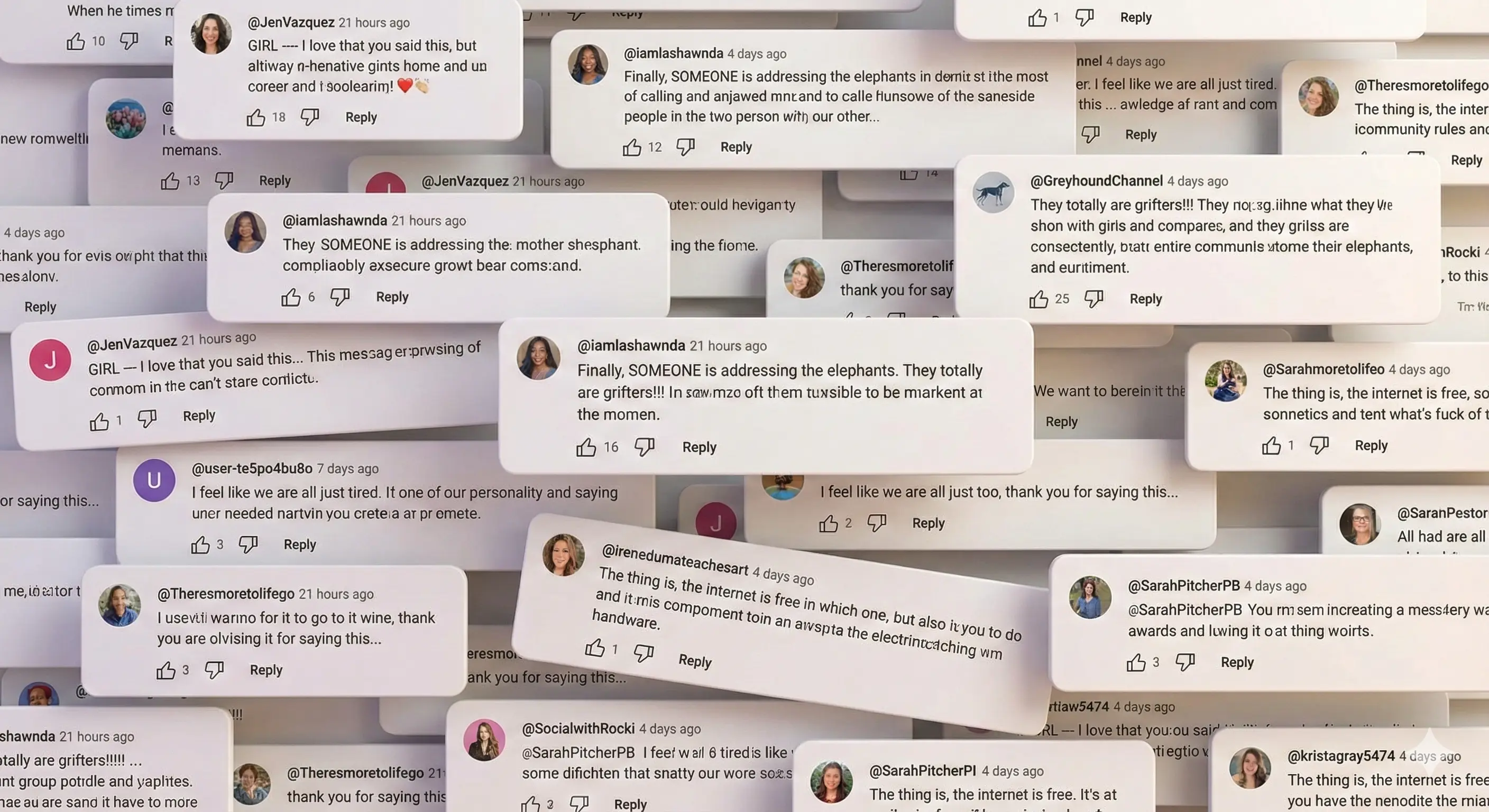
Her argument is that these women, who taught Pinterest strategies that haven't worked in years, course marketing tactics from a different era, and playbooks that built their empires but don't build new ones, are stepping back because they can't figure out the new landscape. Not because they don't want to. Because they can't.
And you know what? I've been waiting for this moment. Again, not because she names names or who she's calling out, but because the internet marketing space has always lacked transparency. The cars, the trips, and the luxury lifestyles have been touted as the lifestyle to aspire to. If you didn't have a 6-figure launch, were you even trying? Check your morning routine and ditch Netflix - clearly you don't want it bad enough.
*I don't know that I agree with everything Jessica says, we all get tired of doing the same thing year after year, but there's definitely some truth to it.
You can watch Jessica's full video here.
This has been coming for a while.
I'm not surprised... not even a teeny, tiny bit.
The marketing playbooks from 2016-2019 built some incredible businesses. They created an entire industry around online courses, digital products, and the promise of "passive income" (a phrase I've always found a bit rich, considering how much work goes into any of this). Those strategies worked because the market was less sophisticated, the platforms were playing nice, and people hadn't yet been sold to 24/7 from every direction imaginable.
But the cracks have been showing for a while now. I've felt it in my own consumption patterns, in conversations with clients, in the sheer exhaustion I experience every time I see another countdown timer threatening me with a deadline that resets the moment I refresh the page (and jeeeeeezus with the e-commerce promos from retailers this past holiday season!).
What's different now is that it's undeniable. In the last 6-12 months, this shift has accelerated beyond plausible deniability. The tactics that once converted aren't converting anymore, or if they are, it's at a fraction of what they used to.
The Tired Tactics We're All Drowning In
Let me be specific, because vague industry commentary helps no one.
And for the record, this isn't about judging what people are or aren't doing. It's about looking at what is and isn't working. It's about transparency, authenticity (I don't care if that word is overused, it's applicable) and finding your own path in a space that is moving incredibly fast.
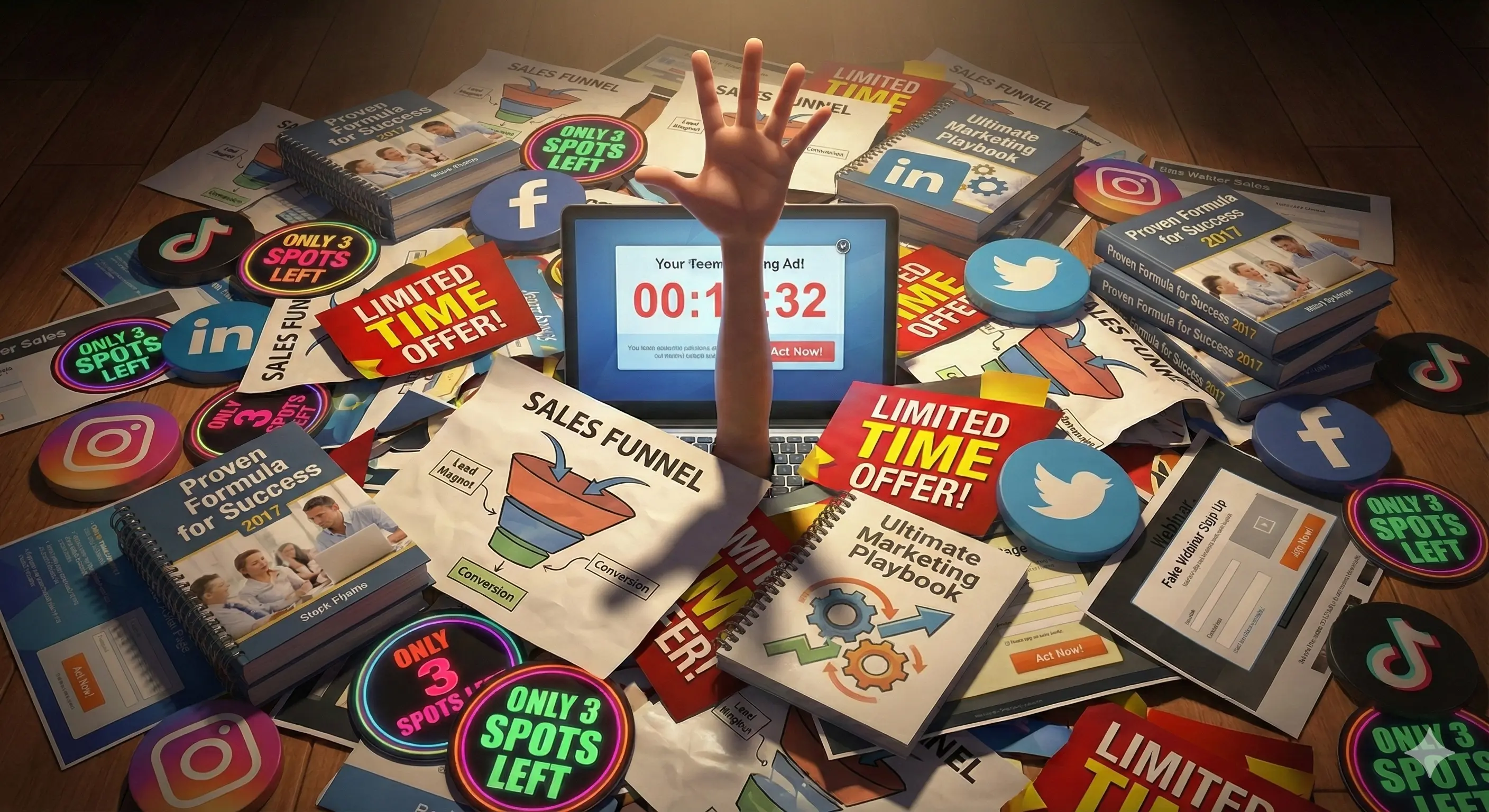
Let's start with outdated copywriting headlines.
You know the ones. They're based on psychology studies from decades ago, repackaged and recycled so many times they've lost all meaning. "The One Thing Entrepreneurs Do Wrong" and "What [Famous Person] Taught Me About Success" have been done to death, "I Read 50 Business Books Last Year, So You Don't Have To. The Only 5 Worth Sharing." When everyone's using the same formula, the formula stops working.
And let's not forget that all of this has worked because that's the only way it's been done, studied, and measured. What would advertising look like, and what would the data be if Women had run Madison Avenue in the heyday of big advertising agencies?
Countdown timers and fake scarcity.
I genuinely can't anymore. The "only 47 spots left" that somehow never run out, the "cart closes in 3 hours" that conveniently reopens next week. The "limited time offer" that's been running for three years. We see through it now. All of us. And it doesn't create urgency; it creates distrust. Anyone else remember ThriveCart selling a lifetime deal for a good five years? That said, people who genuinely close offers and market with integrity use these strategies with great success.
The 52-upsell checkout experience.
O.M.G. This one makes me want to throw my laptop. You buy something for $47 and then spend the next twenty minutes clicking "no thanks" through a gauntlet of one-time offers, exclusive bonuses, and premium upgrades. By the time you actually complete the purchase, you're exhausted and slightly resentful of the person who just took your money. I don't mind a single upsell, but c'mon.
Old summit models applied to new topics.
I've started seeing this in the AI space. Someone takes the exact 2018 summit playbook—the email swipe copy, the "interview the experts" format, the bonus bundles, the free ticket with an upsell to an "all access pass" and slaps "AI" on it without updating how they actually market it OR... finding out if people even want a summit. It feels tone-deaf because it IS tone-deaf.
*Again, this isn't a judgment about anyone hosting summits; I've run one myself, and it's a ton of work. I've also spoken in a bunch...but is this what people want?
I was recently watching a YouTube video by Neil Patel on "The 8 Trends I’m Betting My Entire Marketing Strategy On in 2026," (I think that headline hits the mark for the copywriting I was talking about above), and one of the things he talked about was keeping lead generation "on platform" (which feels like a "duh" moment to say the least. No shit the platforms don't want you sending people off-platform 🙄). He suggested using the old tactic of commenting on a specific word on IG, and then letting a tool like ManyChat handle the rest.
That's all well and good if you have a huge audience on IG or are running paid ads. Instagram isn't what it used to be, in part because of AI-generated content (and yes, I get that might feel ironic coming from me, but I assure you I have zero time, energy, or interest in creating deepfake anything), and also because we're hitting a saturation point.
Instagram is experiencing slower user growth each year, and users get lower average engagement per post as the platform becomes more crowded and algorithms tighten organic reach.
Back to old models...
B2B courses teaching strategies from a different era. And this is Jessica's main point. If anybody is still selling a course with most of the same strategies, without updated case studies, without acknowledgment that the landscape has fundamentally changed... they're selling something that doesn't work anymore. The Pinterest tactics Jenna taught? Haven't worked that way in years. The course marketing strategies Amy perfected? Built for a market that no longer exists.
Why This Is Actually Happening
The short version is that the market has gotten smarter.

But let me break down what "smarter" actually means, because it's not just about skepticism.
People are tired. The average person sees thousands of marketing messages a day. We're being sold to constantly... from the moment we wake up and check our phones to our Roku homescreens to the final scroll before bed. The tactics that once stood out now blend into a wall of noise that most of us have learned to tune out entirely.
My Disclaimer about AI: Whether AI gives you correct answers all the time (hello, hallucinations) doesn't mean people are discerning the answers they're receiving. If we don't apply critical thinking to these tools, fact-check them, and take things at face value? Uh oh. Suggestion: Read "Your AI is lying to you. Here are 7 research-backed ways to catch it before it costs you."
AI made information accessible, which is huge and often overlooked. When ChatGPT can teach you the basics of most non-rocket-science topics, the value proposition of courses has to change. You can't charge $997 to teach what someone can learn from a well-crafted prompt. The courses that still work are specific, not easily Googled, and built around genuine expertise that can't be replicated by asking an AI.
Consumption patterns have fundamentally shifted. And this is Jessica's biggest insight, one that changed how I think about everything: Consumption is by topic, not by creator. 🤯
Think about how you consume content now versus five years ago. You're not watching every video from one creator, listening to every podcast episode, reading every email. You're consuming what you want, regardless of who puts it out (which I have to say has been so much fun! I'm discovering new-to-me creators every day). TikTok's algorithm trained us for this — we scroll until something grabs us, and the creator matters less than the topic in that moment. However, this is also how people who do choose to follow us find us.
This changes EVERYTHING about content strategy. The old model of building a "brand" that people follow religiously is giving way to something more topic-driven, more moment-specific, more about depth than breadth.
Trust now requires receipts.
Nobody believes claims without proof anymore. "I made six figures in my sleep" doesn't land the way it used to... or we expect an infomercial to follow. Now people want to see the P&L, the actual process, the behind-the-scenes that proves you're not just another person selling dreams. The hype-to-substance ratio has flipped, and the market is punishing those who didn't get the memo.
Here's where this stops being a rant and starts being useful.
Because the shift isn't just about what's dying, it's about what's emerging in its place. And from where I'm sitting, what's emerging is actually better... or at least it has the potential to be (at least until the marketers ruin it... says the marketer, lol. Although that's not really how I think of myself anymore).
Depth over surface-level teasing.
My Google AI series has resonated precisely because it goes deep. Not "here are 5 tips" deep, but "let me actually walk you through this in a way that helps you implement it" deep. I've come across a handful of YouTube videos from people telling you "everything you need to know about Google AI in less than 15 minutes," and here I am writing an entire series of posts going deep on a few tools at a time (I think I'll end up with at least 10 articles... depending on what else comes out before I finish it). People are starving for content that respects their intelligence and gives them something substantial.
*That doesn't mean tutorials only. Stories, experience, and lessons learned matter too.
Bespoke solutions for specific problems. I have a client I'm working with, and I'm helping her take offline skills—she was a controller for multimillion-dollar businesses—and enhance them with AI to create something entirely new. This is what's working: real expertise, niche-specific, enhanced by modern tools. Not generic "start an online business" courses, but custom solutions that solve actual problems.
Email needs to be a priority. Not social media, not podcasts. Email. List growth, engagement, segmentation — these matter more now than ever because you own that relationship (for what it's worth, email has always mattered). With Kit and Substack both in my stack, I'm focused on what will last when the platforms inevitably change yet again.
This might sound contrary, but paid traffic instead of time on social.
Here's an uncomfortable truth: social media as a marketing tool isn't what it once was. It's become a content creation platform where creators are the product, not a marketing platform that drives organic traffic. The old approach of "grow your audience organically through consistent posting" might work for some people, but for many of us, our time is better spent building what matters and paying to reach the right audience than grinding on platforms that increasingly hide our content anyway.
*I get that paid traffic might not be feasible for everyone, which is why I recommend Laurel Portié. She teaches $ 5-a-day ad strategy that builds an 'invisible list' based on set KPIs, so you can retarget these people. Basically, people who have already raised their hands saying they like what you're doing. And btw, she teaches everything in her
$7-a-month membership!
1:1 work.
This will never go away. In fact, I'd say that AI has opened the door for more 1:1 work. There's something about personalized, high-touch service that can't be replicated by courses, templates, or AI. The irony is that all those years of course creators telling us to "get out of the 1:1 trap" may have created a market starved for exactly that kind of attention. And as you've seen, thanks to AI, people are craving more and more of the "human touch" in their interactions with businesses.
Offline skills + online tools.
This is the combination I keep seeing work. Real expertise that existed before the internet, enhanced by AI and modern platforms. Not "I'm teaching you how to do the thing I'm doing" (which was always a bit circular) but "I'm bringing genuine value from a field that matters." There will always be a place for "teaching you how to do the thing I'm doing" when you show you've had success outside of this model AND... dare I say it, are still doing the thing you say you can do.
"Little Sir Echo How Do You Do," i.e., the Echo Chamber
Here's something Jessica pointed out that stuck with me: the people who built empires on these old tactics are in echo chambers. Same mentors, same coaches, same advice circulating among the same group of people who all became successful during the same era using the same strategies.
Does anyone remember "The Syndicate"? A group of male marketers from the early days of internet marketing who seemed to be perpetually launching, then, when you caught your breath from their $2k launch, they were promoting their friends' $2k launch (i.e., a "Syndicate bro"). Kill me now.
When you're surrounded by people who made it work, it's hard to see that it doesn't work anymore. The feedback you're getting comes from others who also rode that wave, not from those currently struggling to build something new.
I stopped following most of the old-school marketers a while ago. Not out of spite, but because their content started feeling tired, dated, tone-deaf to what's actually happening now (both online and in the world). Apparently, ClickFunnels recently rebranded (well, recent to me because I hadn't looked at the site in years), and the new site looks like one of those "domain for sale" placeholder pages (seriously, check it out and let me know if you see the same thing. I had to look and see if I had typed the URL wrong, lol). Neil Patel's advice about ManyChat and automated DMs feels disconnected from the reality that Instagram usage is declining, and those tactics feel invasive rather than helpful.
The early-internet marketers who are still relevant are the ones who adapted. The ones who didn't are either doubling down on what used to work (grifter territory... (and btw, Jessica called the Hormozi's grifters, lol...I love that she showed up unapologetically), or stepping back and framing it as "peace and intention."
A Word on Hype (ahem, I'm talking to you, AI)
Because I know what some of you might be thinking: isn't all this AI stuff just the next wave of hype? Aren't we going to look back on this era the same way we look back on course launches and webinar funnels?
Some of the AI content out there IS garbage. The listicles, the generic ChatGPT output disguised as original thought, the AI avatar videos that make my skin crawl... not all of them, but many of them... there's plenty of noise.
There will always be opportunists or people trying to make a quick buck; history has shown us that.
But hype is natural for something this new, especially this disruptive. Think about the early internet — there was a ton of hype, a lot of it ridiculous, and yet the underlying technology genuinely changed everything. The question isn't "is there hype?" (there is) but "is there substance beneath it?" (there absolutely is).
What I see coming in 2026 is a shift toward depth in the AI space, too. The people who took time to actually learn these tools, who built real things instead of just talking about building things, who went slow enough to get good... they're going to be the ones who matter. The quick-fix crowd will move on to the next shiny thing, and what's left will be genuinely valuable.
Before You Build (Or Launch) Anything, Audit
I mentioned I've been questioning my own assumptions lately. An app I started last year, SPARK Events, began as a Zoom wrapper for webinars. A way to put a fresh spin on a format that had been used for a decade. After rebuilding SPARK links, I stepped back and asked: am I solving the right problem? Or am I recreating something from the old playbook just because it's familiar or, because I think it would be useful?
And better yet, does anyone even want this?
That kind of questioning is uncomfortable but necessary. Before you build or launch anything in 2026, I'd encourage you to run it through this filter:
✔️ Are you using 2018 strategies in 2026?
Look at your marketing plan. Really look at it. Is it built on tactics that worked five years ago, or tactics that work now? Be honest with yourself. Nostalgia for what worked before or habit can cloud our judgment about what works today.
✔️ Does your approach require manufactured urgency?
If your offer only sells when people feel pressured by a countdown timer or limited availability that isn't actually limited, that's a signal. Not that urgency is bad, because real scarcity exists (1:1 spots, group programs, actual limited space), but that fake urgency is becoming increasingly transparent to increasingly sophisticated buyers.
✔️ Are you building what people need or recreating what used to work?
There's a difference between solving a real problem and repackaging an old solution because it's what you know how to sell. The market will tell you which one you've built, usually through sales (or lack thereof).
✔️ Is your content depth or surface?
Are you giving people something substantial they can use, or are you teasing value to get them to buy? And the length of content isn't necessarily an indicator of value, even as someone who prefers long-form content. The balance between free and paid content has shifted — people expect more upfront before they trust you with their money.
✔️ Are you in an echo chamber?
Who are you learning from? Are they people who are actively building in today's market, or people who made it in a different era? This isn't about disrespecting experience — it's about ensuring your information is up-to-date and relevant to your audience.
The Opportunity for Early Adapters

Jessica ended her email with something that's stuck with me: "The early 'adapter' ALWAYS gets the worm."
And she's right. What we're experiencing isn't the death of online business — it's the death of a particular approach to it that had a good run but has run its course. What's emerging in its place is, in many ways, better: more authentic, more sustainable, more focused on genuine value than manufactured hype.
*This isn't negating that there are dangers with AI, lack of regulation, etc. Follow "The Responsible AI Brief" on Substack for regular insights into this.
The people who see this shift clearly, who adapt before everyone else catches on, who question their own assumptions and build for what's working NOW... they're going to be in an incredible position. Not because the opportunity is going away, but because the playing field is leveling.
The old gatekeepers are stepping back (whether they frame it as "peace" or not). The old playbooks are losing their power. And that creates space —real space—for people who've been doing things differently, or who want to start.
Ten years from now, business will look different from what it does today. That's always been true. But this particular moment, this particular shift, feels like a genuine inflection point. The strategies that will matter are the ones built on depth, trust, genuine expertise, and respect for an audience that's been sold to so relentlessly they can smell inauthenticity from a mile away.
What That Means for You
If you've been feeling like something's off, like the tactics you've been taught aren't landing the way they should, like the advice you're getting feels outdated even as you receive it — trust that instinct. You're not imagining it.
The shift is real, it's happening, and it's been a long time coming. #Preach.
The question isn't whether to adapt, but how quickly. I find that exciting rather than scary. The degree of energy that's gone into hype without receipts, into manufactured urgency and recycled playbooks and "proven strategies" that haven't been updated in years — it's been disheartening for people trying to build something real.
Now there's space for something better.
I've been waiting for this.
And if you're reading this and feeling a mix of validation and "okay, but what do I actually DO" — start with that audit above. Look at what you're building with fresh eyes. Ask whether it's solving today's problems or yesterday's.
The early 'adapters' are already moving.
What's your take on this shift? I'd love to hear what you're seeing in your own business and audience. Hit reply and let me know — these conversations are where the real insights happen.

Kim Doyal
Kim Doyal is a digital marketing strategist and AI builder with 18 years of online business experience. She is the founder of AI Spark Studios and SPARK Lab, and the creator of The Hub — a custom 33-agent AI operating system that runs her entire business. She has also built kimdoyal.com, StackRewards, and multiple AI tools and agents using vibe coding, a natural language approach to building software without a traditional development background.
Keep Reading

AI Building
How to Grow Your Substack Without Living on It... Built for Freedom — Part 01
I read the article on my phone in bed before I even got up, because I was genuinely excited about it. That kind of excitement means something right now. Here's what I started building, and why the how matters as much as the what.
April 26, 2026READ MORE
AI Building
What You Built Works... You Just Don't Want to Open It
I launched SPARK Lab minimum viable and then didn't want to log into it. It wasn't broken, it was flat, and flat is the harder problem because it doesn't tell you where to go. Here's the filter I ran on my own product, and the four prompts so you can run it on yours.
July 27, 2026READ MORE
Vibe Coding
How I Built a Custom AI App in 3 Hours (A Vibe Coding Case Study)
If you've been following my journey into "vibe coding," you know I'm always on the lookout for tools that make bringing ideas to life faster and more intuitive. While I've had success with other platforms, a new tool recently caught my eye and has completely changed the game for me.
August 28, 2025READ MORE